
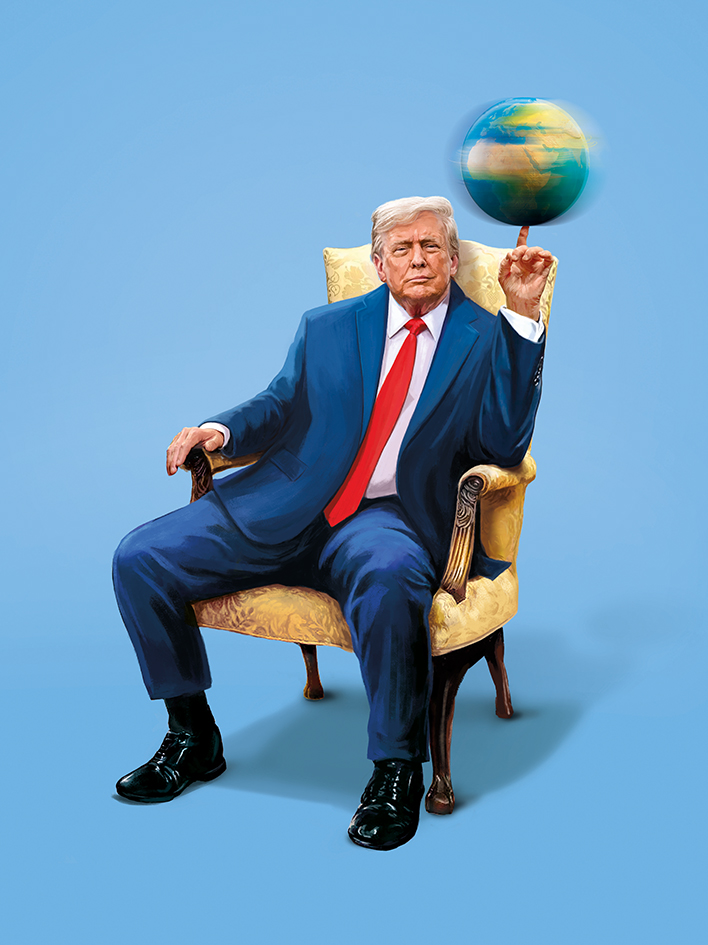
“I hope to God you know what you are doing here,” the cynical British war reporter Thomas Fowler says to Graham Greene’s naive CIA agent, Alden Pyle, in The Quiet American, set in Vietnam during the first Indochina War of the 1950s. “I know your motives are good, they always are… I wish you had a few bad motives, you might understand a little more about human beings. And that applies to your country too.”
It is a curious feeling rereading this passage today, 70 years on from its publication, following Donald Trump’s abduction of the Venezuelan president Nicolás Maduro and his threats to annex Greenland from America’s erstwhile Nato ally, Denmark. Published in 1955, The Quiet American was the first great anti-American novel of the postwar order, casting its jaded eye over the blundering naivety of Britain’s imperial successor. As the US became bogged down in Vietnam a few years later, the novel was vindicated, though American “innocence” soon turned into something much worse. Commentators reached for Greene’s book as a field guide. “We used to sit in the small French cafés and talk about Greene’s book,” the real-life American war reporter David Halberstam recalled. “It was only his portrait of the sinister innocence of the American that caused some doubt, that made us a little uneasy.” He later recalled of the novel, “It was our Bible.”
Today, if anything, it is Greene who looks a little too quiet in his assessment of American power, a little too naive. In the age of the “Donroe doctrine”, Trump’s aggrandising theory of hemispheric order, the very idea of American innocence seems quaintly anachronistic, a morality tale from a lost age. No one believes in the America of simple, good intentions any more; the America that only fights abroad because it believes too much in its own goodness. “If we are good – and are we not good? – then we won’t need to force other people to do what we want,” the chronicler of the American ideal, George Packer wrote in his biography of the diplomat Richard Holbrooke, ventriloquising America’s internal monologue.
But surely not even Packer believes this now, which is why the rise of Trump and his American chauvinism is even more a psychological shock within the US than without. And yet Britain’s foreign policy – its grand strategy, if such a thing exists – plods on, unchanged and unchanging, only with less cynicism and more acquiescence than when Greene first shook his head over the new hegemon.

In this period of British withdrawal and American arrival, we take comfort in one thing: anti-Americanism. Perhaps the most vivid phenomenon of postwar popular culture, it is part-aesthetic, part-psychological, fuelled by feelings of both dependence and disgust at the situation in which we find ourselves. It is there in some of the greatest literary works of the 20th century, from Greene to John le Carré, but so too in the musings of those who ruled over us. “We are Greeks in this American empire,” Harold Macmillan wrote to a young Richard Crossman from North Africa as he watched the new world order take shape. “You will find the Americans much as the Greeks found the Romans – great big, vulgar, bustling people, more vigorous than we are and also more idle, with more unspoiled virtues but also more corrupt.” The same sentiment largely holds along Whitehall to this day. Is this not a description of Trump himself with his great big, vulgar countenance, skin fake-tanned and hair backcombed, more vital than we are, and yet more corrupt, fuelled only by McDonald’s and Coca-Cola?
As Ailbhe Rea has described in the New Statesman, Keir Starmer’s national security adviser Jonathan Powell set out the sober reality of this policy in his memoir of his time as Tony Blair’s chief of staff, The New Machiavelli. He describes Britain’s policy of “stay[ing] as close as possible to the Americans in the hope of being included in their counsels”. Abandoning this policy, Powell argued, would mean less influence in Washington and “less ability to change anything in the real world”. This remains the guiding principle of Britain’s strategy today.
Yet it is this policy, which Powell had the luxury of seeing as a strategic choice, that has taken on an existential reality in the last four years. We are unable to say or do anything about Venezuela because we might risk what is left of Trump’s wavering support for Ukraine. Still, though, we must be “in the room” when the decisions are made; to have “influence”; and to prevent an invasion of the European continent.
Those closest to Starmer understand that Trump poses an existential threat to this long-term British strategy, but maintain it is the right one. “We cannot walk away from the Americans,” one senior figure close to the PM put it to me. Yes, there is a desire for Britain to be more “resilient” and less dependent, but there is also – fundamentally – what they consider a realism. There is, in their view, simply no way, at present, to cut spending, increase taxes or borrow more money to build the kind of country that can pursue a different independent foreign policy. Besides, whichever defensive capabilities we would need to do so would – in the medium term at least – require cooperation with the Americans. We are stuck.
To others advising the government, this is not merely a sensible conclusion, but a wise one. Do not react too emotionally to Trump, they counsel. One influential foreign policy figure close to this government likes to say that the US, much like late republican Rome, is in the grip of a kind of civil war, but that we should not confuse this for decline. As with Rome, the winners of this battle for control are likely to take the spoils of global power. We here in Europe, then, are like Cleopatra’s Egypt: we cannot be picky about our Caesars. And there will be more to come.
Inside No 10 there is both a quiet optimism about the weeks and months ahead, particularly when it comes to peace in Ukraine. But also a real sense of foreboding about the potential for 2026 to be a pivotal moment in world history as China moves on Taiwan and Trump on sovereign European territory in Greenland. It is these twin threats – along with Russia’s continuing assault on Ukraine – that now most concern Starmer and his team. This explains the mild change of tack from the Prime Minister, from his equivocating first statement on the Venezuela crisis to a public statement of support for Denmark. The British government, unable to exert much of Powell’s quiet influence, is seeking to influence American policy on Greenland with rare public declarations of opposition. The very fact that Starmer chose to make his opposition to Greenland’s annexation public – rather than in private – is an indication of how serious the government takes the threat.
Yet, Greenland is only the most cartoonishly extreme example of Trump’s foreign policy. It was already clear that the president does not see the world as our government wishes it to be – or as his predecessors in the White House did. He does not see an American empire or loyal aligned states requiring American protection. He sees a world in which the US has for too long been Greene’s naive idealist and needs to toughen up. It was being exploited when it should have been doing the exploiting itself. Trump believes the US should use its power to create the maximum advantage for America wherever it can – and should not be ashamed about this. It is an explicitly extractive policy: to win concessions, partners must agree to buy American resources – as the EU has done – or to follow American norms, as the White House now demands of the UK. If Ukraine wants its support, it must give up its mineral wealth. It is not America that needs Nato, it is Denmark, so why doesn’t America just take Greenland, which would make the US even more powerful than it already is? This point was made explicit by Trump’s nationalist henchman Stephen Miller this week: “We live in a world… that is governed by strength, that is governed by force, that is governed by power.” And if America – and even Trump’s family – can benefit financially: even better.
It is this analysis that has finally killed off the idea of Greene’s quiet American moral leadership. Of course, the idea of naive American idealism was never entirely true at all. Before Macmillan alighted on his notion of Britain as the Greece to America’s Rome, he believed that London – through Churchill – could run the “eastern” half of the empire, and Washington – through Roosevelt – the western. As the Second World War ground on, this dream quickly faded. Yet the idea that the new Rome could be guided by Britain’s wise counsel never did, even as it flexed its power for its own interests in the years that followed.
But the Americans were never naive or innocent. They were hegemonic, as Macmillan himself understood. The most obvious confirmation of this was the Suez Crisis of 1956, when President Eisenhower – the man who had once presided over British forces in the Second World War – turned on his one-time ally, using the financial power of the US to humiliate Britain, finally putting paid to the notion that it – or anyone else in Europe – had a sphere of its own in which it could act independently of its overlord. Eisenhower pulled the plug on the operation, by triggering a sell-off of sterling while refusing access to International Monetary Fund cash until he got what he wanted. As the historian James Thomas Emmerson once observed of interwar Germany, the ultimate lesson in world affairs is this: “A country which cannot withstand the strain of a run on its currency or economic privation can ill afford to risk incurring international wrath.” Later in life, Anthony Eden remembered a conversation he had with a young Enoch Powell who had warned him that in the Middle East Britain’s great enemies were not the usual suspects, but the Americans. “You know, I had no idea what he meant,” Eden reflected. “I do now.”
While “Suez” has become a byword for British failure – much like “Iraq” – less well known is what followed, which mysteriously has not implanted itself on our national imagination. With Eden’s authority shot, and his health declining, who would be his replacement: Harold Macmillan or Rab Butler? “Shrewdly, Macmillan realised that the strongest candidate would be the one most acceptable to Washington,” Macmillan’s biographer DR Thorpe observed. And so it proved. Macmillan manoeuvred, promising the Americans he could persuade a “sufficient number of Conservative backbenchers to ensure a majority in favour of withdrawal from Egypt”. In return Macmillan pleaded with the American ambassador for a “fig leaf to cover our nakedness”. We have been asking for one ever since, but our nakedness is now impossible to cover.
In the wake of the UK’s humiliating withdrawal from Suez, Eden wrote a secret memorandum that lay undiscovered for many years. In it, he drew what Thorpe described as a set of “unpalatable conclusions with frankness”. In Eden’s view, “We must review our world position and our domestic capacity more searchingly in light of the Suez experience, which has not so much changed our fortunes as revealed realities.” Eighty years on, this process has yet to be completed, even as Trump and Vladimir Putin have revealed our current, lamentable reality even more brutally than Eisenhower did in 1956.
What is curious about this slowly unfolding tragedy is how often we have been warned about the nakedness of our position by the Americans. A few years after Suez, the former secretary of state Dean Acheson made his famous remark that Britain had lost an empire but failed to find a role. Often forgotten are the rest of his words, which are more pointed and more salutary: Britain’s trying to be a “broker” between the US and Russia was “a policy as weak as its military power”. And yet we continue to try.
The great irony is that the alternative now being proposed, a revamped European Union – perhaps with the UK back at its heart – is itself a creation of US foreign policy. In 1950, France took its great leap into the dark – agreeing to pool some of its sovereignty with Germany – amid enormous pressure from the Americans to do so. Paris could afford to swap its alliance with Britain, the bedrock of its security until 1940, for its postwar pact with Germany, precisely because it calculated that its security was now guaranteed by America. And so, the UK was left with the problem of “Europe” for which it has never been able to find a comfortable answer.
Jacques Fauvet, editor of Le Monde in the Fifties, described this first step on the road to the federation of Europe as “extracting a policy from a need” – the need being American military and financial aid while Germany was reindustrialised to help the Cold War effort. The Suez Crisis was supposed to change this fundamental bargain. Upon learning of the calamitous reversal for Britain and France in Egypt, the German chancellor Konrad Adenauer told the French that “Europe will be your revenge”.
And yet it never was. Less than a year after Suez, the Treaty of Rome was signed and the Common Market was born, but always encouraged, protected and guided by the US. From the end of the Cold War, Washington encouraged Europe’s expansion east, even to Turkey and beyond, matching the expansion of Nato.
But what has happened to Europe in this time? Who can look at the continent today – from Britain to the Balkans – and see an independent, thriving power in the world? Europe, very much including Britain, has withered under US protection. Shortly after resigning from the French presidency in 1969, Charles de Gaulle was visited by the new American president, Richard Nixon. “In London, Brussels, Bonn, Berlin and Rome you will have seen that there is no Europe,” De Gaulle told the new US president. There were European countries, he went on, but no real power. Germany was dependent on the US for its survival. “England could have done without your protection, but in the political, monetary and economic domain, since Churchill, she has preferred to follow your policies from which she hopes to profit. She has deliberately chosen to put herself under your general direction.”
And yet, who today looks at the UK today and believes we have profited greatly as a result? Where is the great wealth that was supposed to have come from having the ear of the world’s sole superpower for the best part of a century? Instead, like Europe itself, we have driven ourselves further into dependency, financial and military. And so, today, we look on, as Russia inches westwards, pleading with the Americans to stay while the Americans themselves look to acquire European territory for themselves.
Speak to those close to Starmer and they insist that the continent – and Britain – can rebuild its autonomy slowly, under US protection. They insist the answer is not to return to the EU or its customs union or single market, “to go backwards not forwards”. The policy, in effect, is to shuffle forward, pensively, hoping for the best, trying to avoid the worst.
But as De Gaulle observed half a century ago, Europe today does not exist as a military or economic power independent of the US. It has no sovereign technological capacity. It has no sovereign energy capacity. It has no sovereign military capacity. It cannot defend itself from Russia, a country smaller and poorer than the collective might of the western continent. Its dependence on the US has deepened not simply since 1969, but since 2016 – the age of Trump. All of this is known, but our national discussion continues to revolve around trifles: small alignments with the single market or customs union. Free movement for the young. Erasmus. We need a new policy, extracted from the need of our humiliating weakness.
Trump is not a Quiet American. He is the big, vulgar, bustling and corrupt one of Macmillan’s gentle distaste, who is nevertheless more vital and vigorous than we have let ourselves become. Trump is the Loud American who tells us what we don’t want to hear. We should listen.
[Further reading: Venezuela and the mutation of American imperialism]
Content from our partners

Related
This article appears in the 07 Jan 2026 issue of the New Statesman, What Trump wants
Join the debate
Subscribe here to commentA very reasonable and accurate statement of the present situation and its historical background. Which path should we take for the future? Sadly, I don’t believe any of our current politicians or political parties have the ability or imagination to alter course.
An excellent historical account of Britain’s weaknesses and its over reliance on the US . This is why we are in such a mess today , but I do not believe that Starmer should continue to bend the knee to Trump’s despotism . His sycophancy is nauseating built on a misconception that we have this mythical special relationship that has never in reality ever existed . ( America used us as and when it chose to do so and it flattered us to be useful) .
Europe is similarly paralysed by fear of repercussions from Trump if they step out of line. Having said all of that , I still believe that potentially , Europe , with Britain on board could and should reform itself for the new realities of a very dark and menacing age . America does not have allies in this new age – it has subservient states that pay homage. It has become a rogue state and we should wise up to the fact.
Excellent essay! Using The Quiet American and the poorly understood dynamics of the Suez crisis to illuminate each other works brilliantly. It’s so clear that Britain and Europe need to reunite to withstand the US-Russia great-game pincer movement.
Decent Americans cringe when they see Starmer buttering Trump up, but I think and hope that he’s doing what he must to buy time to realign the UK with Europe and so start forging an actual economic and military independence and strength that looks like the last best hope of democracy right now.
You are quite right that Starmer’s Powellite realism about Trump muffles a ghastliness that cannot be named for fear of hurting tariffs and Ukraine. Yet this leaves a hole in the heart of Labour’s electoral strategy because Farage invades a full-fronted attack pinning him down as a hand-me-down of the orange Liar-in-Chief. Farage is an accomplice, supporter and importer of Trump and exposing this reveals his greatest political weakness. So as not to hamper such a tactic we need to form a great public movement of citizens independent of Government and parties: No Trump! No Farage!
Michael Cuthbert comment correction: ‘invades’ should be ‘evades’