
The Trump administration has made no secret of its military build-up in the Caribbean. A US naval task force began assembling in international waters off the coast of Venezuela in August. On 24 October, the defence secretary, Pete Hegseth, who has been rebranded the “secretary of war” under Trump, ordered the USS Gerald Ford – the world’s largest aircraft carrier – to deploy to the Caribbean along with its strike group. This means that roughly 14 per cent of the US Navy’s surface fleet will soon be in the region.
They are not keeping a low profile. Since early September, the US military has repeatedly attacked small boats in the Caribbean and eastern Pacific Ocean – they have carried out 14 strikes, at the time of writing, which have killed an estimated 61 people. Donald Trump has claimed, without producing any public evidence, that the strikes are legitimate because the boats are carrying drugs and, therefore, pose a threat to US national security. The United Nations’ high commissioner for human rights, Volker Türk, said on 31 October that there was no basis under international law for the attacks, which amount to “extrajudicial killing”.
In recent weeks, US military aircraft have flown missions close to Venezuela, with two B-1 Lancer bombers staging an apparent show of force approximately 20 miles from the country’s coast on 27 October. Their flights paths were clearly visible on popular flight-tracking websites. B-52 bombers accompanied by F-35 fighter jets conducted what officials called a “bomber attack demonstration” around 50 miles off Venezuela on 15 October.
Prominent US newspapers are openly discussing the prospect of imminent strikes on Venezuela. On 31 October, the Miami Herald claimed that the Trump administration had already made the decision to bomb military installations in the country, with sources warning that the first attacks could take place within hours or days. The Wall Street Journal reported on the same day that the administration has identified targets within the country, including military facilities, but Trump had not yet given the order to strike.

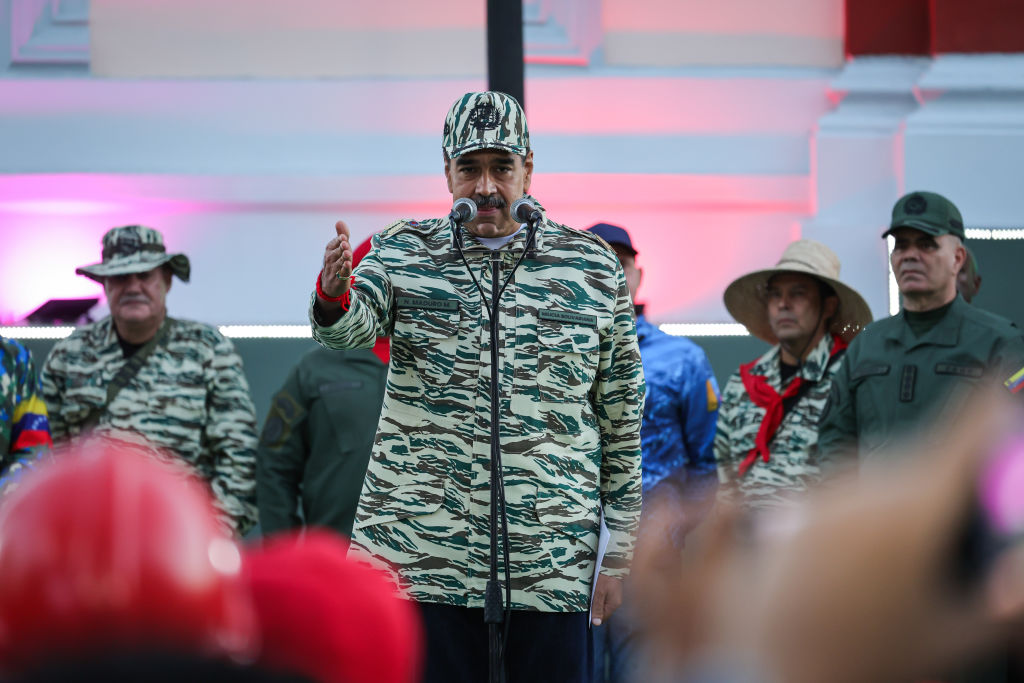
Is the US seriously preparing to bomb Venezuela, or is this all part of an elaborate pressure campaign intended to force the country’s strongman ruler, Nicolás Maduro, from power? The answer may well be: both.
Trump has a long-running grudge against Maduro. During the US president’s first term, he publicly threatened to take military action and reportedly asked his staff about the possibility of invading Venezuela, but he was talked out of the idea by senior officials. Back then, Trump’s main grievances seemed to be Maduro’s socialist roots, which he blamed for devastating Venezuela’s economy and destabilising the broader region. But this time around, Trump has settled on a new charge, accusing Maduro of leading a major drugs trafficking organisation called the “Cartel de los Soles” – Cartel of the Suns – which the administration claims is linked to other criminal groups such as Venezuela’s Tren de Aragua gang and the Mexico-based Sinaloa cartel, which are both designated as foreign terrorist organisations by the US.
The name “Cartel de los Soles” appears to come “from the sun insignia worn by Venezuelan generals, and reflects the proven involvement of a number of military officers in the drugs trade”, explained the International Crisis Group, an independent organisation that focuses on conflict prevention, in a recent analysis. But the group’s experts warned “there is little evidence that any sort of stable, organised ‘cartel’ exists”. The administration’s focus on the supposed drug-trafficking threat to the US from Venezuela is particularly confounding given that most of the fentanyl that enters the country – the synthetic opioid that is estimated to be responsible for the deaths of tens of thousands of Americans a year – comes from Mexico. By contrast, Venezuela is associated with trafficking cocaine from Colombia to the US and Europe.
Undeterred, senior officials are pressing ahead with their claim that Maduro is at the head of a major drugs cartel that threatens the US. “Look, this is [an] operation against narco-terrorists… the al-Qaeda of the Western Hemisphere,” Marco Rubio, who is both secretary of state and national security adviser, told reporters of the strikes on boats in the region on 22 October. “These are well-funded, dangerous, violent drugs cartels that operate as terrorists who are flooding our country with drugs. The United States is going to deal with it. The president’s made a decision to deal with it.” He described Venezuela as a “narco-state” that is “run by a cartel”.
Stephen Miller, Trump’s deputy chief of staff and the principal architect of his immigration policy, has made a similar case and is said to have become a strong proponent of the strikes behind the scenes at the White House. “It is a drug cartel that is running Venezuela,” Miller claimed in September. “It is not a government, it is a drug cartel, a narco-trafficking organisation that is running Venezuela.”
Alongside its military build-up, the US is clearly targeting Maduro and the senior officials around him with an intensifying campaign of psychological warfare. This appears aimed at removing him from power. The State Department is offering a $50m reward for his arrest as part of an apparent effort to persuade those close to him to turn against him. Trump also made a point of announcing earlier this month that he had authorised the CIA to conduct covert action in the country. The overt displays of military force and the increasingly shrill warnings of impending military strikes may well be part of the same effort to convince Maduro that his time is up, and that he should take the opportunity to flee into exile while he still can, or to persuade other high-ranking officials that their survival depends on his demise, or hasty exit.
“Maduro is about to find himself trapped and might soon discover that he cannot flee the country even if he decided to,” one source told the Miami Herald on 31 October. They claimed that there was already “more than one general willing to capture and hand him over”, although this is also what they would say if they were trying to convince Maduro that the walls around him were closing in. It might all be an elaborate bluff, with Trump ramping up the drumbeat towards war, with no intention of actually fighting one. But that is a dangerous strategy.
In the best-case scenario for the administration, Maduro is finally cowed by US intimidation tactics, and swiftly, perhaps even bloodlessly, exits stage left, settling for a quiet life in exile, maybe alongside the Syrian dictator Bashar al-Assad in Moscow. Then Venezuela’s political opposition, led by the Nobel Peace Prize winner Maria Corina Machado, will take over, democracy will flourish, and the country will become a beacon of stability, reducing the flow of immigration – and, if you believe the White House, drugs – into the US. Opinion polls show that a significant majority of Venezuelans are opposed to Maduro, who claimed victory in last year’s presidential election, despite widespread, credible reports that he lost. Few would mourn his downfall.
But the long, bloody history of US efforts at regime change – particularly in Latin America – should caution against such optimistic predictions. Washington’s record of converting tyrannical regimes into stable, functioning democracies in recent decades is less than glorious. Instead, successive administrations have proved all too capable of turning such missions into devastating quagmires and endless wars.
[Further reading: Venezuelans are thinking the unthinkable]
Content from our partners



Related
Join the debate
Subscribe here to comment