
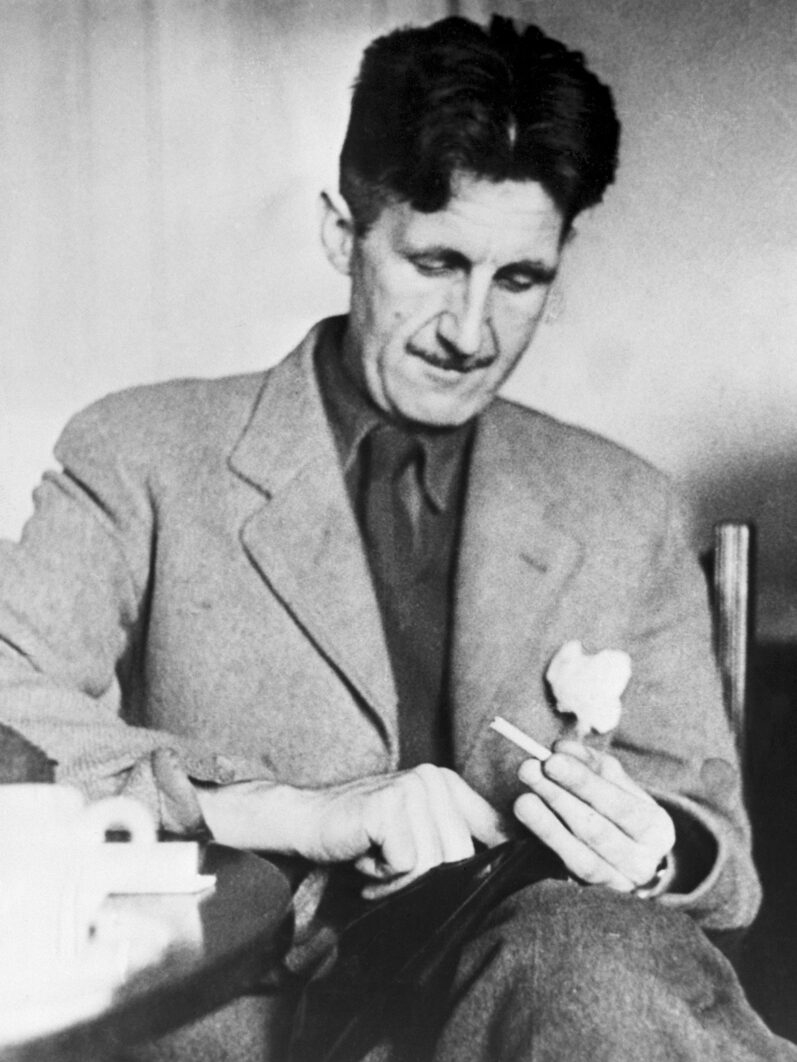
They unfold like Victorian narrative paintings. Twice George Orwell limbered up to bowl a great chain of patriotic Anglo-imagery, and twice he sent the bails flying. This is one, from Orwell’s wartime essay, The Lion and the Unicorn:
The clatter of clogs in the Lancashire mill towns, the to-and-fro of the lorries on the Great North Road, the queues outside the Labour Exchanges, the rattle of pin-tables in the Soho pubs, the old maids hiking to Holy Communion through the mists of the autumn morning…
Nations are abstractions, and love of nation is an abstract feeling. But, as the critic James Wood once wrote, the way to nail down an abstraction is through detail, “any detail that draws abstraction towards itself and seems to kill that abstraction with a puff of palpability”. It is thanks to the vividness of these details – and to his posthumous post-war career as a floating global political signifier – that Orwell’s lines remain indispensable clichés for journalists, think-tankers, cabinet ministers and prime ministers. All continue to imitate Orwell – indeed, attempt to surpass him. And all of them keep getting him wrong.
First, and most famously, there was John Major, in 1993, who laid down the standard with his “country of long shadows on county grounds, warm beer, invincible green suburbs, dog lovers and pools fillers and – as George Orwell said – ‘old maids bicycling to Holy Communion through the morning mist’”, which at least has the advantage of drawing from the source material. But by 2025, there’s been something of a falling-off. From Ed Davey, at this year’s Lib Dem conference: “The place Hollywood comes to make Barbie, Spider-Man and Mission Impossible. The land of the Lionesses and the home of Formula One. Windermere and Loch Ness. Male Voice Choirs and Hogmanay. County shows and school fairs. Fish and chips. Village greens and cricket pavilions.”

Shabana Mahmood, who neglected to look at a list of the biggest American investors in British film or to scan a map of the UK, kept it simple (and oxymoronic): “Mine is the patriotism of Orwell. Pride in a country that is forever changing, while also, ineffably, always the same.” She was merely teeing-up, her prime minister, who free-styled his own imagery, as you can clearly tell: “People like this – they are the real face of Britain. Painting a fence. Running a raffle. Cutting the half-time orange. Or even just that gentle knock on the door, that checks your neighbour is alright. That’s real Britain, conference.”
The persistence of George Orwell as a scriptural authority in political life is, at this point, the only interesting thing about him. His work is comprehensively read and misread; his life, even its greatest controversies (why did gentle George join the Burmese Imperial Police?) has been reduced by its biographers to its final, unsolvable mysteries. And not just Orwell’s life: his first wife, his second wife, his vegetable patch and his nose have had their own biographers. Fortunately, he is not especially relevant to those lines that continue to haunt our politics. Because in this passage, the soi-disant socialist rebel is doing little more than annotating and illustrating the ideas of Britain’s greatest reactionary, Edmund Burke.
As Mahmood blandly summarised, Orwell’s images are meant to conjure an illusion of constancy. As he goes on to say, shortly after that passage, in another almost as famous. He is describing “English civilisation”: “…it is continuous, it stretches into the future and the past, there is something in it that persists, as in a living creature. What can the England of 1940 have in common with the England of 1840? But then, what have you in common with the child of five whose photograph your mother keeps on the mantelpiece? Nothing, except that you happen to be the same person.”
This is the same thought as Burke’s description of the social contract in the Reflections, a line that has become almost the slogan of conservatism ever since: “a partnership not only between those who are living, but between those who are living, those who are dead, and those who are to be born”. It’s a humbling ideal, if a deeply conservative one. The revolutionary might differ from Burke in prioritising those who are yet to born over the dead, and by more aggressively questioning the practices and priorities of those who are living. If you conceptualise history like this, as a merry flow of sacred continuities, it becomes a lot harder to advocate changing it.
Fortunately, Orwell saw this for himself. In his other and equally celebrated Home Counties comic-strip, from the closing lines of Homage to Catalonia, he writes of:
…the railway-cuttings smothered in wild flowers, the deep meadows where the great shining horses browse and meditate, the slow-moving streams bordered by willows, the green bosoms of the elms, the larkspurs in the cottage gardens; and then the huge peaceful wilderness of outer London, the barges on the miry river, the familiar streets, the posters telling of cricket matches and Royal weddings, the men in bowler hats, the pigeons in Trafalgar Square, the red buses, the blue policemen—all sleeping the deep, deep sleep of England…
It’s stirring, Olympic ceremony-standard stuff. But it’s not complacency on Orwell’s part – in fact quite the opposite. Orwell is writing this on the train home from war-torn Spain, rasping for breath, barely able to speak, his neck guttered by a Francoist bullet. And, like the other supremely sensitive writers and poets of the Thirties, he can sense war coming for the rest of continent too. He is urging us to break the deep sleep of England, lest, as he puts it in his closing words, we “never wake till we are jerked out of it by the roar of bombs”.
I prefer the earlier Orwell, in his sharper, pre-war mode, fully aware of the historical convulsion before him. There is no shame in taking genuine pride in the ornaments and fripperies of rural English life – even if it is foolish to pretend that they’re much more than anachronisms outside the parts of the Cotswolds owned and domesticated by Americans. If Labour and the broader left are to continue with these comforting mantras, they should remember another one of Orwell’s other virtues: “the power of facing unpleasant facts”, specifically about the discontent and rupture across their country.
[Further reading: The delusional joy of Labour conference]
Content from our partners


Related



Join the debate
Subscribe here to comment