
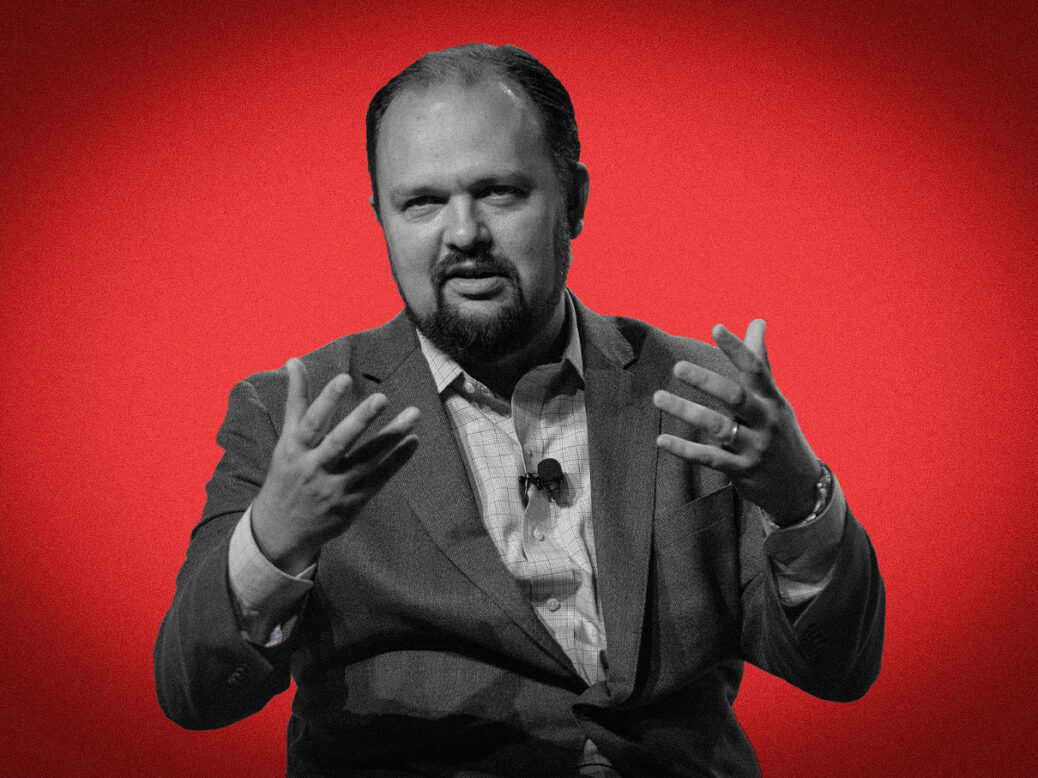
If I were to write about Ross Douthat, America’s celebrity conservative intellectual, in the manner of Ross Douthat, I’d say the following.
Ross Douthat is a Catholic intellectual whose cosmopolitanism sometimes belies his Catholicism, even as it informs his opposition to much of Trump’s agenda, with the exception of certain aspects of Trump’s agenda, excluding some tariff policies but embracing others. Douthat laments, as Trump does, the decline of American civilisation, except for, as Trump might agree, some really fantastic TV shows. At the same time Douthat sees the Götterdämmerung, and the “optimistic possibility”, of our “decadent era”; he also observes the dangers, and the promise, of a right-wing populism. He proclaims that humankind faces imminent spiritual “extinction”, which, fortunately, can be avoided if humans everywhere “support the local theatre, the museum, the opera or concert hall, even if you can see it all on YouTube”.
In a recent epic 10,000-word Q&A with Douthat, the New Left Review described him as “the most consistently original mind writing about American politics in the pages of the New York Times”. (This might have brought a smile to the face of anyone reading a recent column by the veteran Times columnist Maureen Dowd, who welcomed Trump’s shocking dispatch of the American military into DC because someone there stole her sister Peggy’s car.) Douthat has also seized the imagination of the liberal American media. Profiles in the New Yorker and Dissent magazine portray him as a something like a cross between Walter Lippmann, Edmund Burke and Thomas More. And this celebrity – and the Janus-faced intellect that sustains it – reveals much about the accommodations a sanctioned conservative must make in a rapidly changing America. Douthat always hints at very much, all while revealing very little.
Considering Douthat’s lack of originality, often shallow insights, and dense, humourless style, the esteem lavished on him is a perplexity. Yet it could well be that the liberal American media is correcting itself after decades of dramatising its virtue by portraying anyone even slightly right-of-centre as the incarnation of evil. It is appropriate that inflating Douthat, the Catholic conservative, is one way American liberals do penance for their performative sins. After all, one of the marks of liberal pedigree in America has been to turn a nose up at religious feeling. Now that liberalism is in pieces, an empathy for religion has the performative cachet among some liberals that was once reserved for anti-religious sentiment.

The super-privileged son of a prominent lawyer and great-grandson of a Connecticut governor, educated at an exclusive private school and Harvard, Douthat is the darling of elites across the spectrum. His specialty is keeping the apple cart steady as she goes, all while posturing at upsetting the same by daring liberal sceptics to tolerate his traditional Catholicism. He is clever: his Prufrockian ambiguities imply a reservation about his populist ambiguities, which in turn allow him to nod to the status quo while distancing himself from it. Reading Douthat, you think, in fact, of Eliot’s Prufrock: “There will be time, there will be time/To prepare a face to meet the faces that you meet”.
Experiencing Douthat’s thought process – you don’t exactly read him because he doesn’t exactly write; he solemnly rationates – you feel in the presence of a super-civilised mind able to keep its balance in the middle of whirling uncertainties. Super-civilised: that is the point. Douthat’s openness to other perspectives is a very deliberate matter of pride. “If you tell him any idea, he’s going to be the last person to dismiss it, even it’s a really weird idea on its face,” Douthat’s wife, Abigail Tucker, made certain to declare to the reporter from the New Yorker. As if to prove his openness and creative weirdness, Douthat has made the existence of UFOs one of his intellectual hobby horses. Funny also that his wife uses the word “weird”: Douthat has made a fetish of the word, as in “Is it weird to care about the birthrate?”; “Make Catholicism weird again”; “The extremely weird politics of Covid”. On UFOs: “There is clearly something weird going on with this subject.” On politics now: we are surrounded by “weird bespoke radicalisms”. On what lies ahead: we are confronted by “the weirder, stranger future that we’re entering”. The weird advertisement of an affinity with weirdness is like a plea to ignore the privileged background that launched him into liberal circles, and to look beyond the trite religiosity that has made him a desirable novelty.
He doth protest too much: Douthat is about as weird as a trip to the dentist. His definition of decadence is a more precise description of his character as an intellectual. In a decadent society, “you try and get out”, he told Dissent, but “it doesn’t work, and then you just go back to doing the same thing”. In column after column, Douthat tries to break out into some sort of original idea, fails to do so, and simply goes back to saying the same thing. His opinion pieces are like the dialectic transposed into the standard form of the American song: two verses, a bridge, and then back to the first verse. Unlike the American songbook, though, Douthat’s essays don’t exactly sing. Clotted with references to political abstractions, they are like footnotes in search of a text.
Consider his most recent column, “Will MAHA change America?”, referring to the US health secretary Robert Kennedy Jr’s “Make American Healthy Again” health programme. He begins by saying what everyone knows: Maha has “a lot in common with Maga populism”, speaking to “widely shared frustrations with [the] medical establishment”. “But” – “but”, with its promise of radical “openness” to another perspective is Douthat’s talismanic word – “the outsider critique of the medical establishment has always struggled to offer an alternative vision that’s rigorous rather than credulous.” This means that “there are plenty of legitimate questions about the effectiveness of mRNA vaccines and the true rate of vaccine injuries and the right schedule for childhood vaccinations. But the holistic critique never manages to just stay with those specific issues, while conceding the general truth that vaccines are good.”
Never mind that last dangling clause, whose meaning is irretrievable. In other words, Maha is right in its critique, but also wrong in its critique; vaccines cause more injuries than we know and the schedule for childhood vaccination, in place for decades, is debatable. But, the “holistic” – whatever that means – critique, instead of resting content with these positions – incendiary, controversial and scientifically discredited as they are – never admits that vaccines, while causing injury and impeding development and not being as effective as experts say, are, as a “general truth”, “good”. Mostly. And back to the beginning: the “widely shared frustrations with a medical establishment”. Douthat has, somehow, made an intellectual rut look like the 100-yard dash.
Or take his March column on anti-Semitism. Douthat is something of a mini-William F Buckley, having published his first book, Privilege, about his love-hate relationship with Harvard, a knock-off of Buckley’s first book, God and Man at Yale (1951), a morally stunted call for elite secular universities to become Christian universities. Douthat’s sequel was a slogging humblebrag, but it established him as a religious traditionalist in Buckley’s vein, though in Douthat’s case he was railing against ambition and careerism among liberal elite youth. (Published in 2005 when Douthat was 25, the book made his career.). As such, you would think that Douthat, a Catholic convert, would have something original to say about the Catholic right’s ancient aversion to Jews.
Instead, and characteristically, he says both everything and nothing at all. If “decadence” is, in part, a stylistic evocation of the death of originality, Douthat, who published an entire book on decadence – without once mentioning the classic book on decadence by the Catholic writer Richard Gilman – is both an expert on his subject and one of its finest exemplars. As always, he begins with a perception that has been knocking around for years: on the “alienated right… there is a vogue [a “vogue”!] for arguments about malign Jewish influences on Western politics”. Douthat, however, writes as though anti-Semitism had not, since the Gaza war, become mainstream. Anti-Semitism is not only on the “alienated right” but coming from prominent right-wing voices like Candace Owens and guests of the Joe Rogan podcast.
After understating the extent of anti-Semitism on the hard right in that March column, Douthat, in his trademark footnote style, plunges into the granular specifics of right-wing politics, parsing anti-Semites, and “pro-Israel antisemites”, and philo-Semites, and “mainstream Zionist republicanism”, and “evangelical Christian subcultures” – all giving the impression to fans that he is steeped in the subject, and to sceptics that he is displaying a flustered, cramming dilettantism. He comes to the end of the piece with this striking passage. After, cautiously and elliptically, implying that anti-Semitism is yet another conspiracy theory on the right, he writes: “That’s because populism by its nature always carries a somewhat conspiratorial view of the world – a belief in a network of elites, powerful and insulated and incestuous, who have failed their country and need to be defeated and replaced. A belief can be conspiratorial without being false: our elites are incestuous and insulated; they have failed in important ways.”
One wonders if the right’s war on Harvard began with reading Douthat’s feckless prose. You are either conspiratorial or not; no one is “somewhat” conspiratorial any more than someone can be “somewhat” dishonest. More to the point, saying that “a belief can be conspiratorial without being false” is an almost risibly obfuscating way of simply saying that some conspiracy theories are true. Does that mean, then, that a true statement like “our elites are incestuous and insulated; they have failed in important ways” demonstrates a conspiracy? Douthat won’t say yes, and he won’t say no.
And since he has just been talking about anti-Semitism as a conspiracy theory, Douthat appears to be implying that conspiratorial views about conspiratorial Jews have a basis in reality. In this way, he throws a secret bonbon to Maga mandarins, invites liberals to feel they are participating in deep thinking – is it really possible to be conspiratorial without being false? – and embraces “weirdness”. He is not, you see, any old traditional Catholic conservative. Buckley himself, who dared people to see his outrageous intellectual pretentiousness as self-satire, played the weirdo outsider game to a fare-thee-well, tolerating racism, anti-Semitism and homophobia until they made his social and professional status in the liberal world of media and book publishing untenable – until the last minute, as it were.
Douthat has fashioned himself as a populist, but what his dense, pedantic, policy-clotted writing has to do with the experience of the average person is anybody’s guess. You would think that this self-appointed journalistic tribune of the populist right would be keenly aware of the fact that he has no dirt under his fingernails – unlike, say, a previous generation of American Catholic intellectuals like Michael Harrington, Dorothy Day, Garry Wills and Alice Mayhew. The secret to his seven types of ambiguity might be here: Douthat told the New Left Review that “the role I play at the Times could not be played if I was constantly burning bridges; I would just be undermining my own vocation and my professional obligations as a writer”.
You have to wonder what Douthat considers his vocation, and how he defines his professional obligations as a writer. Because not burning bridges is a strange determination to have for a writer, especially an opinion writer. Or an intellectual. Particularly a Catholic intellectual. It’s a strange thing for anyone to cherish as a value who associates speaking their mind clearly and firmly with, as Catholics say, dignitatem, which is the bedrock of being human. Weird and strange, you might say. And, it seems, wildly rewarding.
[See also: David Rieff foretells the fate of woke]
Content from our partners



Related
Join the debate
Subscribe here to comment