
To the British Library to meet the American filmmaker Ken Burns. It has to be said, there weren’t that many of us at the unveiling of his new miniseries, The American Revolution, which will air on the BBC this year to mark the Declaration of Independence’s 250th anniversary. Too soon, perhaps.
I first came across Burns’s documentaries after my wife and I returned from a holiday driving to the American Deep South a few years back. Our discovery of his epic 16-hour “mini-series” on country music when we got home was a revelation. Next, we moved on to what is probably his defining work, an even longer, ten-part retelling of the Vietnam War – a sweeping, tragic monument to hubris and imperial megalomania that is jarringly relevant today.
In person, Burns was quietly spoken, thoughtful and unmistakably American in that everyman blue-jeans sort of way. One of the threads running through Burns’s account of the American Revolution at the event was the notion that it was considered a “civil war”. I was quite taken by this description. In one sense, it is quite obvious. Yet, it is still striking to hear it characterised as such. I remember being similarly struck reading Jill Lepore’s history of the United States, These Truths, a few years ago when she described how Benjamin Franklin would talk about the population of the colonies being about “one million English souls” which would soon grow to have more Englishmen on that side of the Atlantic than this.
When I wrote my book on the history of Britain’s troubled relationship with Europe, Between the Waves, I remember thinking that the simple fact of Britain’s shared history with the world’s sole superpower explained so much about our psychology as a nation, constantly being pushed and pulled between the old world and new. In 1950, when the Europe of Jean Monnet was born, no other country had an Australia or Canada beyond its borders in the same way we did, let alone a set of colonies that had become an imperium. These things matter.

But how much do they still? Less than they did, perhaps. In Karl Rove’s biography of William McKinley – the protectionist President Donald Trump is said to most look up to – he describes how the young Midwesterner was brought up with David Hume’s History of England on his parents’ bookshelves. How much does this kind of thing happen today? Rarely, I suspect, though the shared history endures in other ways. “This is not Winston Churchill that we’re dealing with,” Trump snarled in the Oval Office on 3 March, referring to Keir Starmer, reaching for the comparison everyone immediately understands. No, but then Trump is hardly FDR either.
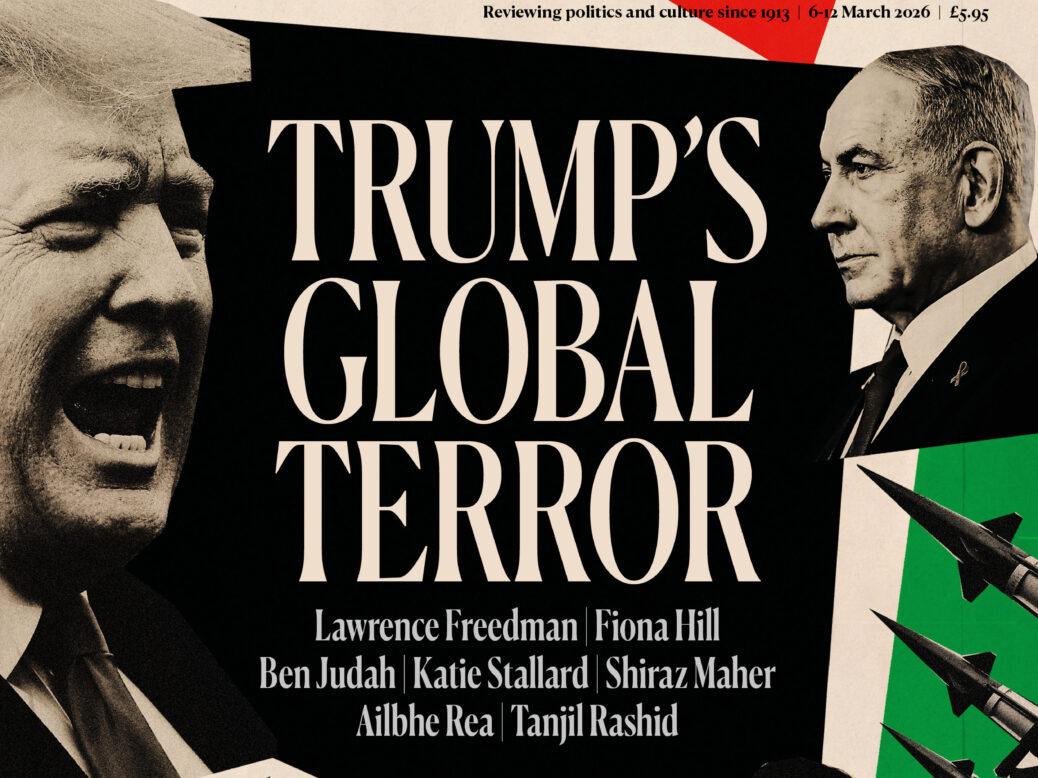
The US president’s war on Iran is – inevitably – the subject of much of this week’s magazine. How could it not be? Of all the decisions Trump has taken in his two terms in office, his decision to throw the full might of the US military at the destruction of the Iranian regime may prove his most seismic of all. This, after all, is not simply a targeted set of strikes on an enemy state – or even the abduction of an irksome Latin American leader. This is a war to destroy one of the world’s central “revisionist powers”, as my friend Professor Helen Thompson describes Iran, China and Russia, each of whom – for different reasons – seeks to end American hegemony. Yet, ironically, as Helen has also noted, given Trump’s desire to acquire Greenland, the US itself might now be considered a revisionist power when it comes to national borders. Such is the world we now live in.
The consequences of Trump’s war on Iran are beginning to be glimpsed, as Lawrence Freedman, Fiona Hill and Ben Judah all set out in these pages this week. The domestic ramifications alone are extraordinary to comprehend. Can British politics cope with yet more economic disruption, inflation and who knows what? The sense of public anger with Labour has already pushed this government to the edge following last week’s by-election victory for the Greens in Gorton and Denton. The former foreign secretary David Miliband has warned the party – and, by extension, Keir Starmer – that it is time for him to define his mission and lead before it is too late.
Britain, like much of the rest of the world, is caught in the storm that is Donald Trump’s presidency. What will be left of our special relationship at its end? As Ken Burns put it at the British Library, the American Revolution is still playing out.
[Further reading: Trump, Iran and America’s years of iron]
Content from our partners


Related
This article appears in the 04 Mar 2026 issue of the New Statesman, Trump's global terror
Join the debate
Subscribe here to comment