
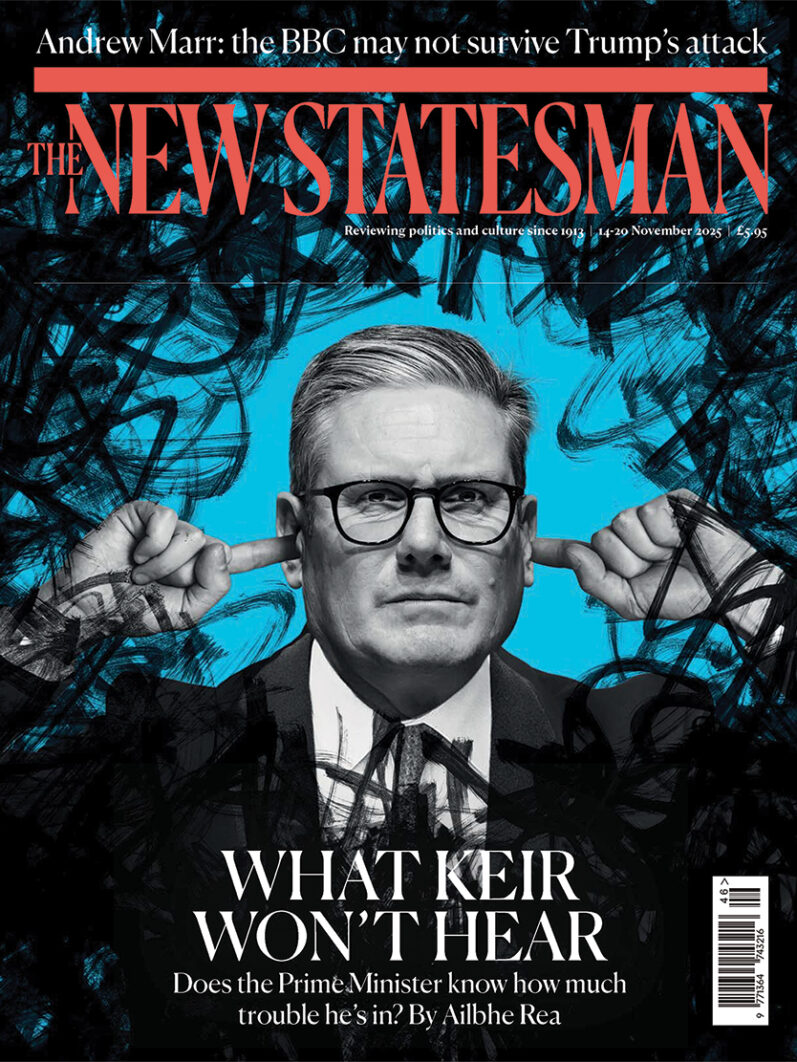
Press days at the New Statesman can be great fun: occasionally stressful, yes, but comradely affairs that often end with a raised glass of something cold to toast the latest edition. This week’s press day was more fun than usual for me, however, because it started with a rather glamorous breakfast at the Delaunay in Aldwych, London, with Andrew Marr, our new editor-at-large, and his successor as political editor, Ailbhe Rea.
Over copious amounts of coffee and “birchermüesli”, Andrew, Ailbhe and I tried our best to right the world’s wrongs – or, at least, those which afflict this benighted isle. Why does this government seem so fragile despite having such a huge majority? Why is there such speculation about the Prime Minister’s position so soon after he was elected? And why does the BBC lurch from one crisis to the next, attacked by both its enemies on the right and on the left?
Andrew and Ailbhe offer answers to these questions in this week’s magazine: Andrew, in his first big feature as editor-at-large, delving into the crisis now gripping the BBC; Ailbhe, in her first piece since returning to the New Statesman, revealing the scale of the crisis now gripping the government. Two crises, one country bound on the rocks by some deeper spiritual loss of confidence and morale, it seems.
Though this week’s cover is Ailbhe’s first as political editor, I cannot miss the opportunity to point out that it is very much not her first scoop since returning to this parish. Ailbhe began her tenure on Sunday night – well ahead of schedule – when she called me from the pub with a thunderbolt of a scoop: Tim Davie, director general of the BBC, was going to resign. “What?” I replied, somewhat taken aback as I tried to take the roast lamb out of the oven. “Are you sure?” Yes, she insisted: it would be announced later that evening. And so, bang! Ailbhe’s tenure as political editor had begun.

One of the challenges of editing the New Statesman is trying to get the balance right between covering the sense of perma-crisis exacerbated by such stories and challenging the corrosive narrative of decline that now seems to dominate our national life. One reader, Alison Eldred from Cheltenham, got in touch this week, pleading for some more positive coverage, “before we all jump off a cliff”. I hear you, Alison, and we will do our best.
The challenge, to put it bluntly, is that the government is not making it easy for us to do so. Even in private, senior members of the government I have spoken to in recent weeks have been utterly despairing about the state of affairs. After one recent encounter with a leading member of the cabinet, I emerged almost dazed by the hostility displayed towards the Prime Minister – a man who, whatever his faults, is clearly a dedicated, hard-working and professional politician.
What is lacking, as a friend put it to me this week, is any sense of intellectual energy. As Geoff Mulgan wrote in our sister magazine, Marxism Today, in December 1991, “There is a sense in which politics is an endless search for energy. Those parties or movements that plug in to the most powerful sources become strong. Those that find themselves running on the equivalent of old 1.5v batteries become an irrelevance.”
What strikes me about this remarkably prophetic piece of analysis is that, today, it is not just the government that is suffering from a lack of energy, but progressive politics more generally. Where are the new ideas emanating from the left today? Where is the analysis that connects the dots between the national crisis undermining faith in the government and in the BBC – not to mention, come to think of it, almost every institution still standing?
Without any intellectual energy, all that remains is a conservative instinct to hunker down and protect. Fear is now the driving emotion in Britain today, dominating everything, everywhere all at once – or so it seems. The government is scared to make an argument; to throw itself into the political melee. So too is the BBC, unsure of who it is and what it is there for.
As Mulgan understood, in such moments, such a loss of intellectual energy can quickly give way to a much more corrosive pessimism in which it becomes impossible even to imagine things improving – an “unrealistic fatalism”, as he put it. This, it seems to me, is where we are heading at the moment and why Alison’s challenge is a fair one.
[Further reading: Does Keir Starmer realise how much trouble he’s in?]
Content from our partners

Related

This article appears in the 13 Nov 2025 issue of the New Statesman, What Keir won't hear
Join the debate
Subscribe here to comment