
My husband and I have been in France, visiting my 81-year-old sister who has now lived there almost as long as she lived in the UK. She is, as she puts it, not in great shape. Perhaps this is why she increasingly takes the view that, given that global affairs are so absolutely ghastly right now, the bomb dropping and putting us out of our misery wouldn’t be such a bad idea. That everything is absolutely ghastly is indisputable – if you really needed me to list the reasons, I would, but they all start with Trump and I don’t think anyone needs reminding. That said, the French sky was blue all week, the trees are in bright, green leaf and the fields are equally lush – the young wheat was almost strokeable as we drove down from Saint-Malo. We stocked up at the local supermarket with everything for an excellent picnic supper, and also a copy of Libération.
J’accuse
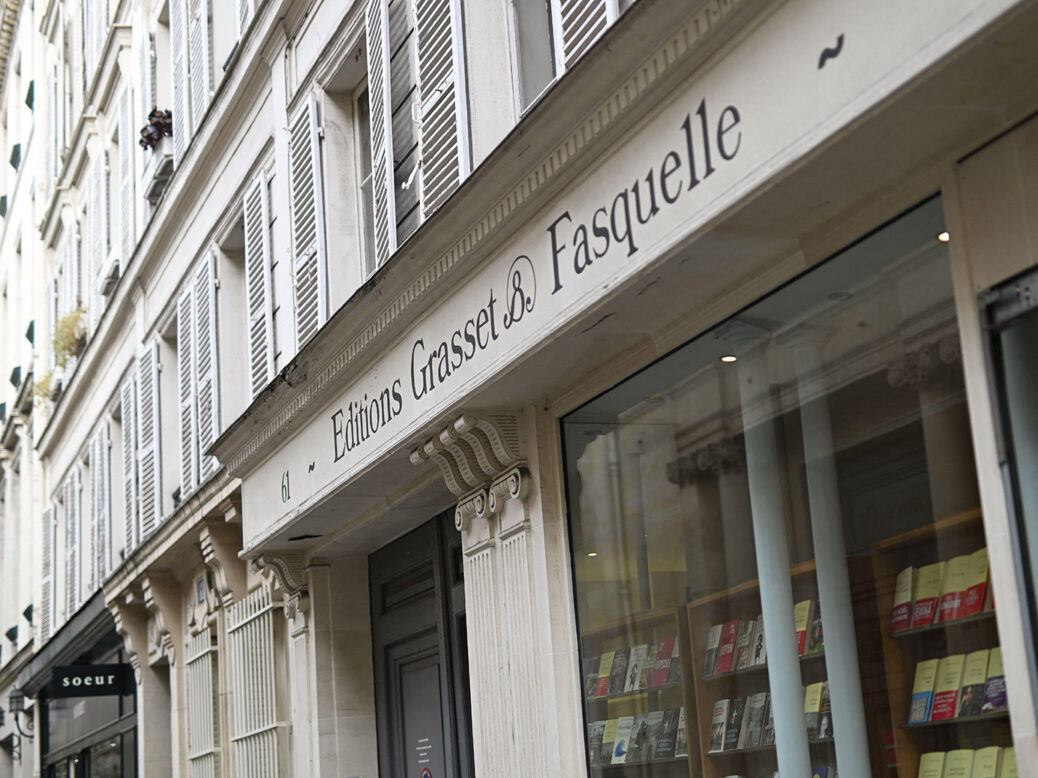
The front page bore the punchy headline “Crise chez Grasset: Bolloré, le temps de venin” (Crisis at Grasset: Bolloré, the time of poison). It refers to the abrupt departure of Olivier Nora, the editor who ran Grasset, one of France’s most prestigious publishing houses, for 26 years. He was ousted by the billionaire Vincent Bolloré, who owns Grasset’s parent company, Hachette Livre. Bolloré is decidedly right wing, and his vast media empire – which includes TV, radio and newspaper companies – is regularly accused of endorsing far-right views. More than 100 authors, among them Virginie Despentes and Bernard-Henri Lévy, have signed an open letter of protest at Nora’s forced departure, in which they say, “We refuse to be hostages in an ideological war that seeks to impose authoritarianism everywhere in culture and the media. We don’t want our ideas, our work, to be [Bolloré’s] property.”
Un-freedom of the press
I texted a photo of the headline to a friend, a leading London publisher, who immediately replied, “Can you imagine the like here?” I think he was referring to the fact that the story was on the newspaper’s front page, as it has made the inside of both the Guardian and the Financial Times. But, given the current political landscape, I can easily imagine a world in which Nigel Farage or a British Bolloré were in charge. When I was a working editor (I retired from Picador last year), all that my colleagues and I really wanted was for enough readers to love the books we did so that we could make enough money for the company to keep its lights on. What would I or any of my colleagues in the industry do if, in the future, we found ourselves owned by someone who wasn’t merely right-leaning but completely beyond the pale?
A busman’s holiday
Retiring is an odd business, not least because one ceases to have any. After two big holidays abroad with my long-suffering husband (who does all the driving and now has to put up with me all day), it’s time to work out what shape my life might now take. So far the chief joy is not having to get up and be somewhere. That and no meetings. I can see myself regularly parked on the sofa watching Z-list telly, so to mitigate such idle behaviour, outings must be arranged, to museums and exhibitions, parks and gardens. I’m also volunteering at a community kitchen.

Then, too, there’s reading for pleasure. Even though I was a non-fiction editor (is this the place to admit I am a nepo-diarist, having edited the first book of this magazine’s editor, as well as an excellent book by its previous editor, too?), I read nearly all the fiction submissions shared by my colleagues as we deliberated over what to add to the list. Having more time to read more widely has been a delight. I confess that lately, apart from Olga Ravn’s deliciously weird and creepy The Wax Child and Paul Gillingham’s enthralling Mexico: A History, I have been reading books mostly published by my much-missed former colleagues. Gwendoline Riley’s The Palm House is slight but weighty, not a word is out of place, and it is both wryly amusing and desperately sad; while Patrick Radden Keefe’s London Falling is a gripping account of the mysterious death of Zac Brettler.
However, I don’t wholly share the title’s claim. London hasn’t fallen. It’s always had a criminal underbelly, whether foreign funded or home grown; show me a city without one. I’m writing this on the ferry home to London, and the sky is blue, as is the sea, and the sun is shining. So while everything remains ghastly, at least today I don’t feel it quite as keenly.
Georgina Morley is a former publishing director at Picador
[Further reading: The secret diary of a Foreign Office civil servant]
Content from our partners



Related
This article appears in the 29 Apr 2026 issue of the New Statesman, The cover-up?
Join the debate
Subscribe here to comment