
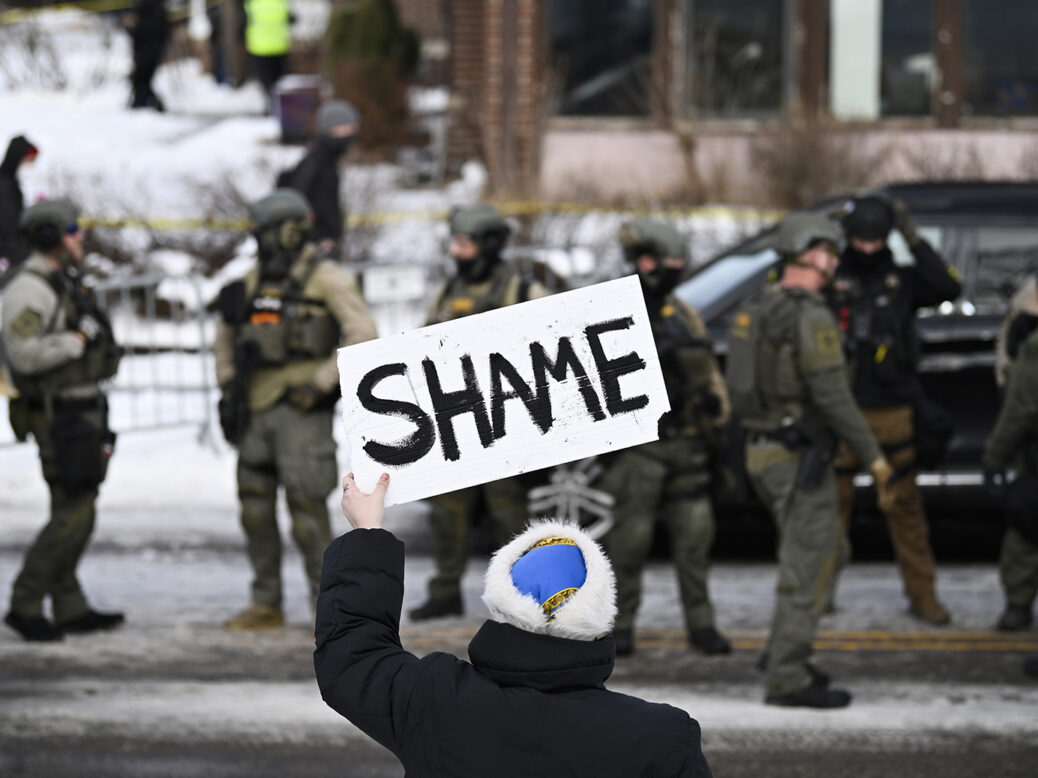
Prince, perhaps Minneapolis’s most famous son, once said of his city that “the cold keeps the bad people out”. In the middle of a Minnesota January, temperatures skirting -20˚C and lower, that dictum, oft-quoted by the city’s liberal residents, has been put to the test. Minneapolis and St Paul, the “Twin Cities”, perched in what is typically a sleepy corner of the upper Midwest, are now the most politicised zones in America. They have become sites at which the power of the American state is being tested. Reporting for The News Agents podcast from Minnesota this week, it felt more and more as if the boundaries of power, and how it is enforced, have been reconfigured.
Mourning in Minnesota
Minneapolis is more than 2,400km from the Mexican border and is home to less than 1 per cent of the US’s unauthorised immigrant population. Yet, there are now five times as many Ice agents in the city as police officers. Over the past two months, more than 3,000 federal agents have flooded in. Why the city has become the focal point of Donald Trump’s vitriol is no mystery. It is where George Floyd was murdered, and is home to the largest Somali-American population in the US (whom he has referred to as “garbage”). I visit a community centre filled with Somali-American citizens who have taken to patrolling the streets on “Ice watch”. There, a young man, a veteran of the US Army, reflects that he can only conclude his commander-in-chief – from whom he is required to take orders – is a white supremacist. The tension has ratcheted since the killing of Renée Good, a mother of three and poet, by an Ice officer, on 7 January. Trump administration officials labelled her a “domestic terrorist”.
Her son’s school has been threatened by the far right. I went to the street where she was shot. In the blanket of snow lay hundreds of flowers, toys for her children, notes of condolence and placards condemning Trump and Ice. There is now a 24/7 citizen watch, not only keeping the walkways clear of snow, but also ensuring the site isn’t vandalised by nationalist thugs. One by one, cars pull up, and small groups shuffle along the road to look, place their gifts, and take a moment of repose. I notice one woman standing alone, silently sobbing. “I’m crying for my kids and her kids – and for what’s happening in America,” she says.
On patrol with the Ice-spotters
Minneapolis has been described as being “under siege”. This isn’t quite right. Walking through downtown, as fine an example of a Midwestern city as there is, you wouldn’t be aware of Ice. There aren’t tanks parked along every street corner (yet). Ice is hidden, right up to the point it isn’t. I spent a day with one of the citizen “patrols” that have been created over the last 50 days, swollen in number since Good’s murder. They deliver supplies to people (including ethnic-minority American citizens) who are too afraid to leave their houses, fearful they’ll be snatched off the street. They also scour the city for potential Ice sightings – blacked out SUVs with young men in balaclavas behind the wheel.

I was on patrol with a Mexican-American woman, Mayra. She’s out 17 hours a day, coordinating 45 others. As we hurled from one side of the Twin Cities to the other, I was more than a bit alarmed as Mayra juggled two phones and the wheel of her Jeep. She barks into one or the other in Spanish, and all the time there is an endless noise – ping, ping, ping – addresses, cars and plates to be checked. Ice agents watch, looking for people to frisk or detain, and they are observed by the locals in turn. If Ice are spotted, whistles are blown to alert the neighbourhood to danger. Five minutes after I ask Ice officers if they have a warrant to do what they are doing, a drone appears and begins to circle our car.
The last guardrail
To Washington. I arrive on the day Trump’s letter to the prime minister of Norway is released, in which he objects being denied the Nobel Peace Prize and reiterates his threats over Greenland. He is only a quarter of the way through his second term. He is close to waging war on his cities and allies alike. Some Republicans wonder whether the president, always mercurial, may actually have lost his mind. Salvation will not be found in the institutions of the capital; Congress is supine, the Supreme Court is stacked, the integrity of the midterms cannot be guaranteed. Rather, it might yet come from the last guardrail: ordinary Americans, who are, according to the polls, unusually united in their opposition both to Ice brutality and to military force in Greenland. The question is whether Trump is simply too addled to care. I take a run along the Mall, stare up at the alabaster Capitol rotunda, gleaming in the winter sun, and remember that nearly a decade ago Trump promised an end to “American carnage”. At home and abroad, I wonder if it has barely begun.
[Further reading: Darren Jones’ vision for Whitehall]
Content from our partners


Related


This article appears in the 21 Jan 2026 issue of the New Statesman, Europe is back
Join the debate
Subscribe here to comment