
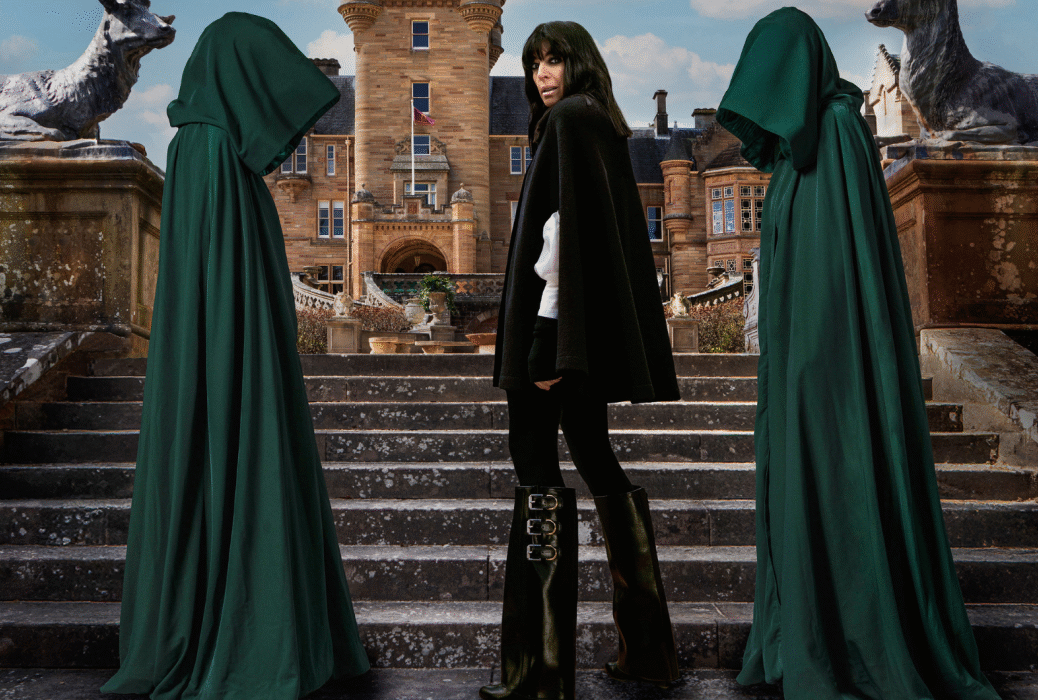
Any hit TV show on will be looking for ways of keeping things fresh for what is, in effect, its fifth season. That’s surely all the truer when it is being broadcast only a few weeks after the conclusion of the fourth season, which had the advantage of being cast entirely with comedians, musicians and other already famous people. (The BBC seems intent on convincing us that The Celebrity Traitors was a separate series, but… come on.) So I was delighted that, at the exact point I worried the format might be getting over-exposed, the show has thrown in a bold new twist: putting someone I actually know in the castle.
This must, now I come to think about it, be something that’s been true for literally thousands of people for every season of reality television there’s ever been. Nonetheless, watching the novelist Harriet Tyce, who I actually know and can text, would have given me a reason to not be entirely miserable about the onset of 2026, even if she hadn’t turned out to be cleverer in this game than literally anyone else who’s ever been on it up to and including Stephen Fry, which she has. What’s more, having posted that I know her on multiple social media platforms in the hope of reflected glory, I’ve been fielding fan mail for her from other friends (“Please tell her she’s my office’s favourite”), and have been able to bask. Really, it’s been a revelation. More shows should give it a try.
There’s another way in which this has added a new layer to the experience of watching The Traitors: by providing me with an insight into what it’s like to be quite hilariously bad at it. Obviously, I told anyone else who would listen and also a few who would not, the producers will have picked the thriller writer to be the secret traitor, right? Plotting is literally her job. Now that I’ve personally had the experience of taking a couple of entirely unconnected bits of information and spinning a richly detailed but wildly inaccurate theory out of them, I’ve got a much greater sense of what it must be like to actually be on the show as a faithful.
Which, of course, is what the secret traitor twist has done for pretty much everyone. This show offers numerous sources of joy – the campness, the cliffhangers, the outfits – but one of the greatest surely is the hubristic thrill that comes from watching people being embarrassingly wrong on prime time BBC One. “How can they not see it?” we ask ourselves, as we watch a smiling villain transparently manipulating their friends or Alan Carr unable, for the fourth time, to say he’s a faithful without pissing himself laughing. “It’s so obvious!” Well, now we know: without the aid of an edit that repeatedly cuts away to the traitors cackling away like supervillains, it’s not so easy after all. You apologise to David Olusoga, right now.

Another source of joy in this show – the one, I suspect, that attracts the sort of people who tell themselves they wouldn’t be seen dead watching other reality TV – is the hilariously bleak insights into human psychology and herd mentality it offers. The players unable to contain their outrage at the suggestion they might be a traitor, even though we literally saw them tell Claudia they wanted to be one, and also it is quite literally just a game. The way some people have an incredible ability to build a mountain of theory on a molehill of evidence, while others have the charisma to bring a room with them no matter how obviously wrong they are.
But by far the most thought-provoking insight it offers, though, by virtue of being the most horrifying, is quite how easily people will conclude that there’s something off about someone, based on characteristics that have precisely squat to do with whether or not Claudia Winkleman may have tapped them on the shoulder. Much of the discourse around this season has concerned whether or not The Traitors has revealed subconscious but widespread racism: suspicion does seem to have an unnerving tendency to round on black people at the early roundtables, although there’s some debate on how statistically significant this is and I may, anyway, be the single worst placed person to comment.
But the same instinctive suspicion seems to me to apply, too, to those with disabilities or too much intellect or the wrong sort of neurodiversity – to anyone one step too far removed from some abstract notion of the median Brit. The first person ever evicted at a roundtable, lest we forget, had to explain that the reason she hadn’t joined in with a toast to “the faithful” is because she literally didn’t have the necessary arm. It’s perhaps too much to expect that a reality TV show should provide moral lessons as well as entertainment. If it does, though, what it tells us is surely that we are none of us free of bias – and where we lack information, we may all be prone to plug the gaps with prejudice.
The other lesson of course is that an upsettingly high proportion of the public cannot, in fact, spell.
Incidentally, Harriet is a secret barrister, not the secret barrister; she’s married to neither Hugo the less secret barrister nor Amanda the world’s least undercover detective (I’ve met Harriet’s husband, he’s very nice); yes, I am jealous of watching her Instagram following and book sales exploding; no, she won’t let on what happens. And obviously I wouldn’t lie to you about that. I’m a 100 per cent faithful.
[Further reading: Heated Rivalry is the romp we need]
Content from our partners

Related

Join the debate
Subscribe here to comment