
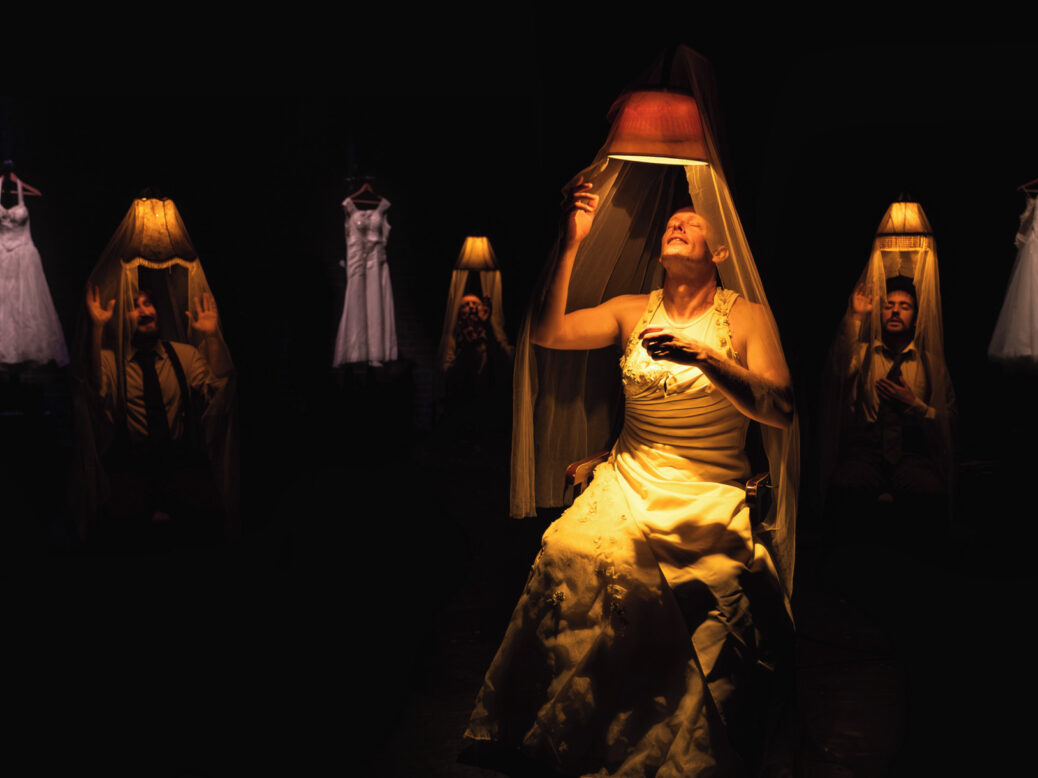
What is a wedding if not the signing of a contract with society? Many things, you might say – starting first and foremost with the joining of two people who want to spend the rest of their lives together. But no. According to The Wedding, an interpretative dance extravaganza by the physical theatre company Gecko currently revolutionising the stage of Sadlers Wells East, the couple element is very much secondary. “We are all married, bound by a contract,” begin the programme notes. “But what are the terms of this relationship – and can we consider a divorce?”
You may wonder, at this point, what it is I actually saw. And some 18 hours after seeing it, so am I. There were wedding dresses, worn by both men and women, swirling across the stage like nuptial spinning tops. There was a metal tunnel-slide, down which ingenues were birthed into the spotlight and onto a pile of teddy bears, representing the sudden lurch from cosy childhood to the obligations of adolescence. There were answers to some of life’s most perplexing questions, such as how much dancing can one really do from within a hand-baggage-sized suitcase? (The answer is more than you would think; the flexibility of the dancers involved is truly something to behold.)
The significance of this was explained, of course. It’s just that it was explained through a gabble of different languages, the Tower of Babel made flesh. Just one character spoke in English, and the only line of significance was a tortured admission, dragged from his reluctant lips as he tried to escape a claustrophobic cable-car booth, that he wanted a divorce. Not from his wife, we by this time had been made to understand, but from… well, it’s open to interpretation. His job, for sure. We had previously seen him navigating a cabaret of telephones and being crushed by the weight of clipboards and calculators, the archetypal symbols for a life of dull corporatism. Perhaps also responsibility? Social norms in general? Authority?
This chimes with what Gecko’s artistic director Amit Lahav told me about how the show was inspired by anger and hope. “Anger at the sense of being locked into a social and political contract I hadn’t consciously agreed to, and at the growing feeling of being bullied as a citizen within systems that increasingly felt fixed, opaque, and unaccountable” – hence the sinister metal box. Hope at the ability of artists to provoke curiosity and challenge those power structures, “particularly at moments when compliance feels easiest”.

So this is a show about power and privilege and how the individual choices we think we are making are dictated by a much more restrictive framework we might not even recognise is there. OK, fine. But why use a wedding? According to Lahav, we should understand that the work is “not literally about marriage, but about what that ritual represents. The wedding became a metaphor for adulthood: the moment we are ushered out of childhood and woven into the machinery of society.”
Here is where my personal biases may slip in. I was commissioned to go see The Wedding by our culture editor because I am known to have an interest in the changing nature of marriage. I find it fascinating, for example, that the marriage rate in the UK and other western democracies is declining: the ONS has found that the overall number of marriages dropped by a fifth between 1992 and 2022. I’m curious about the trend of people marrying later (the average age for a first-time heterosexual marriage is 32 for men and 30 for women – while back in the 1970s you’d be in a minority for remaining unmarried past 25), and what effect that has on divorce rates (which, despite what you might have heard, are actually going down). I am interested in how the legalising of same-sex marriage in 2013 and the availability of civil partnerships for everyone has widened access to legally recognised unions and at the same time sparked a rethink in what it all means.
Oh, and my fourth wedding anniversary is coming up soon. I did a fair bit of thinking (and, indeed, writing) in the lead-up to my wedding day about what it was I was signing up to. I confronted my aversion to traditional ideas of marriage, given I could very easily have married a woman and have a pragmatic approach to the ideal of lifelong monogamy; that I had no intention of ever changing my name; that any wedding vows I uttered would have to include a promise “to love, honour, and disobey” my husband for the rest of our lives. He, meanwhile, was divorced with children and had his views about what he was promising me and why. We wrote our wedding ceremony ourselves, drawing on elements of my Jewish heritage and his love of the Church of England, with some lines from the Australian comic songwriter Tim Minchin and the gay sex advice podcaster Dan Savage thrown in for good measure.
I am not suggesting for a moment that everyone should have a wedding – or a marriage – exactly like mine. I’m just pointing out the notion that the terms of marriage being rigidly set, and thus a potent synecdoche for the terms of one’s contract with society, just doesn’t hold true. Concepts around marriage are culturally fluid (I love pointing out to fundamentalist Christians who oppose same-sex unions that marriages in the early Christian church were meant to be celibate), and if anything, the decline of people choosing to get married demonstrates that other models are available.
So when I watched the Gecko dancers stamp on a glass, as the groom traditionally does in a Jewish wedding, I didn’t interpret it, as Lahav put it, as evidence that “moments of joy, excess, and celebration are tightly contained within the norms of that world”. I remembered my husband and I deciding to play with gender expectations and stamp on that glass together. I thought of how privileged I am to have witnessed both same-sex weddings and a heterosexual civil partnership, and how the brides and grooms each interpreted the rituals of a wedding in a way that is meaningful to them. If a wedding is to be used as code for our relationship with society, there are myriad ways to rebel that don’t require escaping a (metaphorical) cablecar to demand a divorce. It’s not about “compliance”. One can participate in marriage – or society – without entirely surrendering one’s identity. I think so, anyway. But then, maybe I’m just unwittingly compliant.
That said, the dancing is phenomenal. And once the confusion of the polyglossia wears off, it’s strangely compelling. The Wedding is a mesmerising spectacle, and the audience adored it – the mood in the auditorium as the company took their bows to a roaring standing ovation was more akin to a rock concert than a piece of interpretive theatre. Go for yourself and make up your mind. Just don’t start planning the divorce just yet.
[Further reading: What it’s like to be played by Claire Foy]
Content from our partners

Related


Join the debate
Subscribe here to comment