
Membership of the Barbour society at my university, little more than a glorified drinking club, came with a single prerequisite: owning a jacket. Given the association of Barbours as the winter coat of choice for aspirant Sloane rangers, ethnic diversity was not their strength.
You would be correct in assuming, with an extremely Jewish surname like mine, that I hail from very urban north London. Not an ecosystem with much need for a sturdy wax jacket to fend off the elements. As it happens, I actively hate the countryside. Fresh air makes me nauseous. Hampstead Heath is about as rural as I get. Naturally, I did not own a Barbour jacket at university and so was persona non grata.
Years later I bought a Barbour. I took it home hoping to be doused in compliments, only to be met with, “you look very goyish”. I suppose that was the point.
The relationship between Britishness and Jewishness is like a tightrope walk, but Christmas Day is where the balance tips. It’s like crossing a minefield. Watch your step or you’ll commit sacrilege.

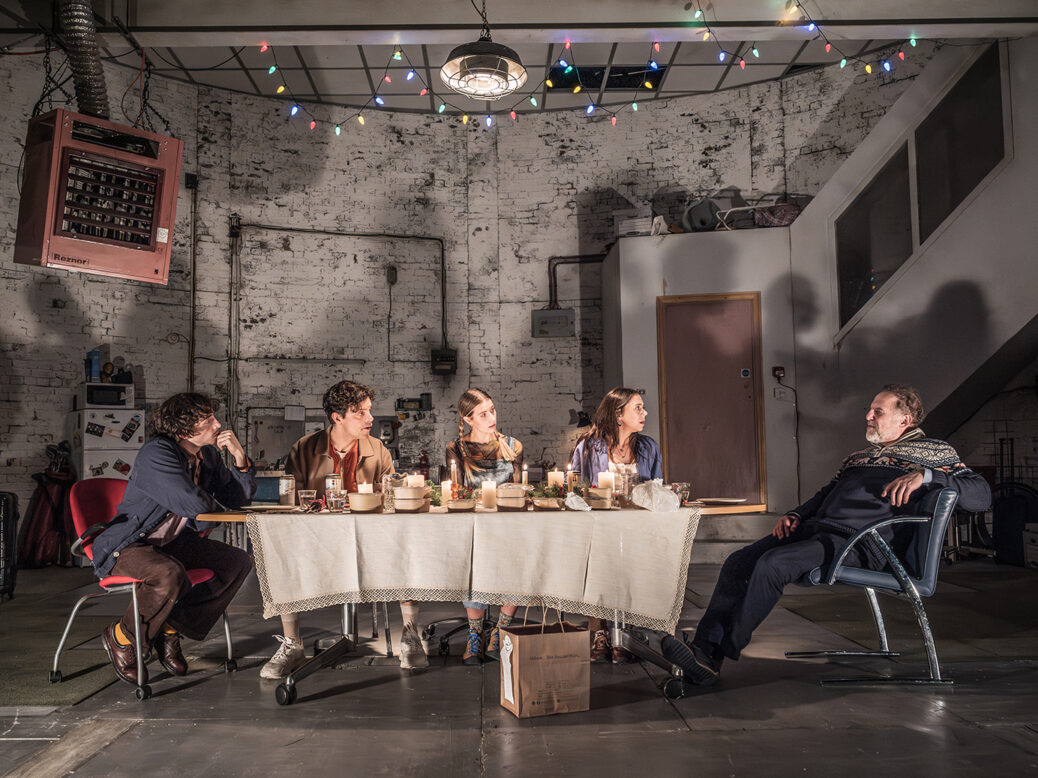
The Olivier-winning playwright Sam Grabiner slyly makes this tension the psychological epicentre of his new play at the Almeida. In Christmas Day, a family of north London Jews convene for a Christmas lunch that gradually swells into a metaphor for the crossroads at which the Anglo-Jewish community finds itself.
It’s all too familiar to me. Jewish Christmas in the House of Cohen is a similarly awkward affair. It starts with Dad maintaining a show of principled resistance by pointedly going to synagogue on Christmas morning. The moment the front door bangs shut, mum and I stuff a kosher turkey and squeeze it into the oven blasting “Stop the Cavalry”, the greatest Christmas song.
We exchange gifts, albeit under the festive loophole of them being Chanukah presents. Pigs in blankets are an obvious obstacle, but this is overcome by their replacement with kosher Vienna sausages. Christmas trees are uncompromisingly prohibited.
My father returns to find us mid-feast. He will grudgingly accept a roast turkey leg and a Brussels sprout, but he steadfastly refuses to pull a cracker. My brother will pull a cracker but won’t wear the paper crown, because that, somehow, crosses the line. My grandfather will remind us, as he does every year, that most of the canonical Christmas songs were penned by Jewish writers.
In Grabiner’s Christmas Day, questions about identity ripple across its cast of twenty-somethings. Aaron (formerly Jack), a family friend, has moved to Tel Aviv. He speaks romantically about a revitalised Jewish spirit, one unbound from the weight of historical trauma. Meanwhile, Tamara sees those same centuries of persecution as a moral summons to stand “with oppressed peoples”. They simmer over Zionism and Gaza.
Tamara’s brother Noah is caught in between. He longs to rediscover Judaism’s spiritual essence unburdened from the diasporic identity, but is haunted by the devastation in Gaza. Grabiner calibrates each idiosyncrasy with uncanny precision. In every icy scowl and snappy riposte, I see people who I grew up with, argued with, dated.
That tightrope walk feels shakier than ever. Outwardly, we worry how freely we can express our Jewish identity after this year’s anti-Semitic attacks targeting Jews on Chanukah and Yom Kippur – hardly surprising following the rising numbers of anti-Semitic incidents in recent years. I removed the star of David I once wore around my neck months ago after one too many glares on the Underground.
Inwardly, many of us struggle to bear witness to retaliatory Israeli aggression inflicted on Palestinians in the name of the Jewish state. We wonder how we can reconcile our idiosyncratic combination of Britishness and Jewishness, and if the cycle of violence that our culture seems swept up in can ever end.
Beyond our community, resurgent nationalism frays certainties about multiculturalism. An ethnically exclusionary vision of Britishness would not welcome people like my refugee great-grandparents. Yet their children, my grandparents, remain deeply patriotic, still carrying gratitude for a nation that protected their parents from persecution. They embraced bacon, Britain and Barbour jackets, never doubting that it would make them less Jewish. A prayer for the royal family has been a fixture of the synagogue service since Jews were let back into the UK in the 17th century, after Edward I’s expulsion in 1290.
Grabiner’s Christmas Day captures change across generations, showing how we, young British Jews, are tentatively finding our way in a community where the shadow of the Shoah still looms. Noah and Tamara are free to mould a Jewishness less bound by the direct memory of persecution. Like me, they never met their refugee ancestors. We live with the stories of flight and persecution, but without experience of the first-hand testimony. By contrast, their father, Elliot, and his dogmatic certainty in his Jewishness is propped up by the memory of his mother’s trauma fleeing genocide.
Grabiner doesn’t condescend with polished answers. As any worthwhile drama should do, it provokes its audience into asking their own questions. Whatever future path emerges from the mist of uncertainty, one thing is assured: I’ll still be proudly carving my kosher turkey for years to come.
[Further reading: The Bondi Beach shooting was an attack on Jews]
Content from our partners


Related

Join the debate
Subscribe here to comment