
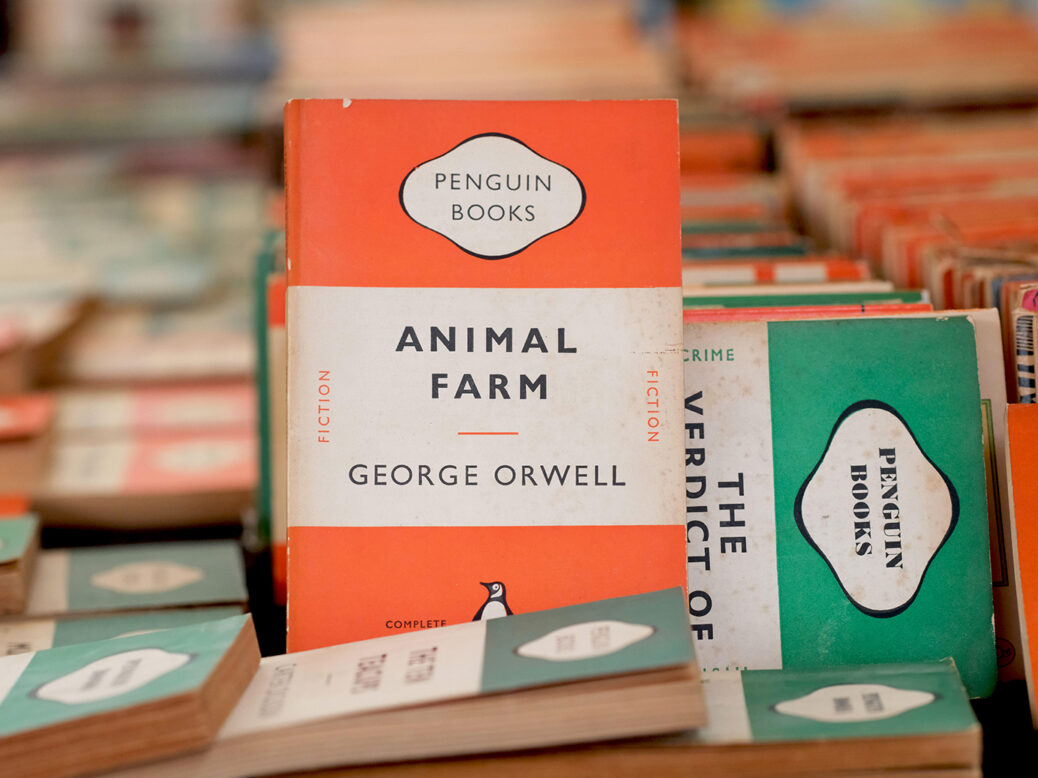
We tend to think of George Orwell as a city dweller, but The Farmer’s Guide to Animal Farm asks us to consider “Orwell the countryman, with his feet planted in the soil”. As Lisa Mullen takes a walk through his rural life, the presenter promises a new reading of Animal Farm, not as a political allegory, but as “a book about a farm, a book about animals”. It’s an intriguing premise, if somewhat hampered by its execution.
The first half of the programme offers a series of observations – pigs are competitive, horses see humans as co-workers – delivered between jarring jumps and loud, grating animal noises introducing each creature. Mullen’s narrative about Orwell’s countryside experiences is intersected by readings from Animal Farm, although they rarely provide deeper meaning. Even the more interesting details, such as that Orwell lived near Manor Farm (which he fictionalised for the novel) and heard the constant hum of its operations while writing, are barely explored.
In the latter half of the documentary, however, Mullen situates Animal Farm in the heart of 1940s agriculture, evoking the clash between efficiency-driven modernisation and traditional, organic husbandry; the movement behind the Agriculture Act of 1947; and wartime anxiety over Britain’s reliance on imports. The discussion reveals just how interested Orwell was in competing political visions of the countryside, particularly in anarchist communal farms, where he spent some time recuperating from tuberculosis.
In The Farmer’s Guide…, Orwell’s Manor Farm becomes more than a stage for barnyard politics. Instead it reflects a juncture in agricultural history, where the push for utility was seen to threaten the farm as a cultural ecosystem. It offers a fresh perspective on his concerns about totalitarianism. For Orwell, the farm is one of the first casualties of the totalitarian state, resulting in the erasure of local farming and, therefore, of English rural culture.

The Farmer’s Guide to Animal Farm
BBC Radio 4
[See also: The millennial parent trap]
Content from our partners



Related


This article appears in the 27 Aug 2025 issue of the New Statesman, The Gentle Parent Trap
Join the debate
Subscribe here to comment