
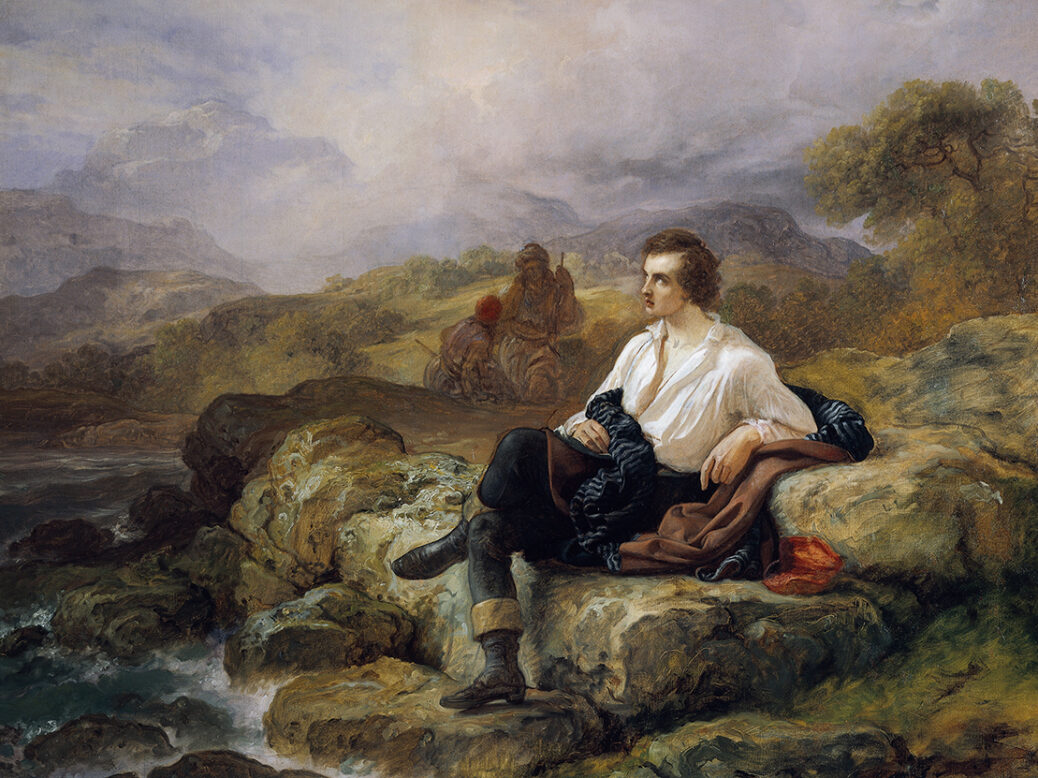
We’re all very particular about what makes the perfect beach read. It has to be light – it can’t weigh too much in the hand or on the soul. It also has to thrill: page-turner, cliff-hanger, jaw-dropper and, ideally, side-splitter. Exotic details and palmy settings are a plus, and if a few hearts have been broken by the end of the book, all the better.
Don Juan does all that, and more. Lord Byron’s epic poem about a charming Spanish aristocrat’s amorous adventures across late-18th-century Europe and beyond became a blockbuster upon publication between 1819 and 1824. It still deserves the acclaim: even by contemporary standards it’s succulent, scandalous and sensational. Its foreign climates, galloping narrative and salacious jaunts offer a glorious escape. Nowadays, we mainly know Byron the man, not the poet. We know about his incestuous threesomes, his university bear pageants, and his demise for love of Greek independence. But Byron’s creations are just as characterful as their author. This summer, we should swap our Byronmania for Juanomania.
The Don is a teenage aristo from Seville. He develops a sensitivity for female beauty early on: during prayer, the lad snubs the images of “grisly saints, and martyrs hairy” to focus his devotion on “sweet portraits of the Virgin Mary.” He turns his first head at 16 years old. Juan has an affair with Donna Julia, a married family friend, and both are caught en déshabillé by her husband. But while she is packed off to a nunnery, he sets off on a journey which will take him to Greece, Turkey, Russia and England.
Byron knew that travel disasters make the finest dinner party anecdotes. Don Juan is teeming with them. After being shipwrecked on one of the Cyclades, Juan is just beginning to savour the island idyll, where “Grecian girls” dance “strung together like a row of pearls”. But then his new lover’s pirate dad, Lambro, auctions him off into the Constantinople slave market. His sojourn in Turkey leaves him little leisure for sightseeing: he is too busy acting the part of odalisque for the sultan (as well as, unbeknownst to the latter, for the sultana). He plays the part so well he wins the favour of the austere Ottoman: “I see you’ve bought another girl; ’tis pity / That a mere Christian should be half so pretty”.

But Juan has to make a run for it after he comes to be suspected of having exchanged niceties with one of the Sultan’s harem sisters. He ends up enlisted in the imperial army of Russia just as it is laying siege on the Ukrainian town of Ismail. After winning acclaim on the battlefield, Juan is swept into the bedroom politics of the Czarina of Russia, Catherine the Great. In St Petersburg, he leads the cushy life of the Empress’s favourite, until harsh local weather tampers with his health and drives him, in the guise of Russia’s envoy, to London’s beau monde.
None of Juan’s journeys are victimless. But he’s no traditional Casanova with a heart of steel; if anything, he’s quite sweet, and at times even movingly jejune. As in any good coming-of-age arc, Juan’s wisdom grows with experience – both in the battlefield and sweet siege of love’s crusades.
In its time, Don Juan was condemned as a “filthy and impious” thing. But, given the rich traditions of literary hypocrisy, one can imagine the same reviewer smuggling a copy in the folds of his hat to privately pore over Juan’s forays into the gilded bedchamber of Catherine the Great. His exploits are a masterclass in international sex education: in Spain, it’s all secret assignations behind holy books; on the Greek islands, passion flows as freely as the wine; and in the English drawing room, “manners make men”. Languages change while travelling, but the fundamental human talent for creating spectacular relationship drama remains beautifully consistent.
But Don Juan does not tell his own story – and the narrator, an irresistible egotist fashioned after Byron himself, tends to steal the spotlight. It is his, not Juan’s, ribald humour which makes Don Juan a perfect beach companion. This fickle, vitriolic, winking gossip with a deathly fear of ageing interrupts the narrative whenever he feels like it, to tell us about his likes (“fire, and crickets, and all that, / A lobster salad, and champagne, and chat”), and dislikes (“inconstancy” and “a dumpy woman”), or to advise those of us planning a sailing trip that “the best of remedies is a beef-steak / Against sea-sickness”, and to diss venerated philosophers (Plato is a “bore, / A charlatan, a coxcomb”) – or to tell us what we all think but dare not say out loud, namely that to a 50-year-old husband “‘twere better to have two of five-and-twenty”.
Some will object that a poem is disqualified from being a “beach read”. But the racy, scurrilous, scintillating verse of Don Juan, with its conversational tone and quick pace, is a thousand times more readable than any of Colleen Hoover’s insipid prose. And there is no need to read a stanza four times to “get the meaning”, because the meaning smacks you right in the face – except it does so with the suavity of a silk fan. So pick up the Wordsworth Poetry Library edition, with its an olive tree-framed vista of the sea glistening on its cover and helpful footnotes at its bottom. Summer fun is guaranteed. Byron knew this well when in Don Juan he recommended that people “travel, if but to amuse themselves; and the next time their servants tie on / Behind their carriages their new portmanteau, / Perhaps it may be lined with this my canto.”
[See also: The political afterlife of Paradise Lost]
Content from our partners



Related



Join the debate
Subscribe here to comment