
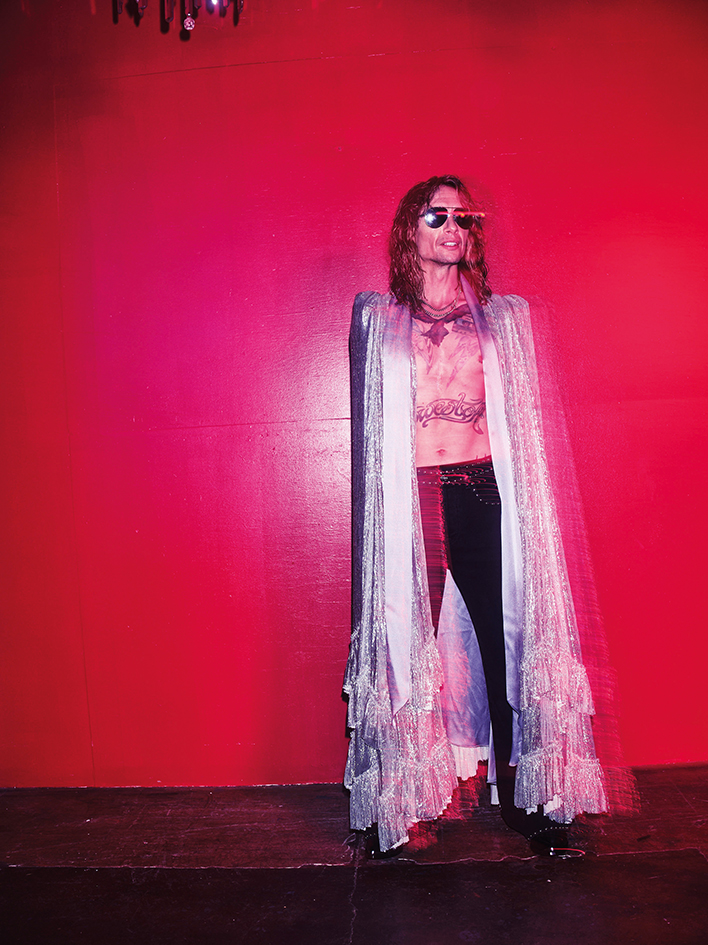
At some point during “Justin Hawkins Rides Again”, a touring chat show with the lead singer of the Darkness, a member of the audience will put on one of Hawkins’s famous catsuits and dance behind him on stage. “There are two spaces available, but only one person paid for that experience tonight,” the tour manager explains.
The man who did, in Sunderland, is Tony, a personable type with the look of one who drives a big rig: he is a local boy, back living in Sunniside, Gateshead, after a stint working in financial services in London. Tony stands up from his special seat close to the stage in order to introduce himself to the New Statesman. He has followed the Darkness since before their debut album, Permission to Land, in 2003, having discovered them at a motorbike festival where they were nearly jeered off the stage. Many fans of the Darkness are built like tanks, while the band members themselves are somewhat feminine and terrifically high singing. This juxtaposition has always been at the heart of rock – ever since the Hells Angels caused a problem for the Rolling Stones at Altamont. Tony has paid an undisclosed amount of money to wear Justin’s catsuit, “because what else are you going to do on a Tuesday night?” He does not know whether it will fit, and he has been asked to keep his orange trucker hat on, and his own shoes.
The Fire Station is an arts venue in the heart of Sunderland’s culture quarter – part of the town centre regeneration for a city that once built ships, dug coal and blew beautiful things out of glass. Although there were several famous musicians born here, there are currently only two portraits on the Wall of Rock outside the venue – Dave Stewart, and the local art rock band Field Music – because it’s not finished yet. Next door at the Empire Theatre, the Rocky Horror Picture Show is playing, 52 years after it first opened in London.
The original film starred Meat Loaf. As it happens, in 2009, having left the Darkness to sort out his drug addiction, Justin Hawkins found himself on songwriting camps in New York trying to write for Meat Loaf’s next album, to keep a bit of money coming in. One of the songs Loaf accepted was called “Next Time You Stab Me in the Back, Do It to My Face.”

A touring band sees little of a city, their heavy kit rolling in through identical stage doors, their expensive hotels interchangeable. But Hawkins’s unusual talking tour allows for a closer connection to the crowd. He takes the complimentary towelling slippers from wherever he is staying and gives them away as prizes for the musical pub quiz section of his show. At Ilkley, a town in West Yorkshire with an ageing population, people Hawkins had not seen since he was studying music tech at Huddersfield 30 years ago turned up to say hello. Outside the venue, there were men trying to get him to sign multiple copies of his albums so they could sell them on eBay. Yesterday, in Salford, he had a day off, and spent it buying a phone charger. He seems worn out in his dressing room: “I’m surprised at how tiring it is, actually.” He leans forward, elbows on his knees. He is wearing a T-shirt printed with many reproductions of his own face.
Hawkins’s father, a builder, raised him to believe he could achieve anything, so he applied himself to rehab with the same energy he put towards becoming a rock star and completed it in one 28-day stint: “The statistics on successful rehabilitation are not very encouraging,” he explains, “but I threw myself into it and I really enjoyed it.” He now lives in rural Switzerland, wakes in the morning, contemplates, runs with his dog, and follows this with circuit training. He is a vegan. Although he has been clean for 20 years, his body is an artefact of compulsion and excess, his hair black and wiry and his skin inked, every inch – a great swathe of sea green on the left arm, a long black swipe reaching vertically up over his voice box. The four faces of the rock band Queen, his childhood inspiration, are tattooed on the fingers of his left hand. They were already there when drummer Roger Taylor’s son joined the Darkness in 2015 – this was creepy, he admits, but rock, like no other genre, is an ouroboros and sons join fathers in an effort to keep it going.
Bombastic rock had reached its zenith by the end of the 1980s: no one could play faster, no one could sing higher. So the fashion, by the time of Nirvana, was to pretend you couldn’t really play at all. Hawkins and his brother Dan, his bandmate in the Darkness, knew their marketable commodity was how unfashionably out-of-time they were. Growing up in Lowestoft, he was a target for classmates, but he was also “hard”, as they said in the 1990s: “People used to call me a twat at school, so I became a professional twat,” he says.
The discomfort has left its trace. He searches for courtesy and responds to it with relief, and with an academic attention to answering questions. But hecklers seem to ruffle him, and in his stage show there is an undercurrent of bullying back, which generally manifests in mocking Gary Barlow. He has tried to keep journalists away from this tour. I met him years ago in a tattoo parlour, for the launch of a 2012 album called Hot Cakes. “That was the album campaign when I really did ask not to be told if there’s press in the crowd. Because it can be quite restrictive. A lot of the stuff I say is either defamatory, or just completely baseless accusations.” He asks me to turn off my recorder, and goes into an unrepeatable conspiracy theory about the Gen Z pop star Yungblud. Later, he asks me to turn it off again, and counts on his fingers the people in the music industry who need to be MeToo-ed.
Hawkins is on stage now in leather trousers, lobbing his mic back and forth at the crowd: “I say Sunder, you say LAND! Sunder-LAND, Sunder-LAND! I say Sun, you say DERland! Sun! DERland! Sun! DERland!”
As someone who has been very successful, and also very unsuccessful, he is uniquely placed to talk about music: the podcast which inspired his talking tour has 600,000 subscribers, and is becoming known and feared worldwide. It started off with him reviewing records, and now, in an attempt to mark himself out from a growing community of YouTube “reactors”, it has a bit more of an edge. He makes interesting points, such as, “When an artist has been ripped off by their manager or label, they tend to pass that trauma on to the next people that they work with.” He is not depressed about the future of guitar rock – and AI is not to be feared. It will not destroy recorded music: “All they’re trying to do is work out how to monetise AI,” he says, “so they’ll find a way of showing that you used it to write a song, and come after you for 8 per cent. I’ll never use it for anything! My belief is that most music is average, and if you’re feeding all of the music in the world into AI, what it’s going to spit out is average – so the people who are visionary are going to shine even brighter.” His musical demos, played live on an acoustic guitar, flicker – even more than he did 20 years ago – between sincere and parodic.
Tony appears on stage, wearing a metallic plum catsuit with a gold cummerbund wrapped around his large belly, his chest naked to display a tattooed plate above each breast. His trucker cap is in place and his legs are small and skinny. He is completely at ease. As Hawkins plays a cover of Maria McKee’s “Show Me Heaven”, eyes tight shut, Tony rolls confidently along behind him; does the rope dance, shakes his bum.
“Justin Hawkins Rides Again” runs until 7 February
[Further reading: Robbie Williams didn’t need Britpop]
Content from our partners



Related


This article appears in the 28 Jan 2026 issue of the New Statesman, How we escape Trump
Join the debate
Subscribe here to comment