
Cornwall’s recent starring appearance on the big screen was as the backdrop to the adaptation of Raynor Winn’s farrago The Salt Path. Fortunately, a rather more valuable, even revolutionary, contribution to films set in Cornwall – a tradition running from Jamaica Inn, through Straw Dogs, to About Time – is being made by Mark Jenkin.
Jenkin, a descendant of the painter Alfred Wallis, began filmmaking with a series of distinctive shorts, often exploring tensions between visitors and the local community. They were made in a resolutely artisanal fashion, using an old-fashioned clockwork camera with a single lens that allowed only 30-second takes, with sound being added later. Jenkin not only wrote, directed, photographed, edited and scored, he even processed the film stock – embracing the flares, graininess and scratches that resulted.
The aesthetic is pure Bresson: images, sounds and rhythms, not theatre. He favours letting things speak for themselves in close-up: faces, hands, feet and objects eroded by time. His work oddly reminds me of the great rediscovered Victorian photographer of fruit and vegetables Charles Jones.
Jenkin first found a big audience with the tremendous Bait in 2019, a feature filmed in black and white, observing all these disciplines yet highly entertaining, sexy and satirical. It is about a conflict between an impoverished fishing family and the conceited incomers who have bought their cottage as a holiday home. Bait was a surprise hit at the Berlin Film Festival, and won Jenkin an Outstanding Debut Bafta.

His 2022 follow-up, Enys Men (Cornish for “Stone Island”), was a folk horror, in rich colour this time. It told the story of a lonely wildlife volunteer on an island off the Cornish coast who becomes involved with a standing stone, a fisherman and multiple ghostly presences from the past. Offering no clear narrative, this was a good deal more baffling – a bit of an art installation, as even its most zealous fans admit.
Enys Men was made on a tiny budget, but Jenkin’s new film, Rose of Nevada, has been substantially backed by the BFI and uses well-known actors George MacKay (the lead in 1917) and Callum Turner, as well as several of Jenkin’s previous collaborators.
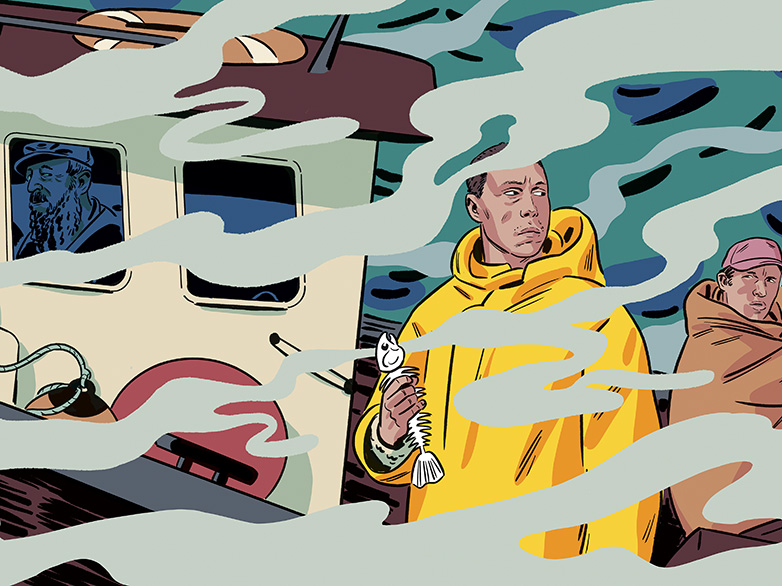
The Rose of Nevada, a small bright red fishing boat, disappeared at sea in 1993. The loss is still felt 30 years later in the unnamed small town that has depleted over the years: the pub is run down, the former Post Office is now a food bank and the public toilets are abandoned. Two young men who disappeared are still grieved, one by his now ailing parents, the other by his wife, Tina (Rosalind Eleazar), and the daughter he left behind.
Then, inexplicably, the boat reappears in the harbour. “Jesus Christ! She’s back!” says a local man. “I know it is hard, but we’ve got to decide what to do.” The decision is taken to send the boat out fishing again with a lairy old skipper, Murgey (Francis Magee), taking along the newcomer and chancer Liam (Turner), and local boy Nick (MacKay), who adores his wife and little girl but has no work or money.
They strike lucky and haul the fish in – it’s very fishy, this film – and after a couple of days they head home. “Home to Mother!” chortles the grotesque old salt. But when they get back, the men realise they have returned to 30 years earlier, when the village was vibrant, the Rose of Nevada not lost – and they are being mistaken by everyone for the men who vanished then.
Nick is distraught about his disappeared family and rebuffs the parents who take him for their son. But Liam, embraced by Tina as her husband, plays along. They go out to sea again, Nick hoping that they will return to their own world. Again, they come back with a good haul to a busy dock. “Can’t you see what’s going on?” Nick eventually says to Liam. “It’s us. They don’t catch fish, unless we catch fish. They’re dependent on us.” So he commits to those who need him now.
A Cornish Back to the Future, then? Not quite sci-fi, but time travel nevertheless. Rose of Nevada is quite beautifully made, its rhythms hypnotic, the images delectable in themselves, the colours sumptuous, the often-harsh soundtrack brilliantly uniting the short shots. Does it make any deeper sense, though? Jenkin has suggested that it is, in its own way, political: “a story about community and sacrifice”, not just a supernatural tale. That seems a stretch. But he has also admitted time travel just suits him: “I don’t think we exist in the present at all.” Time to watch this one again, I think.
“Rose of Nevada” is in cinemas now
[Further reading: Does Inter Alia understand the manosphere?]
Content from our partners



Related

This article appears in the 22 Apr 2026 issue of the New Statesman, All alone
Join the debate
Subscribe here to comment