
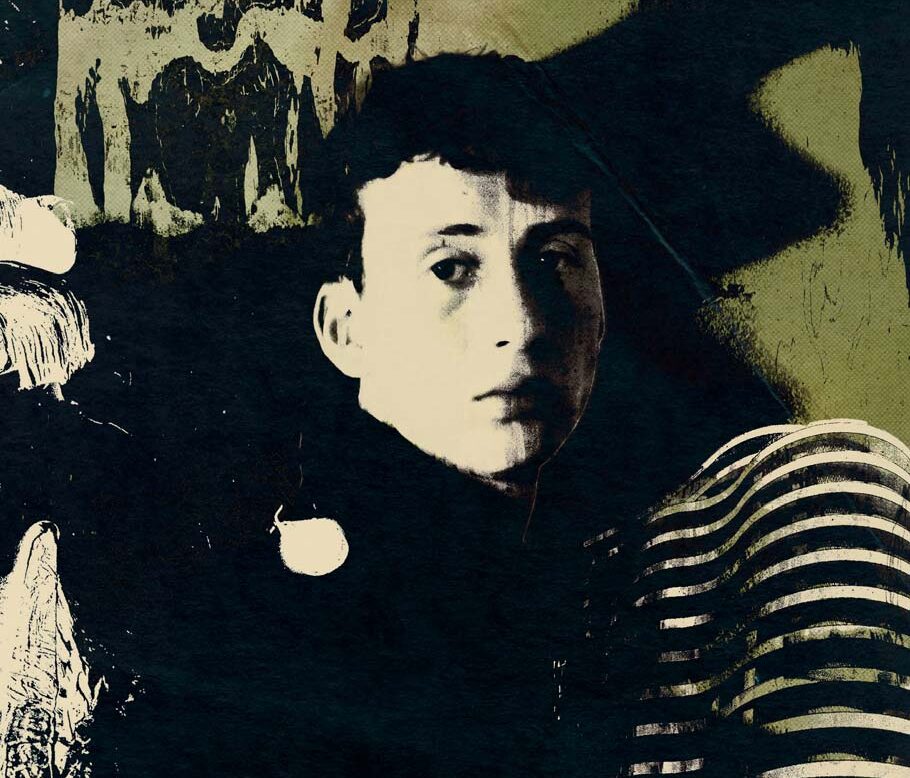
Who could turn this scene down? We’re at Riverwalk, 161 Millbank, London SW1 – a rippling, attention-seeking luxury apartment block in Pimlico, where units sell for between £2.1m and £4.85m. Inside, on the fifth floor, is one goon, one chancer and one naïf; the career gangster Verinder Sharma, the bankrupt bounder Akbar Shamji, and the 19-year-old fabulist Zac Brettler. They are talking, and drinking, and there is threat in the air. Shamji leaves, and is slaloming drunkenly around nearby Westminster in his red Mercedes, surging down famous streets (Whitehall, the Mall). It’s the early hours now, and Zac has moved to the balcony of the apartment. And then he jumps, and is falling, hoping to reach the water. He strikes the riverside balustrade with his hip, and probably falls into the Thames unconscious, where he dies. The following dawn, his body is uncovered by the tide, broken on the filthy shingle. Only now he is no longer Zac Brettler. He is the story of a dark, sticky, secret city – a fly caught, killed and consumed on the spiderweb streets of 21st-century London.
We know how a British journalist would have reacted if they’d got this exclusive. (The narrator of Martin Amis’s novel London Fields, stumbling into a similar mort à trois: “This is a true story but I can’t believe it’s really happening. It’s a murder story, too. I can’t believe my luck.”) They would already be dreaming up their crappy cinematic intro, googling Netflix’s typical series option fees. Fortunately for him and his family, Zac Brettler came the way of one of the finest, and most famous, magazine writers in the English-speaking world, Patrick Radden Keefe.
Keefe is no naïf. If he ever knocks on your door, be very afraid. Don’t be distracted by his fashion-model good looks (the apparel brand J Crew launched their Patrick Radden Keefe campaign last year). It’s not that he leaves a trail of corpses behind him – rather, like the most literate bloodhound in America, he is perpetually snuffling in their wake. Keefe writes scrupulous investigative journalism, mainly for the New Yorker, and mainly about the criminal underworld we avoid thinking about and the criminal overworld we cannot imagine. His subjects have included Mexican drug lords, international arms dealers and billionaire collectors. His bestselling history of the opioid crisis, Empire of Pain (2021), helped turn “Sackler” into a byword for capitalist inhumanity to rival “Maxwell” or “Madoff”. He uses words like traffick, extort, snakehead, fraud, triad, heist, kingpin and murder a lot.

When Keefe flies into Heathrow, he comes to knock on the conscience of a nation. His breakthrough book, Say Nothing (2018), attempts a proper reckoning with the Troubles, the civil war Britain absent-mindedly fought for 30 years. If Keefe can be accused of such crude archetypes, Gerry Adams is that book’s primary villain. But Keefe’s reporting on Britain’s military conduct – the morally dubious counter-espionage of “Stakeknife”, state-sanctioned drive-by shootings, a campaign waged as a colonial rearguard but never named as such – is still filtering into the public consciousness. We can be flattered that he spends so much time auditing our past. He has, since hitting the longform bigtime, written dozens of articles, of which four have been expanded into books. And of those, half – now – are set in the United Kingdom.
The story of – and behind – Zac Brettler’s death is such a richly plotted maze, as twisting and interconnected as a nervous system, that it is a relief when Keefe summarises its spinal narrative at the end of his book. Brettler was a solitary, daydreaming teenager from a well-to-do Jewish family in north London. Obsessed with money and power, he lied about his family at school: his mother was dead, his father an arms dealer, he was “doing oil deals with some Russians”. He eventually landed on the story of a mother living in Dubai and a Russian billionaire father. To his misfortune, the moneyed and the powerful started to hear him out.
A chance connection somewhere in the court of Roman Abramovich’s Chelsea FC got Zac into the world of Maseratis and Annabel’s that he’d lusted after through rags-to-racketeer films like The Wolf of Wall Street. Via his wild guff, an illusion maintained through conspicuous Uber journeys and claims of living at One Hyde Park, Zac fell in with two dangerous men – first Akbar Shamji and then Verinder Sharma – who fancied a portion of Zac’s fake fortune. His lies piled up; he began to trip over them. The men became desperate. One evening, the temper turned violent (“I have just been heating up knives and clearing up blood,” Akbar messaged a friend from the Riverwalk apartment). Trapped, and apparently fearing for his life, Zac jumped.
“Novelists don’t usually have it so good, do they,” Amis writes in London Fields, “when something real happens (something unified, dramatic, and pretty saleable), and they just write it down.” London Falling, full of such extraordinarily rich scenes, wasn’t just written down, and the labour of research to transform Zac, Akbar and Verinder from names into lives has clearly been epic. But Keefe is very fortunate in his personae, who, twisted together, plot the modern history of the British capital. The book’s first third takes in the Brettler family, which is by no means generic. Matthew and Rachelle Brettler are the children of Holocaust survivors – Rachelle the daughter of Hugo Gryn, a media rabbi who doctored his own past with lies about attending Cambridge University after the war, and who maintained a “second family” inside London’s Jewish community. Though Rachelle and Matthew are very sympathetically drawn – how could they not be? – Keefe also notes their “lassitude” as Zac slipped out of their control.
If the Brettlers are novelistic in the ambiguous, psychologically riven sense, Akbar and Verinder are grotesques on a Dickensian scale. While Keefe’s prose never slips from its metronomic sobriety, these middle chapters about the South Asian duo are thrilling and comic. Akbar is the son of Abdul Shamji, a Ugandan-Asian businessman who immigrated to Britain after the persecutions of Idi Amin. Shamji Sr would become a Thatcherite parable, amassing wealth through leveraged debt, and buying shares in Wembley Stadium, before serving time for lying about his assets. Akbar, it is shown, was truly his father’s son. As to Verinder, it would take a novel to recount his exploits. But a brief CV: short, snappy dresser, alias “Indian Dave”, a graduate of London gangland, associate of Dave “Muscles” King and Gary “Tyson” Nelson, and a specialist in debt collection and intimidating hostages by warming knives on hot stoves.
The cast of names that swirls around these characters is astonishing. Margaret Thatcher, Nick Gold, the Candy brothers and Boris Berezovsky float on the edges of Keefe’s book. Equally astonishing are the new details that have emerged since the original New Yorker article. At Zac’s post-mortem, a single sperm was found in his rectum, a sample too small to identify a suspect via DNA. Could there have been a sexual element to his relationship with Verinder or Akbar? Meanwhile, Verinder seems to have remained mostly a free man for decades despite a flagrant life of crime. Could he have been a police informant, protected by the same forces that investigated him for Zac’s murder?
Despite his rigour, Keefe is unable to answer these questions categorically. On two occasions I felt his perceptions blur. His account of London’s history is a little impressionistic. We get a version of the revolutionary “Big Bang” narrative according to which, before Nigel Lawson’s 1986 banking reforms, Londoners ate only boiled mutton (in the Nineties “there were good restaurants for what felt like the first time in history”). And the assessment of the Brettlers’ class, and its relationship to Zac’s material lusts, could have been subtler. Recounting Zac’s obsessions, Keefe transcribes Rachelle Brettler’s comment that, “This world of Porsches and cosmetic surgery and Ibiza, it’s everything we’re not.” But the Brettlers were clearly very wealthy, only in a different way, with their second home in New York, intimate knowledge of London public-school hierarchies, holidays in Oman, and Rachelle’s columns in the FT’s How to Spend It magazine. Zac’s attraction to a more gangster-capitalist form of consumption (his brother Joe sneered when he bought a pair of Gucci shoes) can be read as a rebellion within and against his family’s haute-bourgeois tastes. But these are the divergent readings that the depth of Keefe’s writing affords us. The book remains a citadel of research. Indeed, it forms a topography not just of the physical London but its psychological terrain, its labyrinth of paranoia.
In his post-amble to Say Nothing, Keefe assures us that he is not one of those Irish-Americans, they of felt green hats, unsettled Guinness and contrived ethnonationalism. He was brought to the Troubles not by partisanship, but by disinterested questions around honour and betrayal. While not especially Anglophile – Dickens does appear in London Falling but the book is written like a soft-boiled Raymond Chandler – Keefe is also no Anglophobe. His attraction to our country and its capital is perhaps the only unacknowledged mystery of his book. Why the unresolved murders of the IRA, and not the unresolved murders of the Basque nationalists ETA? Why is it London that is falling – if not “fallen”?
There are prosaic answers to these questions: the commonalities of language and culture, the fact that, as he tells us, Keefe was first alerted to Zac Brettler’s story by an acquaintance when he was filming for television in London. But Keefe’s book forms part of a more generalised turn. Not since the Seventies have Britain and London’s global reputations been so low. Even on a sick continent, on a very sick ward, we are the sickest man by far. And, worse than the Seventies, our problem is not poverty and stagnancy – or not just that. Much of Keefe’s book has to do with the urban economy built since the Eighties, in which all his characters are participants (including Matthew Brettler, who worked in structured finance). He sees it as filthy at both ends, our every attempt to irrigate international finance a humiliation of our lost power to create it. The symbolism colours Keefe’s book. “London is such a beautiful place,” he writes, in a rare purple outburst, “that it can be easy, as you stroll around the city, to forget that much of it was built on imperial plunder. London is the capital of pristine facades, often painted in wedding-cake shades of cream or ivory; the city’s dominant aesthetic is a literal whitewash.”
So: is it only Zac Brettler’s corpse that Keefe finds himself examining? What else was Zac, with his naivety in the face of oligarchic wealth, his love of American films, and his mid-tier public school, topped up by Russian pupils? “‘When public officials in post-Soviet Moscow developed a taste for graft,’ the Russian billionaire Sergei Pugachev once observed, they became ‘like people who had drunk blood. They can’t stop.’ The same might be said of the English economy.” This is the most direct of Keefe’s implicit comparisons between the United Kingdom and a late-stage regime suffering a post-imperial collapse. Patrick Radden Keefe is a reporter, but he’s also a writer. When he pictured the scene of the falling boy, he couldn’t miss the metaphor.
London Falling: A Mysterious Death in a Gilded City and a Family’s Search for Truth
Patrick Radden Keefe
Picador, 384pp, £22
[Further reading: Little England, Great Britain]
Content from our partners



Related



This article appears in the 15 Apr 2026 issue of the New Statesman, Angry Young Women
Join the debate
Subscribe here to commentPerhaps there is a pattern: it’s interesting that here too, if the review has it right, Keefe is much better on nailing his prime focus, the main narrative – Adams’s behaviour in the story of the murder Jean McConville in “Say Nothing”, the three main shady characters here – than in his wider commentary. I’ll be interested to read this as a former resident of London, because as a former resident of Northern Ireland, Keefe’s potted take on Northern Ireland and the Troubles at the start of Say Nothing was all over the place. I was as appalled by that as I was admiring of his tenacity with the detail of his main subject, and it struck as remarkable that the two could co-exist in the same writer to that extent.