
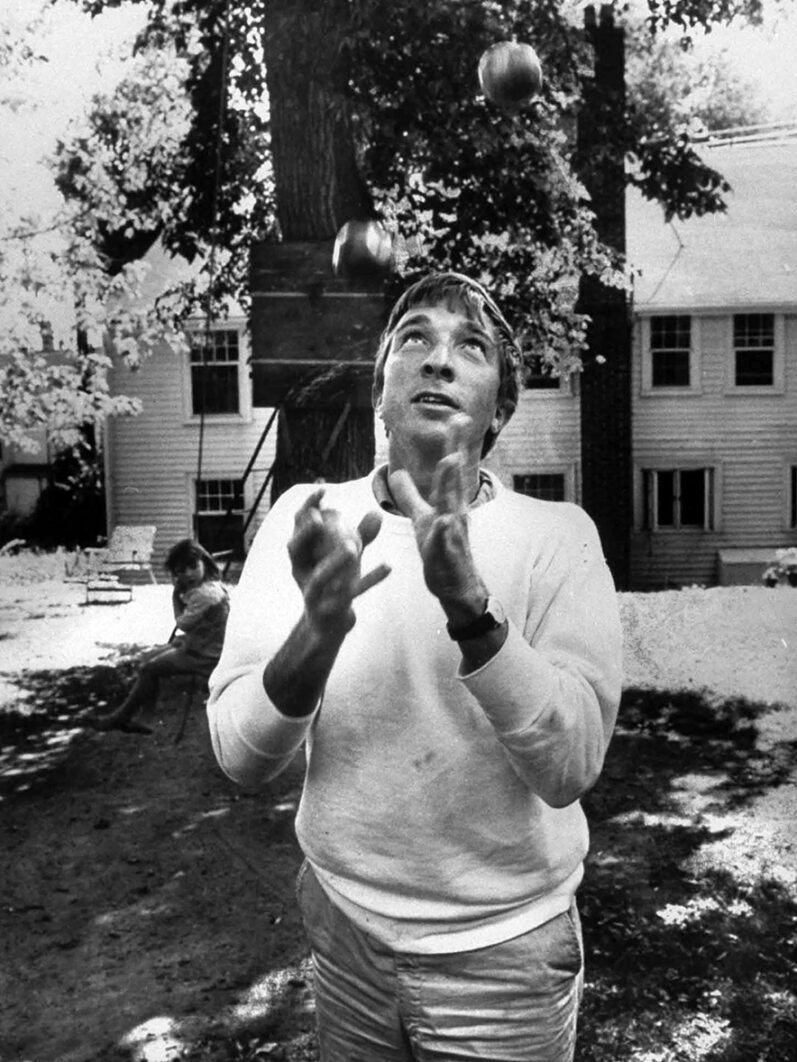
Seated on his mother’s lap in a 1933 photograph, the infant John Updike already looks like himself, with one cocked eyebrow and the first iteration of that famously unruly hair. Perhaps he already sounded like himself, using compound sentences to request a bottle or nappy change. In any case, the picture, reproduced in the wonderfully copious John Updike: A Life in Letters, seems a handy emblem of the author’s precocity. Updike did everything early: marriage, literature, fatherhood, fame. What’s more, he appeared to carry it all off with such ease as to make his contemporaries feel like late-blooming clods by comparison.
Needless to say, Updike got down to business early as a correspondent. By 14, he was already submitting poems and drawings to the New Yorker. To an adolescent living in a cramped Pennsylvania farmhouse, the magazine was a distant beacon of literary craft and urban élan. He would not appear in its pages for a decade. Yet the first letter here to capture Updike’s characteristic tone, written when he was 19, is a defence of that very publication, aimed at a local newspaper columnist who bragged that she had cancelled her subscription: “Eustace Tilley [the caricature on the magazine’s cover] is grey now about the temples, his walk is less buoyant, he pants slightly as he climbs the steep staircase to the humour he attained once without apparent straining. But he is not as ancient as you would have it; he is still wearing a contemplative sneer.”
This is not the sound of your average American teenager. Nor is it the imitative eloquence of a bright English major at Harvard, which Updike was then attending on a full scholarship. No, Updike simply had it: an instinctive feeling for the shape of American sentences, for the murmuring music of nouns and verbs and the way they could pin reality to the page. His notion of literature as a calling was doubtless encouraged by his mother, Linda Grace Hoyer Updike, who would eventually publish two books of fiction, both semi-workshopped by her prodigious son.
His time at Harvard was not exclusively a matter of tuning up the literary engine. During his junior year, Updike fell in love with a senior named Mary Pennington. His mother, tracking the relationship via his letters home, was not at first enthusiastic. Indeed, she suggested that such a union would quash his sense of identity. His reply was lofty but unbending and also a quasi-Emersonian statement about the centrality of self: “It is impossible to sacrifice the self, even if we could find a suitable altar, and a knife probing enough to make the incision. And, since we are bound to that self, we must learn to live with it, dignifying it with respect that is not adoration, a kind of introverted idolatry.”

God knows what his mother made of this. In any case, it did the trick. The couple married in 1953, when Updike was 21. Conjugal life initially treated him well – literary life, less so. He was still bombarding various outlets with submissions, feeling ashamed of what he had earlier described as “puttering around with postage stamps” and racking up hundreds of rejection slips.
But the floodgates were about to open. On 15 July 1954, an ecstatic Updike sent his father a Western Union telegram: “New Yorker buying Rolls-Royce poem future things must go to Mrs White Whopee [sic].” The poem, “Duet, With Muffled Brake Drums”, would appear about a month later. It was not a fluke. In 1955 alone, the magazine would publish four stories, 16 poems, and eight “Talk of the Town” pieces by its newest discovery. James Thurber, the idol of his adolescence, hailed him as a great new voice. The Pennsylvania farm boy had arrived.
Updike’s lifelong connection to the New Yorker constitutes a kind of romance, with much swooning, warmth, and occasional bouts of alienation. But Updike the writer was something of a polyamorist. While he pursued a deft, genteel, tap-dancing elegance at the magazine, he had other aims in mind for his novels. These included a refreshing candour about sex, which caused some headaches for Updike when he submitted Rabbit, Run (1960) to its publishers in both the United States and England.
In our highly sexualised age, where porn is easily accessible, it’s easy to forget Updike’s boldness. Nicholson Baker memorably saluted him as a pioneer of Eros, the first novelist to “take the penile sensorium under the wing of elaborate metaphorical prose”. It’s not that Updike had a long history in that department. In fact, a 1952 letter sent to Mary in advance of their wedding night sounds positively Victorian: “I think that night should be kept special, that the climax should be achieved in an atmosphere not of furtive eroticism but of, God bless the terms, propriety, rightness and moral sanction.”
In time, though, furtive eroticism got to be more interesting for Updike – in real life as well as in his writing. Rabbit, Run included a scene of fellatio, verboten not only for the pearl-clutching William Shawn, the New Yorker’s editor, but for the publishing industry in general. The dangers were real. Henry Miller’s Tropic of Cancer had not long prompted a flurry of arrests and lawsuits, and the author had been summoned to appear before a grand jury.
Updike argued forcefully against bowdlerising the text. “I am firmly convinced that if I made these changes I would have difficulty living with my decision for the rest of my life,” he told his US publisher Alfred A Knopf. He was even more blunt with his English iteration, Victor Gollancz: “The whole prospect of hand-tooling the prose down to within a millimetre of the legal concept of obscenity seems to me, itself, obscene.” In the end, his hand was forced, since neither publisher was willing to print the book as written. Updike swallowed his pride and trimmed the offending passages with his usual professionalism. “Now that the expurgations have become a merely technical challenge,” he wrote to Gollancz, “I hope I can perform them with some gusto.” He restored all the dirty bits in subsequent editions.
Of course, Rabbit, Run was a tea party compared to what came later. In 1957, the Updike family, now including two children (there would be two more), had moved to Ipswich, Massachusetts. As the docile Fifties turned into the wild Sixties and Seventies, Updike increasingly availed himself of the suburban pleasures of the day – volleyball, poker, a baroque recorder group and screwing. He had affairs, Mary had affairs, and this spouse-swapping epidemic would eventually be commemorated in Couples (1968), which made him rich. His newfound wealth, he wrote to the publisher Bennett Cerf, seemed an unlikely outcome from a novel he described as “a bouquet of copulations and attractions and loyalties and betrayals”.
But amid all the swinging in the sunken living rooms of Ipswich, Updike struggled with his conscience. To one lover, Joan Cudhea, he lamented that “affairs are cruel, and if they are sin, they carry the punishment with them”. He added: “I feel bad about adultery, and covetousness, and flirtation; but don’t know what else to do. Whole areas of mystery and constraint were cleared up by you in those various stolen hours and borrowed rooms.” Sceptics will call this an easy bit of absolution. But Updike’s shame was real, rooted in his Calvinist impulses and in some uneasiness about the prerogatives of the self, so celebrated in that earlier letter to his mother.
He returned to this theme in a 1974 letter, noting that “the institution of marriage offers to wall us in nicely, in a consecrated concupiscence, for the sake of stability – not merely society is conserved, but ourselves. Lovers place themselves outside the walls, and it is windy, and one is prey to all sorts of nervous disorders.” But Updike was then on the verge of vaulting those very walls: the recipient of that letter was Martha Bernhard, who would become his second wife in 1977. (He and Pennington divorced in 1974.) Of the 912 pages in this collection, about 130 are devoted to Updike’s agonising extrication from his first marriage. They are so detailed and so attuned to the author’s alternating currents of grief and infatuation that they feel like a novella of sorts. “Give me what you can in this time between,” he pleads with Bernhard, “I am terribly alone, though I do not always know it.”
Marriage to Bernhard stabilised Updike’s life. A long-time Congregationalist, he now joined his new wife in the Episcopalian Church, although the benefits of institutional Christianity sometimes struck him as mainly subtractive. (Even a “feeble faith”, as he noted in one letter, “does cut down on the possibilities, and eliminates at least some things as out of the question”.) The couple eventually moved to Beverly Farms, Massachusetts, where they bought a grand house overlooking the water. In the four tiny ground-floor rooms once occupied by servants, Updike set up shop and churned out, over the next couple of decades, some of his greatest prose. There he wrote the remaining volumes of the Rabbit trilogy, a bushel of marvellous stories, many more novels, plus a magma-like outflow of critical essays that required four books to contain it.
Having attained a certain glide path of celebrity and success, Updike, for the rest of his life, never really deviated. The earlier striving and the romantic agonies were now muted, which made for a more tranquil life though less compelling correspondence. Yet he remained a bracing voice in the later letters, whether he was analysing “some plausible arguments for God’s silence and majestic tact” or dismissing persistent critics such as Christopher Hitchens (“a breezy British blowhard, courting approbation and indulgence in his cups”) or James Wood (“a great annoyance”).
He was also a humble man. He had a rueful sense of exactly how transient his success might be. In 1992, writing to his former editor at the New Yorker William Maxwell, Updike already imagined himself as obsolete. He noted the “sadness of thinking that you and I, you in your office with its view of Rockefeller Centre and I in my Ipswich domicile surrounded by children and dinner parties, are figures of the past, characters in a drama whose scenery is all packed up and in the van”. He would, of course, keep publishing until his death in 2009 – indeed, he had four books in production when he drew his last breath. But glory – as Updike the writer and Updike the Christian well knew – was fleeting.
Perhaps that’s why I so relish the letter that Updike sent to a highly specialised fan in 1996. His correspondent had been savouring Updike’s very first book, the poetry collection The Carpentered Hen, since it first appeared in 1958. Now, nearly four decades later, he was writing with an unlikely question: “Have you written anything else?” You can imagine Updike sputtering as he composed his reply, yet his instinctive Wasp politeness prevails. Only in the final sentences does a plaintive note creep in: “Have you never noticed any of my reviews or stories in the New Yorker? Or seen any of my novels in a book store? Well, such is fame.”
James Marcus is the author of “Glad to the Brink of Fear: A Portrait of Ralph Waldo Emerson” (Princeton University Press)
John Updike: A Life in Letters
Edited by James Schiff
Hamish Hamilton, 912pp, £40
Purchasing a book may earn the NS a commission from Bookshop.org, who support independent bookshops
[Further reading: Tupac Shakur: lion or loser?]
Content from our partners



Related

This article appears in the 20 Nov 2025 issue of the New Statesman, Meet the bond vigilantes
Join the debate
Subscribe here to comment