
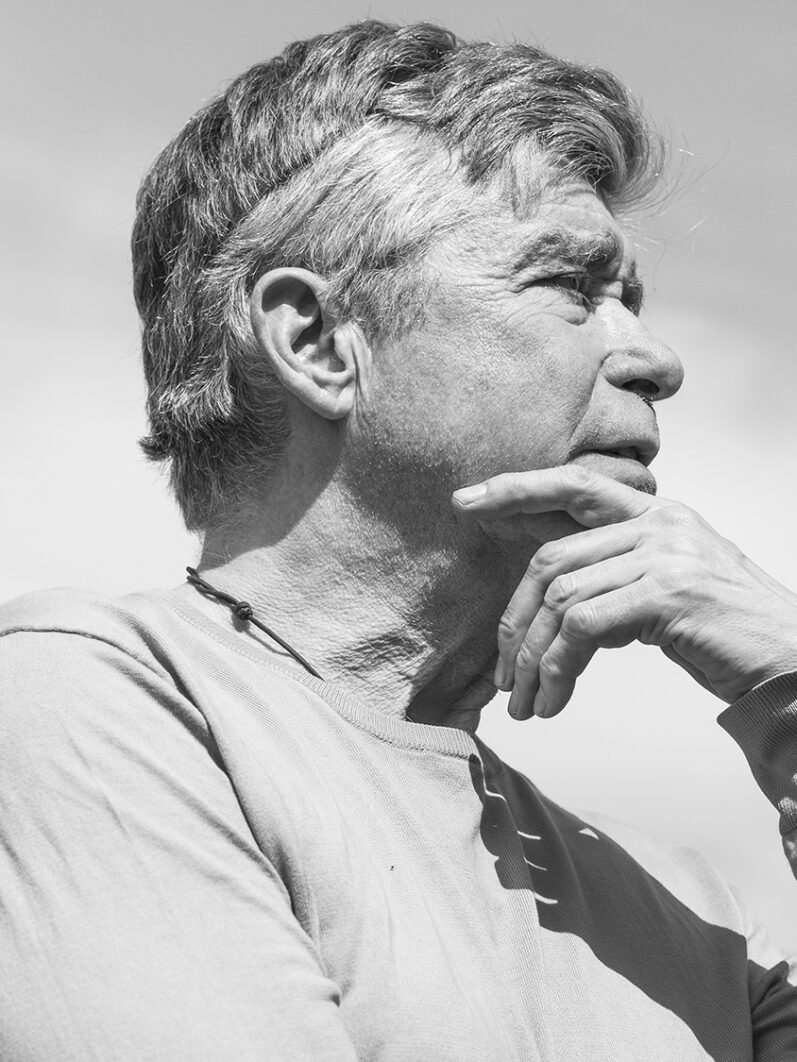
What must it be like to have access to any room in New York City, but not really want to be in any of them? That is the secret conundrum of Jay McInerney – author, wine critic, reformed raconteur, and once King of the Scene. When his debut novel, Bright Lights, Big City, was published in 1984, McInerney became an overnight celebrity – or at least a cause célèbre – at just 29. Along with Bret Easton Ellis and Tama Janowitz (a gang dubbed “the brat pack” in 1987 by New York magazine), details of his affairs in Manhattan populated the tabloid pages: the restaurants, the romantic indiscretions, the late nights, the cocaine, the ambient presence of Basquiat and Warhol.
That was when the world was exciting. Graydon Carter, who went on to edit Vanity Fair in 1992, was running Spy magazine – “tormenting” McInerney and his friends; the New York Post was “paying waiters to eavesdrop” on their conversations. In London you had “the Granta lot” – Martin Amis, Julian Barnes, Salman Rushdie, eating at L’Escargot in Soho; back in New York the “two-martini lunch” was commonplace; restaurateur Keith McNally was making Downtown cool. And now? McInerney, 71, puts a question to me: who cares about the lives of novelists any more? “I mean – no one writes about what Jonathan Franzen is doing!”
We meet at the Mayfair branch of Noble Rot – one of McInerney’s favourite places in London. The food is good, he says, but the wine list is great. And it caters to a young crowd, he reckons, “though not today…”. We look around at a sea of private-equity men. But it is only Monday lunchtime, after all. And McInerney prefers late evenings anyway, explaining that he doesn’t like to drink during the day: “I drink a lot at night. You gotta draw the line somewhere, or else just be an alcoholic.” I order a glass of white from the Jura region of France, and he chooses a glass of a 2023 Burgundy. It is 1pm. He smells my wine, unimpressed: “Do you like sherry?”
We are here to talk about his latest novel, the fourth in the Calloway Trilogy – See You on the Other Side (so not really a trilogy any more but “a quadrilogy” he says). But he seems uninterested in the topic, or perhaps bored by me. It’s hard to know. We order radishes and cod roe from the set menu for our starter. “Where is the cod roe?” he asks me, holding aloft a fork of the stuff. Is this a test? I panic. No, he was just not expecting it to be whipped into a light pink, Angel Delight-esque paste. “What’s your favourite restaurant in London?” he asks. The bar at St John, I tell him. That place is like, 25 years old, he says.

McInerney has lived in Manhattan for the best part of 50 years. He worked in – and was fired from – the fact-checking department in the New Yorker shortly before the publication of Bright Lights, Big City. It was a book his friend and mentor Raymond Carver encouraged him to write. In 1992, McInerney published the first in the Calloway “trilogy” – a series of novels about a couple, publisher Russell and socialite Corinne, punctuated by four major events in the contemporary history of New York. First came Brightness Falls (1992), set against the financial boom of the 1980s; then The Good Life (2006), the post-9/11 novel; Bright Precious Days (2016) concerned itself with the 2008 crash; and now See You on the Other Side, told via the Covid pandemic and the attendant Black Lives Matter protests.
A sympathetic reader would call them snapshots, or potted histories. They will be useful to future archivists of the “scene” – the bars (think Upper East Side lounge), the restaurants (Odeon), the neighbourhood (Tribeca). A cynic might contend that attempts at this state-of-the-nation-style writing are a fast way to date your own work. Take the couple in See You, centrist liberals of McInerney’s ilk, worried about gentrification: “The opening of the Whole Foods, new restaurants and boutiques… they had felt the tensions of integrating a historically black neighbourhood, of the residual poverty and the all-too-understandable resentment of their presence.” That really does feel like a homily to a very 2010s mode of hand-wringing.
Meanwhile, one character is woken by his ringtone – a Lil Nas X song (no one has spoken of him for five years). In another scene, a celebrity chef, cancelled under the weight of Me Too accusations, is hounded out of a restaurant. There are arguments about Donald Trump, some of which feel like being whacked over the head with a copy of the 2017 New York Times opinion pages. Such details might suggest a satire (it’s “a good question”, at least). A snapshot, definitely. Whatever it may be, it is certainly not an exercise in timelessness. And even McInerney is over it. Thirty-five years on, he is ready to consign the story to the past. That it is all already located there goes undiscussed.
“I don’t want to follow [Russell and Corrine] into their seventies,” he says. “When I started they were this glamorous thing… and the wind-down is not something I want to write about.” A barely perceptible pause. “At least they are both sexually functioning when I leave them.” It’s no fun to ventriloquise people having affairs aged 75, he once said. And besides, he goes on, their kids form far more of the narrative propulsion of the books now – the 20- and 30-somethings shaping the city.
I am torn. Is this a writer pathologically obsessed with the future (where is the next cool place? Why is my 30-year-old interlocutor’s favourite restaurant 25 years old?), or is he just mourning the 1980s and 1990s, when he used to take cocaine with Carver and populate the tabloid pages, when it was cool to be a writer, or at least cool to be him?
We are eating confit duck leg and lentils now (still from the set menu). “Tasty – that’s really good,” he says to no one, though I am right here. McInerney is an entertaining conversationalist – cute, just as he is on the page. Of his good friend and semi-rival, Easton Ellis, for example: “I mean some of Bret’s books weren’t as good as the first (American Psycho, 1991).” And even then he stops himself just short – I think – of calling it overhyped at the time. He likes Lunar Park (2005), though accuses his friend of self-aggrandisement. And what about The Corrections (Jonathan Franzen, 2001)? Much the same evasive diagnosis as American Psycho. (The second drive-by poor Franzen receives in this conversation.) At one point he says something so potentially libellous about a now-cancelled chef friend I nearly choke.
It continues (I have lost control of the interview): What am I reading, McInerney asks. Well, I enjoyed Ian McEwan’s What We Can Know (2025), I say, but it is about climate apocalypse… “Well, there may be a reason I left it behind in New York,” he replies. I haven’t read Julian Barnes’s latest – “It won’t take you long, not like The Shards” (Easton Ellis, 2023) – he mimics a tome in the air, about half his wingspan. It’s my turn to ask a question. But what about Barnes’s wine cellar – a fellow oenophile, as McInerney would say – is it better than yours? “No.” So that’s me told, then. “It used to be,” he conciliates about his great friend. But it isn’t any more.
In Bright Lights, Big City, a one-week, cocaine-fuelled turbo-autobiographical jaunt through New York, an unnamed narrator is haunted by a primitive sense that “where you aren’t is more fun than where you are”. We would call this Fomo in 2026. But whatever McInerney felt then, I cannot help but suspect he senses it more acutely now. On the opening page of See You on the Other Side, the 60-something protagonist Russell succumbs to nostalgia: for a time when dinner was punctuated by trips to the bathroom for a pick-me-up (“Bolivian marching power” he is fond of calling it), “back when novelists were the toast of the town”. So whatever happened to the scene McInerney once reigned over?
Well, New York has changed a lot, he says– an unusually banal observation for the otherwise thoughtful conversationalist. Young people have decentralised – moving to the “boroughs” (it is said in an almost pejorative tone). Everything used to be within walking distance of Washington Square Park, where he still lives, and the idea of a coherent bohemia requires a certain geographical focal point. Brooklyn is just too big. Russell in See You is perturbed to learn his daughter is setting up a restaurant deep in the borough: who the hell is going to show up on opening night?
I mention Dimes Square – a tiny neighbourhood on the Lower East Side. Somewhere in the 2010s everyone decided it was the locus of New York’s literary revival – the kind of place that McInerney might be hanging out if he were 29 again. (“New York’s coolest party”, “New York’s hottest club”, so went just two hysterical op-eds). “Well, I haven’t noticed any great literature coming out of Dimes Square; some good restaurants and bars maybe,” he says.
Meanwhile, he tells me he’s been invited to a dinner with Purple magazine. He’s unimpressed, again: “They’re hosting it at Indochine? But that opened in 1984? It seems sort of sad that these guys are supposed to be so on top of things and that’s what they came up with.” He has been made a member of a new club on the Upper East Side, Maxime’s. “I mean people are falling over themselves to get in… just not my thing.” I finally work out that McInerney talks about New York like the father of a disappointing, wayward son: so much potential, squandered for nothing.
McInerney met Julian Barnes at a party in London, for the UK publication of Bright Lights. Of all of that crowd – Rushdie, Amis, Barnes – McInerney says he and Julian are the least likely of friends. McInerney – caddish, baroque; Barnes – understated, classical. But when the pair shared a bottle of 1962 Châteauneuf-du-Pape they embarked on that most unlikely of friendships, and perhaps the most creatively important of McInerney’s career. Secretly, his best writing is all found in his collected wine columns – Bacchus and Me (2000), Hedonist in the Cellar (2006), Vinous Veritas (2012) – the ancestors of which, he says, were the faxes shared with Barnes about what they had been drinking. And at some point over those years he traded the cocaine in the bathrooms at Odeon for private tours of Château Lafite – all while similarly self-assured, louche, vaguely unimpressed with the world.
He is meeting Barnes for dinner tonight, just to catch up with him one-on-one. Maybe for the first time in our conversation, he sounds excited.
“See You on the Other Side” by Jay McInerney is published by Bloomsbury
[Further reading: Meet the Angry Young Women]
Content from our partners



Related


This article appears in the 15 Apr 2026 issue of the New Statesman, Angry Young Women
Join the debate
Subscribe here to comment