
Some decades ago, at a time when the struggles and delinquencies of Nonconformist clergy were a staple theme of Welsh-language fiction, the adjudicator for the prose awards at the National Eisteddfod remarked in his speech that “at least the clergy seem to have been behaving themselves for once this year”. The novelist of the 2020s can take a lot less for granted in terms of the public and social visibility of the clergy than might their predecessor of the Fifties or even the Sixties. Novelists as different as Pamela Hansford Johnson (The Humbler Creation) and Iris Murdoch (The Time of the Angels) could dramatise vividly and credibly the crises of clerical soul-searching within a broad conspectus of recognisable dilemmas in a changing culture. Clerical breakdown could still function powerfully as one among other indices of a broader postwar disintegration. Less sombrely, Barbara Pym could paint a poignant and sympathetic, not to mention funny, picture of clerical oddities within a general purview of fading middle-class values.
As time has gone on, the extent to which this remains recognisable has shrunk. There have been novels about clergy, certainly: briefly in the Eighties, Susan Howatch’s “Starbridge” series introduced the airport-bookshop public to highly coloured variations on the lives of prominent Anglican divines of the recent past. Novels like these, though, have come from a rather different, more marginalised place: in which the priestly figure represents nothing more than the troubles of a dwindling and increasingly impenetrable in-group.
Yet, when all that is said, there is something that goes on scratching at the imagination here. This batch of new novels from all over the Anglosphere seems to bear this out. It is not quite that there has been a recovery of the priest’s or pastor’s (or, in one instance, rabbi’s) dilemmas as cultural straws in the wind; more that the central strangeness of their vocation keeps pushing away at the storyteller’s mind. The cleric – manifestly a man or now, a woman, of ordinary appetites and idiosyncrasies – is marked out as someone who claims to have news for us of a drastically different order of things. And their failure to communicate or embody what they talk about is not exactly an unusual or unexpected phenomenon, given just how different that order is.
When St Paul talked about carrying treasure in earthen vessels, breakable and graceless clay pots – or when George Herbert wrote of the “brittle, crazy glass” of humanity charged with proclaiming a divine Word – they were already giving notice of this. If misbehaving clergy had become a tired cliché in Welsh novels of the mid-20th century, the cliché had been in the making for a couple of millennia, well beyond the borders of rural Ceredigion.

From the storyteller’s point of view, the failure in question can be treated satirically, comedically, tragically. It may be presented as an implicit subversion of any possible claim to authoritative insight or vision; as something ludicrous but tolerable; as a mechanism that grinds up and destroys.
From Chaucer’s lecherous friars to the lethal, feverish drivenness of the mountain priest in Ibsen’s play Brand, by way of the BBC’s sharply observed sitcom Rev, or the baroque escapades chronicled by Auberon Waugh, the possibilities are multiple. The narrative of clerical struggle and failure can be deployed for or against traditional faith, and retains its fascination even as the public understanding of the vocation withers away. These three new fictions illustrate pretty dramatically the different ways in which issues of religious vocation can still furnish a novelist’s mental room.
My Lover, the Rabbi, a long, diffuse novel from the American artist, poet and novelist Wayne Koestenbaum, is the least easy to include in any of the conventional typologies of “clerical” fiction. Its highly unreliable and garrulous narrator is in an obsessive sexual relationship with an older man, referred to simply as “the rabbi” – an enigmatic personality, on the edge of mainstream Jewish community life (his actual status is never made clear, like much else in the book). The rabbi is promiscuous and even predatory; he is the centre of a group of devotees, for whom he is a near-prophetic figure; and he is also lastingly wounded by a series of traumatic bereavements, including the loss of a wife and small child many years before the events of the novel. The narrator (also left nameless) becomes increasingly caught up in the attempt to discover how exactly this bereavement happened; his investigations set in process a chain of events leading to a catastrophic denouement, whose full details are, once again, left deliberately unclear.
The book’s style is idiosyncratic. Breathlessly short chapters are presented in staggeringly long sentences (I counted one of 27 lines): the narrator pauses, rephrases, loops and doubles back; challenges the credibility of what he has just said and endlessly shuffles the pack of his own reactions and anxieties.
There is a great deal of sex, described with a matter-of-fact detail that is distinctly non-erotic. The spoken dialogue is bizarrely non-realistic: “‘Truly’, I said to the red-headed proprietor, ‘now is a ripe and appropriate time to get my ears pierced.’ I wasn’t sure whether he would immediately cotton on to my idiom.” The idiom of most of the characters has the same super-self-conscious tonality. As the narrator admits more than once, he is filtering his memories of the speech of others through his own hypercharged sensibility. It doesn’t make for easy reading. The narrator speaks of “the fog of disidentification and ambiguity that filled the rabbi’s household”, and of the dissonance between his sense of being centrally important to the rabbi and his awareness that he is marginal to what the rabbi is actually engaged in. It sets the scene for a deliberately disorienting storytelling.
The story is not just a secular tale of sexual obsession with a bit of titillation added by way of the rabbi’s calling. At moments the rabbi appears as an almost Dostoevskian figure, embodying the old myth (traceable in some Christian and Jewish traditions) about how transgressive behaviour may be revelatory, even “holy”, in its shattering of stereotypes and its acceptance of opprobrium. At the end of the novel, the rabbi appears, powerfully, as a possible saviour and life-giver. Yet the accounts of his sexual predation, his authoritarian, bullying behaviour with his lovers and what seems to be an anxious self-regard leave us at sea. It is not surprising the book is polarising audiences. Even a sympathetic reader may feel that 450 pages is a long time to sustain attention to so alienating a style; and that the hothouse of self-examination and Jamesian fastidiousness in language, isolated from any wider contemporary context, becomes stifling, an aesthete’s long afternoon.
Stephanie Sy-Quia’s debut novel, A Private Man, is a stark contrast: a finely crafted story, recognisably written by a poet, with a crystal-clear trajectory and moral position. It is a lightly fictionalised account of the marriage of the author’s grandparents – a former Roman Catholic priest and a lay theology teacher thrown together to work in a Midlands parish. They are liberated by the reform movements spurred on by the Second Vatican Council, but also cast adrift by the tides of change, left to shape a new identity without much support. The story shifts between the Sixties and the near-present. Margaret, the attractive and intellectually turbulent young woman who falls in love with David, the priest and “private man” of the title, is now awaiting death in the French village where she has lived for decades. Her grandson visits regularly, charting her decline into dementia, gradually piecing together something of her story, which is never fully acknowledged in the family.
There is not all that much narrative tension. We know from the first that David will resign his priesthood, and it is obvious that Margaret is destined to be the catalyst. Understandably, in what is a kind of family memoir, they are somewhat idealised – handsome, articulate, brave – and the authorities who frustrate and condemn their relationship are correspondingly two-dimensional. The Archbishop of Birmingham in the Sixties, George Dwyer, appears as a “long-legged, vulpine” pantomime villain rather than an averagely conservative ecclesiastic of his day.
David and Margaret seem condemned to seek work outside of Britain, and we are given a glimpse of a rather nomadic career, only much later stabilising with their life in rural France. What is left mostly – not entirely – unspoken is the question of why this uneasy and insecure future is the only one David can envisage – and why Margaret accepts this with relatively little challenge. There are hints of a barely expressed conflict here. Both David and Margaret are coping with serious loss: he has left behind a pastoral and teaching ministry that he valued deeply, she has abandoned hopes of developing her writing and scholarship. Despite the arrival of a child, they are lonely. There is an exchange reported towards the end of the novel – undated and subtly unspecific as to who is speaking to whom – that articulates resentful competition around who has had more to lose in the upheaval of their love and marriage.
There are hints here of a different, untidier and more probing novel that could have been written about this subject. It would trace the long-term stresses in a marriage that can still undoubtedly be presented as a good – if not exactly happy – ending, stresses intrinsic to the unwelcomeness of the choices the couple are forced to make. More exploration of this would have qualified the moral neatness of the story just a bit further. The strength of the novel is perhaps in the way it shows how both the central figures are driven to challenge the authorities of David’s church in part because of what that church has taught them. This is one of the familiar paradoxes in narratives of ecclesiastical rebellion, latent in every religious collision with religious authority. And it hints at why stories like this still resonate outside the community of faith.
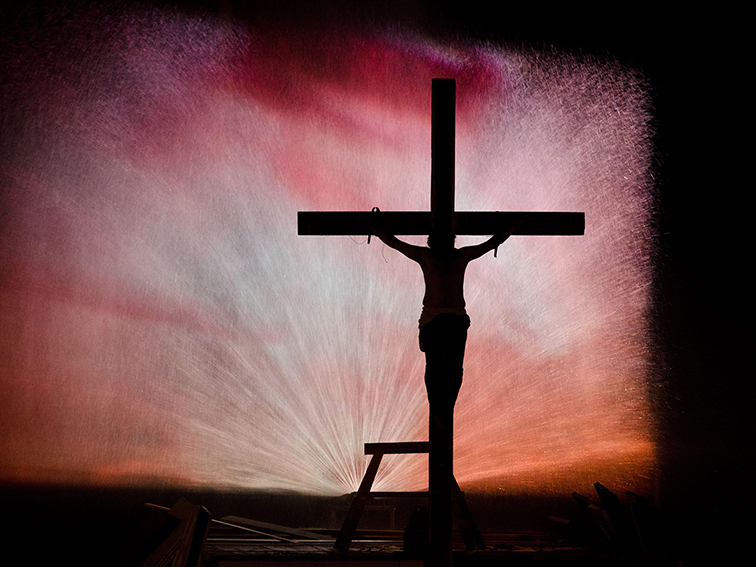
Cross-genre: Michael Sheen in National Theatre Wales’s The Passion, staged in Port Talbot, April 2011. Photo by Donald Cooper / Alamy
Communion, Jon Doyle’s novel (a debut like Sy-Quia’s) takes this in a different and more disturbing direction – which makes it, in my judgement, the most simply impressive of these three accounts. It comes from a deep immersion in the specifics of a locality and of a moment in time while framing more universal moral and spiritual questions. The time and place are Port Talbot in South Wales at the time of Michael Sheen’s revolutionary exercise in community theatre in 2011, when he directed and acted in a three-day Passion play in the streets of the town over an Easter weekend, drawing in local people as actors.
In the novel, Doyle juxtaposes this with a critical decision affecting the local steelworks and the debates over industrial action that this provokes. As in the script of Sheen’s drama, the massive shadow of a major multinational industry hangs over the narrative. This is an industry in which decisions are made at an inaccessible distance from the lives of workers and the human and environmental cost is airbrushed in the name of power and profit. Some of the steelworkers have convinced themselves that the days of retrenchment for old-style heavy industry are over (they might well be Trump voters in another context today). Insofar as they understand the Passion story they are involved in dramatising, it is as a version of their own sense of oppression and powerlessness. The forces crucifying Jesus are the forces that threaten their own lives; Sheen’s drama is – it seems – on their side.
But there is more going on, and it pushes the narrative firmly towards the tragic. Doyle’s central figure is not a priest but a young man, Cormac (Mac) who has left the seminary, told by the authorities that he is too idealistic for the priesthood. He now works as a security guard at the steelworks, not very satisfactorily reabsorbed into the world of his father and his father’s workmates, still deeply but confusedly engaged with faith, not knowing where this leaves him in regard to both church and world.
In his last days at the seminary, he has done something spectacularly irregular: he has been visited by Siwan, a young woman he knew when they were children, who asks him to hear her confession. Although this is prohibited for an unordained person, he responds to her urgent request and her plea that he treat it as completely confidential in the way a priest would have to.
What exactly she confesses we are never told in plain terms. But as the novel unfolds, we begin to see that it involves an act of reckless, catastrophic witness, rooted in the young woman’s passionate environmental ethic. Mac is forced to be complicit in this, without at first grasping its full proportions, and we watch him struggling with increasing mental anguish as he realises what is in prospect. He remains faithful to the ordination vow he has never taken, preserving Siwan’s confidence right up to the threshold of an apocalyptic conclusion, at which we are left as the book ends.
Mac is pushed into a commitment he has not consciously made and constrained by a loyalty to someone else’s (dangerous) integrity that he has never explicitly chosen for himself. His turmoil is vividly and movingly drawn. As the Passion play unfolds around him, he is like the bewildered disciples in the original story, wondering exactly what their association with a revolutionary teacher is going to cost; whether and how they will be caught up in the all-consuming price this teacher is determined to pay.
Doyle, in other words, invites us to connect his narrative with the gospel story itself. That is a story (among other things) about the tension between, on the one hand, an imperative vision involving a huge sacrifice but promising equally immense levels of healing or freedom, and on the other the fragile human egos that are drawn to this while being terrified of its implications. The gospels have occasionally been compared to novels, precisely because of their repeated evoking of this tension by way of dialogue, irony and complex interactions.
Mark’s gospel, in particular, portrays Jesus as almost despairing of communicating to his disciples why he has to take the tragic risks he takes. Yet the whole logic of who he is and what he must do entails sharing, at personal cost, his vision and working with others; it cannot be just a solitary heroic act that changes nothing in how humans see and relate to one another. From the very first, Mark seems to suggest, the community gathering around Jesus, while frail, must be held to its task by the abiding agency of the one who calls it together. Jesus never allows the community to forget what it has been given to say and do. The truth must be said and acted out, yet the fear of this will always weigh heavily on human beings. Someone, some group, has to take responsibility for keeping the memory alive across the generations – failing, confused, anxious witnesses, no doubt, but necessary presences.
It means the lines between failure, suicidal recklessness and exemplary fidelity are pretty shaky. Doyle offers a story with something of the same unsettling challenge as the Passion narrative itself, leaving us to think through what kinds of loyalty matter most, where heroism ends and folly begins. But ultimately, what all these fictions – and so many other novelistic explorations of clerical identity – place on the agenda is this: what if there were a place to stand beyond the realm of majority opinion, institutional compliance, the conventions that make someone popular? And what if that place were not a place of privileged freedom to ignore and demean the reality of others in the name of unchallengeable power, sanctioned by the divine, but a place of both absurdity and extreme jeopardy? What if this were the place whose existence was testified to by the life of the priest, pastor, rabbi, whatever – even when these people so regularly themselves failed to occupy that place convincingly? Is this what makes fiction about the clergy – behaving or misbehaving – still a compelling way of asking where freedom really lies and how it works in a culture ever more in love with simple, authoritarian answers?
Rowan Williams was the archbishop of Canterbury between 2002 and 2012, and now lives in Cardiff
My Lover, the Rabbi
Wayne Koestenbaum
Granta, 363pp, £14.99
A Private Man
Stephanie Sy-Quia
Pan Macmillan, 288pp, £16.99
Communion
Jon Doyle
Atlantic,288pp, £17.99
Purchasing a book may earn the NS a commission from Bookshop.org, who support independent bookshops
[Further reading: How the far right co-opted the cross]
Content from our partners



Related


This article appears in the 25 Mar 2026 issue of the New Statesman, Easter Special
Join the debate
Subscribe here to comment