
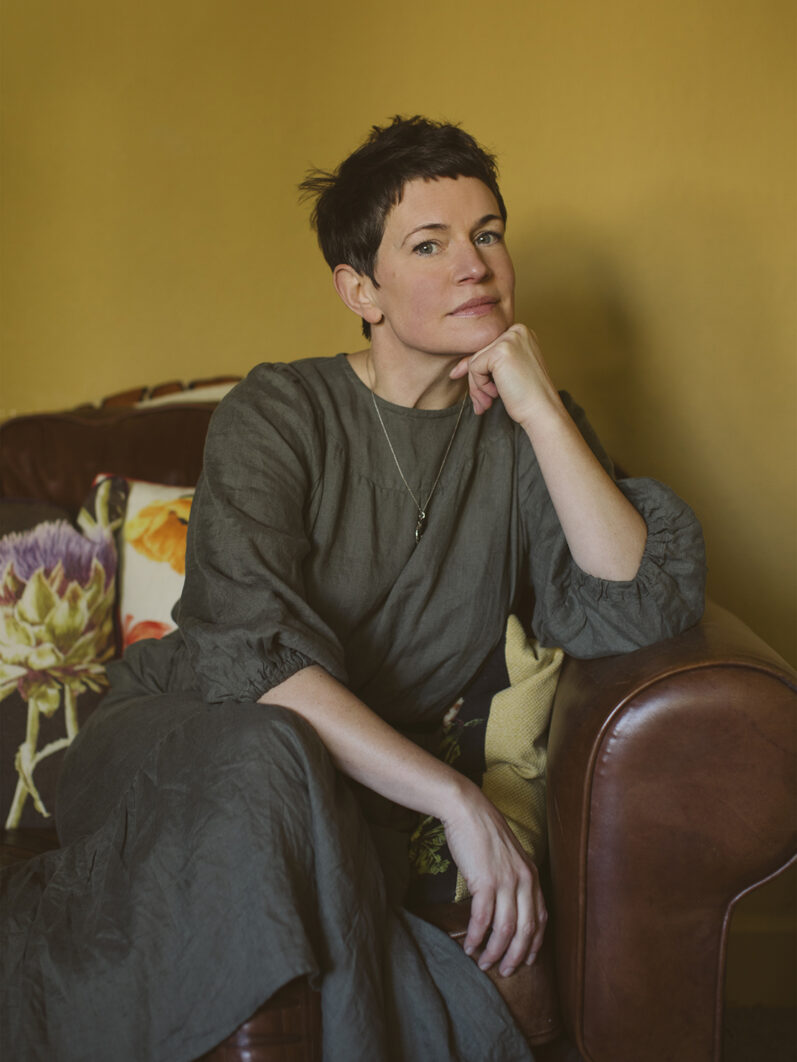
Sarah Hall is the unofficial novelist laureate of Cumbria. Born in Carlisle in 1974 and still resident in her native county, Hall has published around a dozen books of fiction, whose presiding preoccupation appear to be the northern landscape that has surrounded her for most of her life.
Her novels include Haweswater (her debut from 2002), The Carhullan Army (winner of the John Llewellyn Rhys Prize in 2007), Burntcoat (2021), and Helm, this year shortlisted for the Goldsmiths Prize – titles that are indicatively replete with proper nouns placing Hall’s writing in a very distinct region of Britain.
Helm is named after Britain’s only named wind, which is local to Cumbria’s Eden Valley and, unusually, is anthropomorphised as the book’s main character. The novel is composed of eight narratives about the way this elemental life-force has shaped the lives of people in the region across millennia, including a Neolithic tribe, a Dark Age wizard and a Victorian engineer. Together, these stories constitute a deep, imaginative history of the relationship between nature and culture, but also a kind of weathervane for the ways in which climate change will continue to remake societies. The novelist Mark Haddon, a judge for this year’s prize, has described Helm, fittingly, as an “absolute tour de force.”
The New Statesman caught up with Hall over email.

Tanjil Rashid: Helm, the title of your novel and the name of its main character, is Britain’s only named wind. Where did the idea to personify a wind come from?
Sarah Hall: Being in nature so much as a kid helped; I didn’t feel separate from the environment. The natural entities in my locale – whether they were waterfalls, rivers, mountains or trees – had very particular features and they were just part of a community that included animals, humans, and the elements. The starting place for writing a book about a wind probably isn’t that odd when you’ve grown up surrounded by environmental “characters”. Adding personality to reflect the essence of a phenomena is just the next step.
This is the kind of move found in magic realist novels written in tropical climates like Latin America and South Asia. But Helm is a Cumbrian character. How did you conceive of introducing fantastical and mythical elements to a story about the Cumbrian landscape?
British folk art and folk tales have similar tendencies, though perhaps the class and cultural judgement system in the UK has suppressed this fantastic, colourful heritage. Cumbria is full of myth and legend, magic and lore; I think that remains quite active in the imagination and history of the region, and the spectacular landscape certainly seems like a stage for wonder and marvellous reality. But yes, having written so many short stories, I’ve definitely been influenced by places where that form is revered rather than demoted, where it is vivid, fantastical, proletarian and brilliantly disobedient – Latin America, Ireland, Turkey, Russia…
To what extent have you been shaped by Cumbria, where you were born, still live and teach, and to which you have consistently returned in your fiction?
To the extent that it’s almost impossible for me to answer this really – I think my writing probably answers it best. Saturation. Intrigue. Chemistry. Like a lot of Cumbrians, I have roamed quite far away, lived abroad, become interested in other cultures, and come home with new eyes. A love of the land and a desire to be able to recreate the north sensually on the page has, I hope, allowed me to be curious about and pay attention to an array of other settings in my work – Finland, Mozambique, South Africa, Brooklyn, Norfolk, Antalya, Japan.
Your work seems to my mind a strange combination of being deeply rooted in a particular English landscape but also deeply cosmopolitan and international in its apparent formal influences.
Why a strange combination? The north of England is and has been cosmopolitan and international. Think how many multi-national Romans were stationed up here on the Wall!
The notion of a great town/countryside divide in this country hasn’t helped in terms of how we imagine rural life to be – naive, impoverished, inward-looking, not progressive, not diverse, culturally bereft. This just isn’t true, especially if we think in terms of the radical social legacy of Romanticism, and contemporary artisan craftwork.
The Goldsmiths Prize was set up to reward fiction that “breaks the mould or extends the possibilities of the novel form”. What can an “innovative” approach offer the reader (and writer) that a more conventional novel might not?
We don’t all think and sound the same and if novels become orthodox in style and content, who are they for and what do they represent? With any art form, if ABC is expected from it, how can it surprise, challenge, develop cultures, reflect and revolutionise the way we see the world? The world is also XYZ, WPB, OVR, etc, endless combinations. Often when I’ve been teaching creative writing, especially with kids who think or have been told they aren’t good at English Literature, I’ll give them some kind of anti-fiction, something playful or tricksy that surprises them. It’s all about undoing what you think literature is or can’t be.
Amitav Ghosh has argued that the realist novel is not fit to rise to the challenge of writing about climate change, because it is concerned with a fairly stable reality where drastic changes do not occur. Do you think the surreal, the magical, the absurd and the fantastical are styles of writing that can better rise to that challenge?
I disagree with this assertion, but it depends how you define realist. I don’t see it being at odds with creative and political challenges – it’s a very valuable tool in the writer’s kit. If the first job of fiction is to suspend disbelief and if a world or characters depicted don’t seem credible, how will the reader be immersed and keep reading? Catastrophe has to convince on the page. There is a fundamental physical reality to the drastic environmental changes occurring, and if a novel can convey how those changes might look and feel, if the reader can be embodied in a character experiencing it all, so much the better.
Along with many people in Carlisle, I was extremely badly flooded in 2005 – water two-thirds of the way up the ground floor. And when I say water, I mean mud, silt, sewage; the city was in blackout, with helicopters rescuing people off roofs. That experience directly led to me to write The Carhullan Army, with its flood zones, raised temperatures, and collapsed governmental systems. I wanted readers to truly experience the dystopia and think hard about the future. That’s about very careful word choice, content, mood, atmosphere, creating a virtual word that seems true – realism.
Would you say you have broken with the conventions of realism?
I haven’t really broken with realism. Helm functions as an amalgamation of realist fiction, folk fiction, and anti-fiction. The stories are told realistically – at least I hope the reader believes they are in a neolithic settlement or wilderness glade, or a Dark Ages village, or on a Victorian train. There is an impossible Puckish elemental narrator, but the language it uses to communicate has to be understood. The book has a kind of storm structure, a chaos of chapters, which was a decision that seems to break traditional form. But within, there’s a pattern, chronology, and architecture for the reader to orient themselves. It’s a balancing act of established tactic and naughtiness.
Tell me about a piece of art, literature or music that was important to you when writing this book.
Oh, the book took so long to write that there were multiple influences along the way. Major and minor and quite a lot now forgotten.
Why do we need the Goldsmiths Prize?
It’s wonderful for writers to feel there is value in being unboundaried, adaptive or evolutionary – at any stage of their career. I think it’s easy to forget otherwise what a flexible form the novel can and should be. I’ve been writing for 25 years and it took until book ten to feel I could try some funky moves on the floor. That is quite terrifying and isolating, but to look up and see that Goldsmiths is your dance partner, well, thank you!
What past British or Irish novel deserves a retrospective Goldsmiths Prize? Why?
Maybe James Kelman for The Busconductor Hines, after which so many contemporary writers gained confidence to write using the demotic, and reverse hierarchies, and inhabit consciousnesses, and give voice to new sections of the population. Or Alasdair Grey. He made just extraordinary stuff.
[Further reading: The prophecies of Paul Kingsnorth]
Content from our partners



Related


Join the debate
Subscribe here to comment