
In 1907, Maurice Leblanc released a collection of short stories called The Extraordinary Adventures of Arsène Lupin, Gentleman Burglar. It focused on the adventures of Lupin, a thief with a good heart – the Rive Gauche equivalent of EW Hornung’s Raffles. Both Lupin and Raffles stole property but didn’t hurt people, unless it was to speed well-heeled malefactors towards a reckoning with justice.
One of the stories in Leblanc’s book was “The Queen’s Necklace”, centred on the real jewels made for Louis XV’s mistress, Madame du Barry, that were later the key prop in a celebrated scandal, the “Affair of the Diamond Necklace”, which implicated, erroneously, Queen Marie Antoinette. The furore inflamed public opinion against her in the years immediately before the French Revolution.
Leblanc’s tale was the inspiration for the Netflix series Lupin. In the first episode, the hero, played by Omar Sy, sets out to clear his unjustly disgraced father’s name and revenge himself on the family that framed him. To do this, he works as a cleaner to scope out the Louvre, and on a gala night in the museum steals a royal necklace once owned by Marie Antoinette. The theft, enacted under the noses of a crowd, involves sleight of hand, strong nerves and quick thinking.
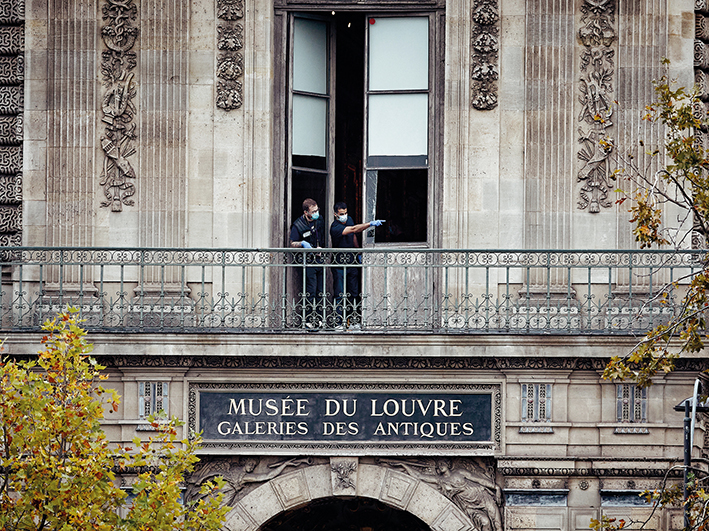
Strong nerves were in evidence at the real-life theft of historic jewellery from the Louvre on 19 October when a group of four thieves posing as workmen parked a lorry mounted with a cherry-picker ladder against the Seine-side façade of the museum where restoration work is being carried out. This side of the building has history: it was from here, during the St Bartholomew’s Day Massacre of 1572, that the king, Charles IX, leaned out of the Louvre’s windows to shoot at wounded Protestants who “tarried in their drowning”, having been thrown into the Seine by rampaging Catholics. He was, as one contemporary put it, “not a good king, but a good marksman”. The range is now home to the Galerie d’Apollon, the Louvre’s grandest gallery – gilded and frescoed with a ceiling painting by Eugène Delacroix, Apollo Slays the Python, at its centre – and home to the remaining French crown jewels.

At 9.30 in the morning, three of the thieves climbed to the first floor and forced the end window, then threatened the security guards before using an angle grinder to break into display cabinets and taking various pieces of jewellery. Empress Eugénie’s crown (which comprises more than 1,300 diamonds and 56 emeralds, and sold for $13.5m in 1988) was dropped during the escape. The thieves climbed back down and, having failed to set fire to their lorry, disappeared on scooters. The whole incident took seven minutes.
Among the stolen items are an emerald necklace and a pair of emerald earrings that belonged to Napoleon I’s second wife, Empress Marie Louise; a tiara and brooch belonging to Empress Eugénie de Montijo, wife of Napoleon III; and a tiara, necklace and earring from the sapphire set that belonged to the last queen of France, Marie-Amélie, wife of Louis Philippe I.
The jewels are pretty much unsellable in their current form, their most likely fate being the removal of the gemstones for individual dispersal and the melting down of the gold. The gemstones are 18th- and 19th-century cuts, which makes them both suspicious and worth less than stones with a modern provenance. Their best hope for remaining intact is as bargaining chips for ransom or insurance money, or as collateral between crime networks.
The idea of a Thomas Crown Affair collector having works stolen to order is the stuff of fiction, although in 2005 a French waiter called Stéphane Breitwieser was convicted of stealing 239 artworks from museums across Europe for his personal collection. His scissors-wielding mother cut up 60 of the paintings, including a Brueghel the Younger and a Watteau, in an attempt to destroy evidence. As each day passes, the probability is that the Louvre jewels, a slice of France’s history, are likewise in the process of being destroyed.
“What is certain is that we have failed, since people were able to park a furniture hoist in the middle of Paris, get people up it in several minutes to grab priceless jewels and give France a terrible image,” said the justice minister, Gérald Darmanin. He has a point.
This is not the first theft at the Louvre – museums are, after all, inherently vulnerable institutions. The most recent was in 1998 when a painting by Jean-Baptiste-Camille Corot, Le chemin de Sèvres, was stolen: it has never been retrieved. The most famous, however, was in 1911 when an Italian named Vincenzo Peruggia, who had worked at the Louvre as a glazier, took Leonardo da Vinci’s Mona Lisa off the wall, removed its frame, wrapped the painting in his workman’s smock and walked out of the building. The director of the museum thought the theft was impossible: “Steal the Mona Lisa? That would be like thinking that someone could steal the towers of Notre Dame cathedral.” Suspects included, for some reason, JP Morgan and Kaiser Wilhelm, and among those questioned about the crime were Pablo Picasso, the poet Guillaume Apollinaire, and the passengers of an ocean liner that was about to head to sea.
Peruggia himself was eventually interrogated. But although he had twice bailed on appointments to present himself at the police station, had left a fingerprint on the painting’s protective glass, and had his apartment – where the Mona Lisa was hidden – searched, he was dismissed as a suspect. After two years, he returned to Italy with the painting and was only unmasked when he contacted a gallery owner in Florence in the hope of a reward for returning a piece of Italy’s cultural heritage. The painting, Peruggia said, was stolen from Italy by Napoleon (it wasn’t; it was taken to France by Leonardo himself, although it did once hang in Napoleon’s bedroom). Peruggia was sentenced to a year and 15 days in prison but, acclaimed as a patriot, served just seven months.
It was the theft, however, with its newspaper reports and photographs, that turned the Mona Lisa into a celebrity, so much so that crowds gathered at railway stations along the route as the train returning her to Paris rolled through.
The Louvre affair is just the latest museum burglary. One of the more celebrated examples is the 2019 robbery at the Grünes Gewölbe (Green Vault) Museum in Dresden Castle in Germany, where four thieves with axes broke in and made off with 18th-century jewellery sets worth €113m. In 1990, 13 paintings – including works by Vermeer, Manet and Rembrandt – were stolen from the Isabella Stewart Gardener Museum in Boston and none has been seen since, despite a $10m reward being offered. In Norway, Edvard Munch’s The Scream has been taken twice, in 1994 and 2004. That is nothing compared to Rembrandt’s Portrait of Jacob de Gheyn III, stolen four times from Dulwich Picture Gallery, earning it the sobriquet the “takeaway Rembrandt”. And in 2017, in a scene of near comedy, a 100kg, 24-carat gold coin was stolen from Berlin’s Bode Museum. The coin, a specially-minted Canadian “Big Maple Leaf” – a gold version of the novelty cheques used for charity photo opportunities – was so heavy the thieves had to trundle it through the museum in a wheelbarrow.
Whatever the outcome, there’s an opportunity here for the Louvre. When the Mona Lisa was taken, more visitors came to stare at the gap on the wall bearing the painting’s ghostly outline than had ever gathered when it had hung there. If today’s museum director, Laurence des Cars, leaves the smashed vitrines just as the thieves abandoned them, visitors will come flocking.
[Further reading: The right doesn’t get Banksy]
Content from our partners



Related


This article appears in the 23 Oct 2025 issue of the New Statesman, Doom Loop
Join the debate
Subscribe here to comment