
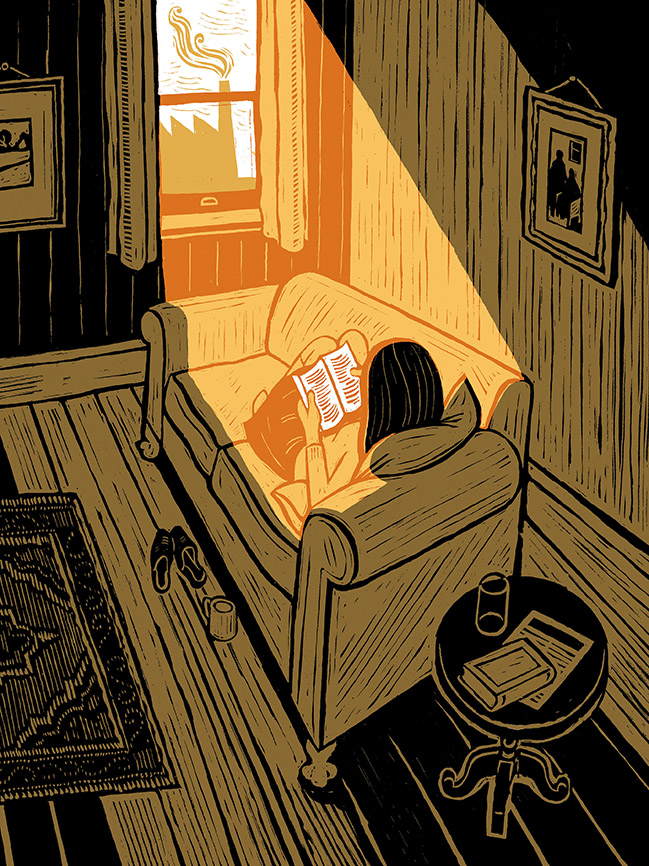
My mother, born Kathleen Marie Bloor, was a clever child, and all her life she valued intelligence and good grades. They were the ladder by which one climbed out of the back streets of a small coal-mining town, out of terraced homes with outdoor lavatories, and away from air that was perpetually polluted. She was a textbook illustration of the thesis expounded, I think, by either Raymond Williams or Richard Hoggart. It describes the way in which working-class families improved their lives through books, reading, public libraries, enlightened education authorities; not through a wider culture, but through the word. (Annoyingly, I can’t find my precise source, though I’ve read and reread several books in search of it. Maybe I made it up.)
Although she would have considered herself a cultured woman, Cambridge-educated and the first of her family to go to university, she cared little for theatre, art or music. To her, the word was all. She claimed that Iris Murdoch’s 1975 novel A Word Child could have been written with her in mind. She often told us that as a child she would seize upon anything that was printed – advertisements, instructions on bottles and medicines, lists, timetables. This is not an uncommon trait, and many have written about it. I inherited it, and am unhappy and anxious if I find myself stranded even for five minutes at a bus stop without a book or a newspaper. The Kindle has been a great comfort to me and I nurture its battery as though it were a small bird. Like my mother, I was attracted as a child by long and not very meaningful words. I remember memorising the word “paradichlorobenzene”, an ingredient of mothballs, in our bathroom in Sheffield, and repeating it to myself as a mantra. As a charm against ignorance, perhaps. My mother despised ignorance.
I reread A Word Child in search of my mother. It is a darkly hilarious novel, and it’s the opening sections with which my mother must have identified. The protagonist, Hilary, escapes an abusive and orphaned working-class childhood in an unnamed northern town through the attention of a teacher, Mr Osmand, and by his own discovery of language and grammar. “Mr Osmand believed in competition. It was necessary to excel. He loved and cherished the examination system… Grammar books were my books of prayer. Looking up words in the dictionary was for me an image of goodness… I was not a philological prodigy… I was just a brilliant plodder with an aptitude for grammar and an adoration of words.”
This aptitude gets Hilary into Oxford, having come from a school from which no child had ever been further afield than a northern polytechnic. Similarly, aptitude got both my mother and my father to Cambridge, with the help not of a Mr Osmand but of a Miss Crowther, of whom both my parents spoke with deep respect. Hoggart’s phrase for the working-class child expected to do well is “trained like a circus-horse for scholarship winning” – not a racehorse, but a circus-horse. In his autobiography, The Boy Who Loved Books, the academic John Sutherland titled a chapter “The Family Racehorse” in allusion to the pressure put upon him by his mother to do well at the eleven-plus. While still the leader of the opposition, Keir Starmer said on television that the only thing his father ever praised him for was passing the eleven-plus. The pressure on my mother came not from her parents, but from the school and from herself.

I don’t know what my mother made of the rest of the goings-on in Murdoch’s novel, which characteristically embrace sudden deaths, passions, adultery, fornication and infidelity, as well as some memorably horrible meals. My mother’s life was extremely proper in comparison with Murdoch’s: she married her childhood sweetheart and remained faithful, though not always friendly, to him for her entire life. But she would not have been shocked by Murdoch. She was a liberal reader, and in no way prudish: she had a matter-of-fact, 1930s, common-sense attitude to sexual matters. I gave her copies of Robert Nye’s Falstaff (1976) and DM Thomas’s The White Hotel (1981), both sexually explicit novels that she read with interest. In fact, I think she might have liked to discuss them with me in more depth than I wanted. I wanted her to read them, but I didn’t really want to talk about them, or not to her.
Hilary’s nameless hometown might have been rather like my mother’s Mexborough, which was once described by the historian Nikolaus Pevsner as “a small colliery town”. It was working class then and is now suffering from post-industrial blight and the long fallout from the miners’ strike. My mother did not like Mexborough, and after her parents bravely moved in the 1930s to run a B&B on the Great North Road in rural Nottinghamshire, she never went back. I don’t think I ever visited it during her lifetime.
But she had good memories of Mexborough School, where she met my father, and both my parents owed a great deal to the enlightened West Riding County Council “whose schools and libraries”, according to a letter in May 2020 to the Times Literary Supplement, “were the envy of the land”. My parents were born the same year and in the same class, and my mother’s grades slightly outclassed his, though both achieved consistently good marks. They played Helena and Lysander in the school production of A Midsummer Night’s Dream. My father was from the neighbouring Conisbrough, a small town on the River Don. It had more aristocratic associations than Mexborough, thanks largely to its outstanding feature: its famous white castle that was built in the 11th century. It features romantically in Walter Scott’s Ivanhoe, set in the time of Richard the Lionheart, although South Yorkshire was still a pastoral landscape when Scott was writing the novel.
I did, I think, go to Conisbrough once, as a child during or just after the war. I have a dim memory of my grandfather’s small factory (in my recollection, little more than a large shed) where the locally famous Drabble’s Sweets were manufactured, but of the castle I remember nothing at all. The shed also had some connection with brightly coloured wooden spinning-tops – were these an advertising gimmick, a giveaway gift? And can I be right in remembering strips of white and brown sugary stuff being whipped around and twisted to make humbugs? My grandfather, Joseph Drabble, died in February 1945, and, according to the South Yorkshire Times, my parents, “squad leader and Mrs JF Drabble” (sic), attended the funeral at Conisbrough Baptist Chapel.
I feel a sentimental attachment now to these small towns and this abandoned and neglected landscape, an affection that was shared by my aunt, who, unlike my mother, never rejected them and never struggled to get away from her origins. I visited Mexborough with her after my mother’s death, and we had a nice lunch in a modest little café above a shoe shop, which she seemed to know well and where she was at home.
I was moved, a year or two later, when I was invited to speak at Mexborough Grammar School’s speech day, a school that had been attended, long after my parents, by Ted Hughes. It might have been on this occasion that I was presented with a fine heraldic biscuit-coloured jug bearing a coat of arms that read “Honi soit qui mal y pense” (“Evil to him who evil thinks”). I treasured this object then, and treasure it still, though somebody knocked its handle off. I don’t think it was me, but it might have been. It now stands in the kitchen and holds celery and spring onions.
This is an extract from “The Great Good Places” (Canongate), a new collection of fiction and memoir by Margaret Drabble. She will be speaking at the Cambridge Literary Festival on 23 April
[Further reading: What it’s like to be played by Claire Foy]
Content from our partners



Related


This article appears in the 25 Mar 2026 issue of the New Statesman, Easter Special
Join the debate
Subscribe here to comment