
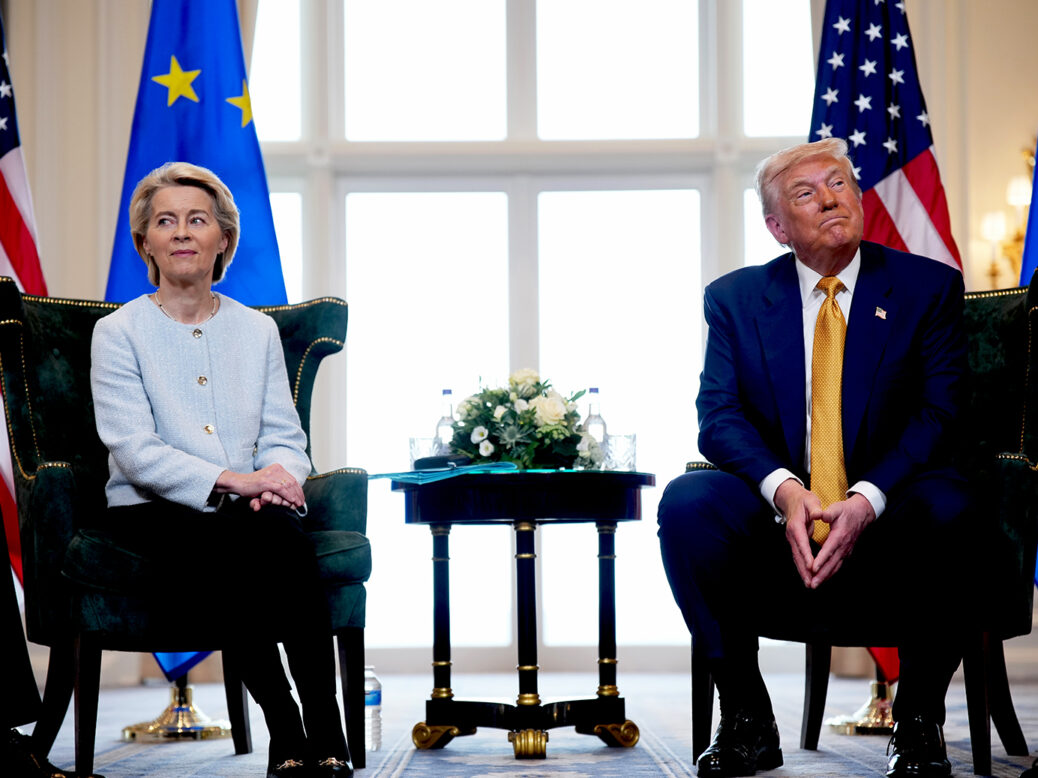
The French prime minister François Bayrou said it was a “dark day” for Europe. Under the trade deal that Donald Trump and European Commission president Ursula von der Leyen announced in Scotland on 26 July, the US would impose a 15 per cent tariff on most European imports, but the European Union would not increase tariffs on American imports in return. According to Bayrou, “an alliance of free peoples” had “resolved to submission”.
It was definitely a climbdown for the EU. Ever since Trump was re-elected last year and threatened new tariffs on imports to the US, the European Commission had threatened counter-measures – just as it did during the first Trump administration, when it responded to US tariffs on European aluminium and steel with its own tariffs on American products like bourbon. In the end, though, the EU simply accepted the new US tariffs this time – and on top of that, promised to increase purchases of American liquified natural gas and weapons.
To be clear, what was agreed in Scotland is a political or “framework” deal and a lot of the important details have yet to be worked out. In particular, it is not yet clear whether pharmaceuticals – a hugely important sector for the EU and especially Germany – will be included or how much steel will be exempt from tariffs. Moreover, the promises that von der Leyen made to increase investment in the US have already turned out to be empty – there is no way the EU can buy $750bn of American oil and gas in the next few years and it cannot direct companies to invest in the United States.
Nevertheless, in the few days since the deal was announced, it has widely been seen as a humiliating European capitulation to Trump. Many critics of deal – especially EU boosters who fantasise about the idea of “strategic autonomy” or a “geopolitical Europe” – seem to imagine that the EU could have followed an alternative approach and stood up to Trump. In reality, though, there was little alternative to what Bayrou called “submission”.

Critics of the deal think EU member states undermined von der Leyen and forced her to negotiate from a position of weakness. It is true that some member states, especially Germany and Italy, ultimately backed off from threats of retaliatory measures because they feared that a full-on transatlantic trade war would ultimately hit important sectors of their economies harder than they are now being hit by the new US tariffs. But the idea that the EU had leverage over the US that it had but did not use – and that if it had used it, it could have struck a much better deal – is wishful thinking.
As the world’s largest trading bloc, the EU has long thought of itself as an economic superpower and prided itself on its ability to negotiate trade deals – that, of course, was one of main arguments why the UK should remain within in the EU. This deal has somewhat undermined that self-image. After all, in May, the UK was able to negotiate a slightly better deal with the Trump administration, with a baseline tariff of 10 per cent. But what really makes the EU weak relative to the US is its vulnerability in security terms.
The idea that the EU had leverage over the US that it did not use only makes sense if you think that economics and security are completely separate realms and that security issues are irrelevant to trade negotiations and cannot be linked. But deep down, despite all the tough talk and the threats of retaliation to Trump’s tariffs, European politicians knew that taking such a confrontational approach could have consequences for US support for Ukraine – or even for Nato and the US security guarantee to Europe itself.
It’s striking that this trade deal was being negotiated just as Trump seemed to be becoming increasingly frustrated with Vladimir Putin and more supportive of Ukraine. Earlier in July, Trump had reinstated supplies of US weapons to Ukraine – albeit paid for by Europeans – and threatened new economic sanctions against Russia if Putin did not make progress in negotiations within 50 days. (The day after the EU-US trade deal was announced, Trump said he was now giving Putin even less time.)
As tentative as European leaders know Trump’s shift on Ukraine is, they do not want to jeopardise it. EU trade commissioner Maroš Šefčovič, who apparently spent hundreds of hours in frustrating negotiations with Trump administration officials, hinted at this in a briefing the morning after the announcement of the deal. He said he could not go into the details of everything that was discussed with Trump in Scotland, but “it was not just about trade”.
In the end, what has made the EU so dependent on the US, and made the EU’s “submission” inevitable, is the war in Ukraine – or, to be more precise, the way that, for the last three and half years since the Russian invasion in 2022, European leaders have insisted that their own security depends on a Ukrainian victory.
Content from our partners


Related

Join the debate
Subscribe here to comment