
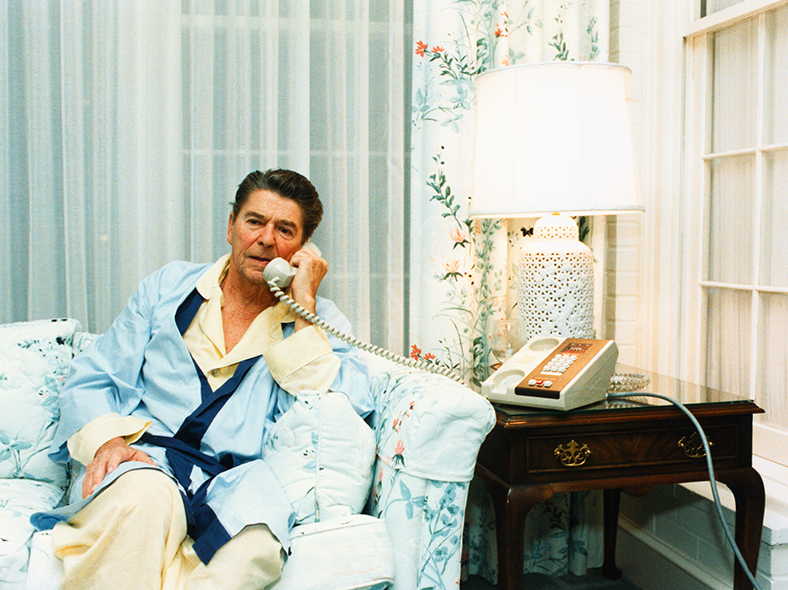
In October 1983, Grenada’s prime minister Maurice Bishop was overthrown and executed by hard-line Marxists. Ronald Reagan invaded the Commonwealth island to depose the military council led by General Hudson Austin. The slight notice given to Margaret Thatcher was considered a significant snub. Correspondent Peter Pringle reflected on the chaos.
It boggles the mind to learn, in this age of satellites and microwave communications, that the Foreign Office’s outpost in Grenada does not even own a telex machine. But so it was, when Whitehall wanted to send word of the US invasion to our man in Grenada, John Kelly, that the coded message – a jumble of letters, figures, question and exclamation marks – came clattering over the telex of the office above him: an office run by the Organization of American States.
I mention this not to suggest any security breach – Mr Kelly was the only one with access to the relevant codebook – but as a symbol of the pathetic nature of the Foreign Office’s (and therefore Mrs Thatcher’s) concern about events in Grenada prior to the invasion. The really depressing aspect of this lack of concern is that it is as widespread in the Caribbean and Central America as revolutions and coups d’etat. In its desperation about Grenada, the Organization of Eastern Caribbean States (OECS) was forced to turn to the US. For the moment, the US is, as one diplomat put it, “the big good wolf”.
This definition might be a bit ambivalent for the Americans, who are so obsessed with being liked – especially in countries they have just invaded – that the CBS television company conducted a popularity poll in Grenada ten days after the Marines attacked. Not surprisingly, in the atmosphere of fear and confusion following the invasion, 91 per cent said that they were glad to see the Americans.

Grenadians also readily complained about the Cubans (they didn’t speak our language and they fucked our goats) and communism (we didn’t like having to attend all those classes on Marx and Lenin) and the thugs who murdered Bishop. For Bishop himself, however, there are few bad words. In part, this is the “one-manism” of West Indian politics. “Look man,” said Peter James, a 22-year-old unemployed clerk, “if you are nice to a Grenadian, he will love you quick, quick, quick. If you yourself would like to be Prime Minister here, you could be if you are nice to us. Ronald Reagan has been nice to us, he could also be Prime Minister”.
But also, after Bishop’s death, many Grenadians feared that General Austin, the ringleader of the violent coup, would kill again. As Peter James put it, “I believe we were going into a gutter without any way out”. To many, Ronald Reagan offered the prospect of jobs and prosperity – even perhaps a visa to America. “But we also know that if the Americans invest $20 million here, they will want $100 million back. The money won’t stay in Grenada”.
There is some confusion here. How does one tally the support and mourning for Bishop with the fulsome welcome for Reagan? Invading armies, we know, are often met by flag-waving crowds, but the Grenadians weren’t waving flags when the Marines came in. Rather, they were obviously stunned by the sheer force of the invasion: 5,000 men (one for every 20 Grenadians); the sky dotted permanently with noisy helicopters and even noisier fighter bombers; the tiny roads clogged with soldiers, jeeps and trucks; the infamous British and Cuban-built 9,000-foot runway at Point Salines cluttered with C-130 transports.
It is perhaps also helpful to see the Grenadians’ enthusiasm in the light of what has been called their “cultural ambidextrousness”. In days gone by, young Grenadians who aspired to enter the European-colonial kingdom often did so by discarding any loyalty to colour, creed or class. As Patrick Emmanuel, a sociologist of the University of the West Indies, observes, “They could portray the culture of the elite or of the mass as the circumstances warranted.” When Grenadians from the emergent middle classes succeeded, as the West Indian political scientist CLR James put it, in “crawling or worming their way into recognition by government or big business”, they quickly found how impotent they were.
But that was before Independence and Grenada’s attempt at a socialist revolution – something of which has remained. Peter James learned to be cynical about the American profit motive and the aims of the invasion during the Bishop years.
Outside the capital St George’s other, less thoughtful, opinions are heard. The Charles family, for example, work the fish-filled waters off the south-western tip of the island. “God bless America,” they cried in unison. “All of them (members of the Bishop and Austin government) was wicked.” Never mind that, for the last four years, Washington has done its damnedest to make sure that a socialist Grenada got no foreign aid at all; or that, when elections are held next year, it may not approve of the new government. It might not be the “suitable” administration that Major Douglas Frey, of the 82nd Airborne, told journalists was what the American troops had come to install.
Actually, the first civilian official to arrive on Grenada to help put the new government together was not American, but British. As I left Grenada a strange figure appeared on the tarmac. He was wearing a pale suit over a blue pinstriped shirt and sporting, in his breast pocket, an overflowing grey silk handkerchief the same colour as his shoes. He introduced himself as Antony Redfern Rushford, recently arrived from London and now appointed legal adviser to the Governor-General of Grenada, Sir Paul Scoon.
“The situation is this,” he began, by way of explaining his presence. “At the top is the Queen – that is, the Queen in her capacity as Queen of Grenada. Below her is Paul Scoon and then,” and he drew a big open box in mid air and punched his fist through it, “there is a big gaping hole. That is where I come in and, if you want any help after hours, I’m not averse to a tipple.”
God help Grenada, I thought, as I walked off the tarmac into the boiling hot belly of the C-130. The British are back.
[Further reading: From the archive: The King’s decision]
Content from our partners



Related
This article appears in the 21 Jan 2026 issue of the New Statesman, Europe is back
Join the debate
Subscribe here to comment