
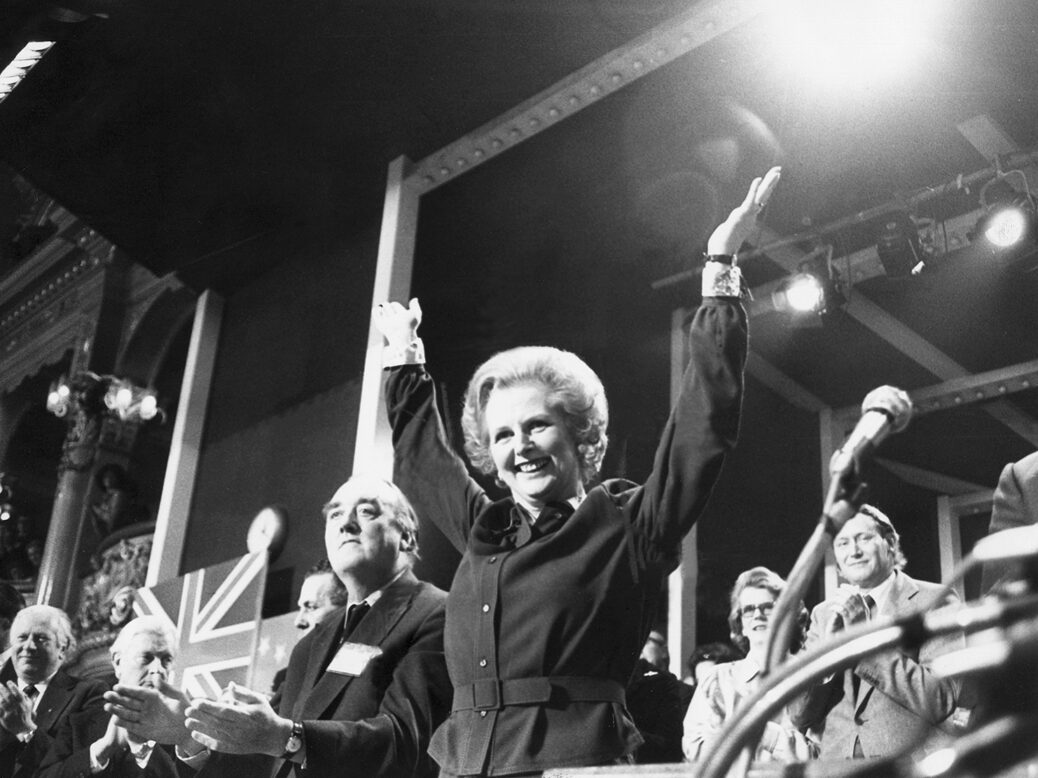
In a perfect Tory world, of course, the pound would now be approaching parity with the US dime, unemployment would be running at 50 per cent, inflation might just have come down to two figures, an ailing David Steel would recently have been awarded the Lenin Peace Prize, and the (official) police strike would be entering its second month. Tragically, though, we do not live in a perfect Tory world. At last year’s conference things looked so promising, with irreparable national collapse just around the corner, that the Tories could say whatever they liked, provided they said it excitedly enough. But now they would have to be careful – what with those depressing trade figures the other day, Labour’s morbidly cordial conference last week, and, here at Blackpool, an oil-rag glinting steadily at the edge of the lumpy brown sea.
Too careful, culpably careful, according to many. On the eve of the conference (it is the Conservatives’ 94th, and my first), I was taken into the sly confidence of three young representatives – one prospective candidate, one NAFF member, and one more straightforward YC. Tirelessly reproducing long losts, analyses and breakdowns, they attempted to show how puny and emasculated the conference was by now certain to be. The two key debates, on industrial relations and race, had already been fixed by the insipid selection of the motions. It was all tailored to maximum non-confrontation, maximum unity; it would be non-divisive, non-ideological. Just wait and see.
But who were these guys – and who were all the pert boys and powdered girls cruising round the Imperial’s drink-logged bars or bobbingly supervising the fringe get-togethers, all smartly dressed, cheerful, serious? I have always thought that the idea of a Young Conservative was, if not a contradiction in terms, then a remarkably unattractive package. When I asked my three confidants if they had ever been even vestigially left wing (the prospective candidate, by the way, looked about six years old), they said that, no, they had always been “sound” – apart from a brief and bashful fling with PEST on the part of the NAFF maverick. These people are not silk-hatted brayers, with the decibel-count of the natural Tory: they are of the petit bourgeoisie; they have cautious, experimental beards, gingery moustaches, bum-fluff sideburns; they have surprisingly uniform off-white accents; they talk with raffish, mischievous condescension (“Got it: Prentice to replace Prior! The man who destroyed our grammar schools is at least sound on the closed shop”); they are wiser and cooler men than the legendary, overblown mock-ups they smilingly serve.
Later that night, in the hotel room of a young and fizzily ambitious MP, I watched Tonight’s feature on the Tories among a dozen voluble junior representatives. (Apparently, the show went out so short and so late because of Transport House, who objected to the one-sided publicity. The BBC originally proposed to make two programmes, one on each; but whereas Central Office was thrown open to the cameras, they were firmly forbidden entry into – guess where? – Transport House.) After the show there was comment and evaluation, most of it satirical, before the company moved on to generalised, journalist-pleasing bitchery. “No way,” said the young MP, no way would Heath ever stand against Thatcher.” He would get 20 votes, of which 1- would be offered merely to save him humiliation. Why? “Because he cannot disguise his contempt for subordinates.” 12 hours later, the young MP was prominently present at an absurd FCS meeting addressed by the ex-PM, hugging himself at the delicious lash of Ted’s clumping ironies. Perhaps Heath has got a lot to be contemptuous about. Anyway, it is hard to imagine a Labour equivalent behaving quite like that.

Tuesday afternoon saw the two crucial “rigged” debates. My young-Tory friends had pointed out that, of the 197 motions received from local associations on the trade unions, 70-odd were about the closed shop, 41 about picketing, 12 about Bullock, 10 on secret ballots, and so on. Most of these, they said, had been quite soundly worded, with hearteningly inflammatory talk of “mob violence” and “bully boys”. And look at the anodyne rubbish selected by the NUC for debate! The list of speakers had been similarly vetted. “If I applied to speak,” said the tot-like prospective candidate, “my application would simply be ripped up”. They promised they would be there to mob Prior the next day, with badges saying GEORGE WARD FOR EMPLOYMENT SECRETARY and other good suggestions.
As it was, the debate got fierier than many expected – more so, assuredly, than a sober reading of those 197 motions would have prepared you for. There is talk of “bully boys” – and of “wreckers”, “infiltration”, “compulsory secret ballot”, etc – but the great majority of the motions are calmly worded, attempts at moral suasion rather than invective. The Tories nevertheless showed their nerves by having Ted Heath (looking like a drastically rejuvenated Angus Wilson) bound popularly on to the stage before curtain-up – a trick they used to work with Sir Alec, as Enoch Powell was the first to note. Introducing the debate, Mrs Rosemary Brown (of the Newham North West CA) certainly made up for any softness in the original wording: her hour come at last, Mrs B spoke of “rent-a-mob”, “power-crazed militants”, “the Siberia of unemployment”, the “tentacles” of union power that “claw into” national life (versatile tentacles, those), ending with a powerful quote from our own Paul Johnson. Various speakers then denounced “reds on the shopfloor”, “communist-inspired takeovers” and whatnot; one MP, mirabile dictu, was so against the closed shop “that it just wasn’t true”. Prior bested this oratory, of course, helped by the providential “Happy Birthday To You” from the YCs and some tolerable anti-Jim jokes. Everyone relaxed. If Prior could just be dull and safe, victory would be his. He was; it was.
The race debate – much less heavily attended – was in fact a good deal more illuminating on Tory tactics for this conference: and provided ample justification for NAFF grouses. The “balloted” motion really was anodyne. 59 motions on the topic were received: nine of them (two from relatively youthful organisations, others from South London constituencies) were sanely worded, while the remaining 50 were monotonously fierce, demanding either immediate and total bans on immigration or severe and immediate restrictions. By comparison, the motion introduced by John Pritchard was cringingly open-ended. (“‘Conference therefore demands…’” – “that’s lefty,” said a NAFF man: “it should say, ‘This Conference’,” “It does,” I said. “Hello, so it does. Ah, but it says ‘Conference’ later on That’s lefty.”) One of the opposing speakers said that he challenged the motion because, “like all the others”, it was designed to “preclude argument” and “suppress discussion”. The chairman loftily reminded him that the motion had been selected by ballot. Did anyone believe it by now? As the plump young reps surged out after the motion had been frictionlessly passed, there was much disgruntled muttering along the lines of “bloody disgrace… never coming again… no bloody point”. The Tories had brought off their responsible, centrist bid, it seemed, but only at the expense of a rather detailed insult to their rank and file.
Sir Keith looks older, handsomer, sadder this year. In a sparse press conference on small businesses he seemed a bemused and uncertain figure, but his speech on free enterprise, with its risky stress on unemployment, went down heartily enough. He has taken on the ascetic, wild-eyed glaze of Tony Benn, someone he is coming more and more to resemble as his party’s only ideologue. Maggie gazes at him with particular motherly care, as if concerned by all the intellectual burdens borne by Little Keith – I mean Sir Little Keith.
[Further reading: From the archive: Alfred, Lord Tennyson – the most Victorian laureate]
Content from our partners


Related
This article appears in the 08 Oct 2025 issue of the New Statesman, The truth about small boats
Join the debate
Subscribe here to comment