
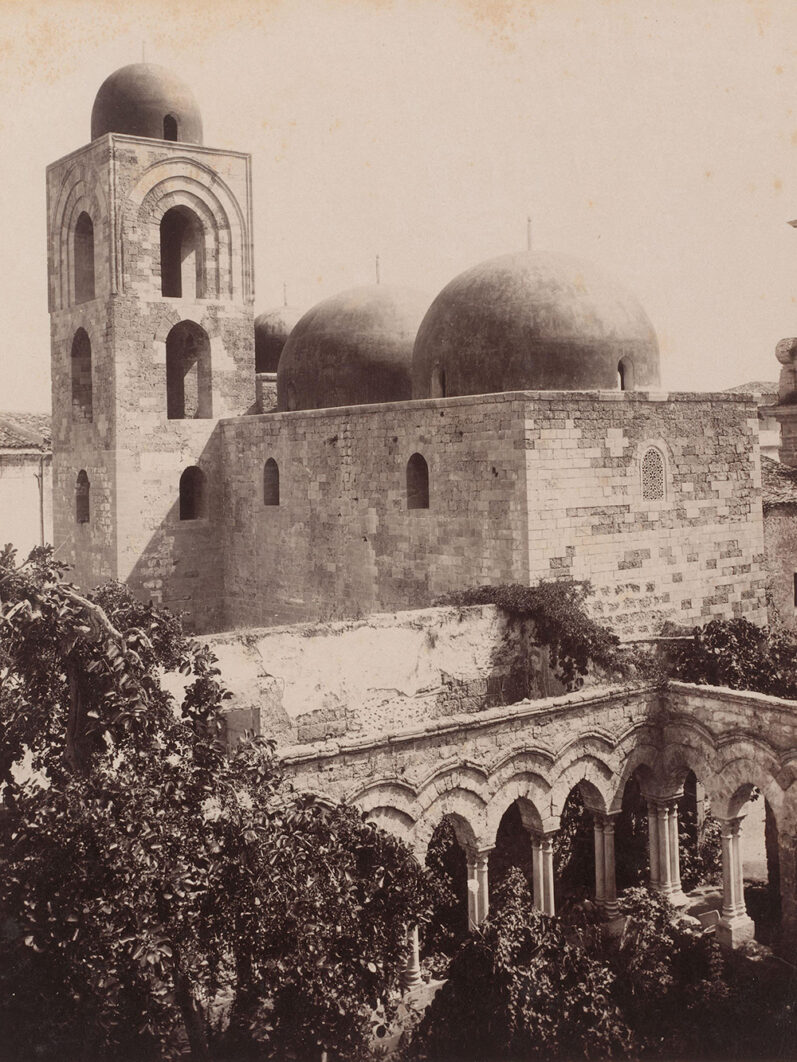
I’m writing this from Palermo. I’ve never realised how many parallel realities Sicily has to offer the UK. Their Norman Conquest came at roughly the same time as ours – Palermo fell in 1072 – but these Normans enthusiastically integrated and merged with the Greeks and Arabs of Sicily and southern Italy, producing a hybrid culture, represented today by cathedrals such as Palermo, Cefalù and Monreale. Much later, having been grabbed and run by almost everybody, Sicily came close to becoming British during the Napoleonic Wars: the military leader and statesman William Bentinck tried to introduce a British-style constitution in 1812 to overthrow the despotic Bourbon rulers. He failed, but it was a close-run thing.
Today’s Palermo is pretty bashed about. The RAF, after raids in the Forties, is partly at fault. But after huge quantities of reconstruction money vanished into the pockets of the Mafia, the postwar housing around the centre looks as bad as anything in provincial Russia. Meanwhile, Sicily has become one of the rare parts of Europe that has assertively welcomed migrants, in part because of its own very ethnically fluid history – Greeks, Moors, Jews, Normans, Germans, Spaniards, and so on. The left glimpses a more benign European future here; the hard right, including on the Italian mainland, sees cultural capitulation to Islam. What would the Normans have done?
Poetry for the (old) ages
Health anxieties – nothing too serious, I hope – have put me back in the hands of the NHS, and I can only marvel at the smooth efficiency of my care. I know many others have had very different experiences but, speaking for myself, it doesn’t feel or look broken. Early old age – what I’d call my condition – comes at a time when most of us live longer and therefore, naturally, poetry covers experiences which, in the past, it knew nothing about. I’ve long enjoyed the late James Michie’s wry lines about the blessings of modern medicine, “The moral of this verse is:/However dire one’s ills,/Be thankful for small nurses/And blue remembered pills.” In the same spirit, can I recommend John Fuller’s new collection, Marston Meadows, which includes an account of a hospital visit. When his heart is connected up to the technology, he finds it “a slobbery devouring in unvisited deeps/or the gulping of the washing machine…” at a time when “the vital muscle has become a grand soloist”. This is a new poetry made possible by technology.
For the love of music
There is a glorious new book by Julia Boyd soon to be published about the history of Wigmore Hall, that temple of music in the heart of London. It includes the early years of people paying to hear music in the capital, from scratch concerts in taverns following the closure of the theatres during the Civil War, to the commissioning of Beethoven’s Ninth Symphony for the Argyll Rooms by Oxford Street. The Wigmore started in 1901 when it was an important part of the commercial campaign by Bechstein pianos.

These were days when almost every home with any pretensions to culture had a piano of some kind. Bechstein was at the top of the tree, only for the wealthy. My London village, Primrose Hill, was then a frantic manufacturing centre for cheap pianos. Consignments of ivory, wire and wood arrived down the Regent’s Canal. The ghosts of the piano factories are all around the area even now. My house once let rooms to a wire-puller from one of them. So perhaps nothing has changed very much.
One of the first stars at Wigmore Hall in Edwardian times was the fabled Catalan cellist Pablo Casals. When he was 80, he married a cellist a mere 60 years younger, Marta Montañez. His friends remonstrated at length about the age gap. Casals replied, “I look at it this way. If she dies, she dies.” They were married, happily or otherwise, until his death at 96.
Walk in the park
Primrose Hill remains oddly favoured by actors and literary types – Alan Bennett and Nick Hytner these days, and blue plaques for Yeats and Sylvia Plath. I’ve always wondered when that started. In her memoir, the former New Statesman staffer Claire Tomalin – who once had a plan to restock the hill with real primroses – explains that in Victorian London, when they weren’t paid much, actors and actresses found they could walk home late after West End shows across Regent’s Park, and began to settle there. Catherine Dickens, after separating from Charles, was one of them. It wasn’t a dangerous walk – unless you count the risk of being savaged by the sheep that were used to keep the grass in the park under control. In Trollope, living “north of the park” is used to denote down-at-heel or improvident characters.
[Further reading: Britain is in denial on defence]
Content from our partners

Related

This article appears in the 18 Feb 2026 issue of the New Statesman, Class warrior
Join the debate
Subscribe here to comment