
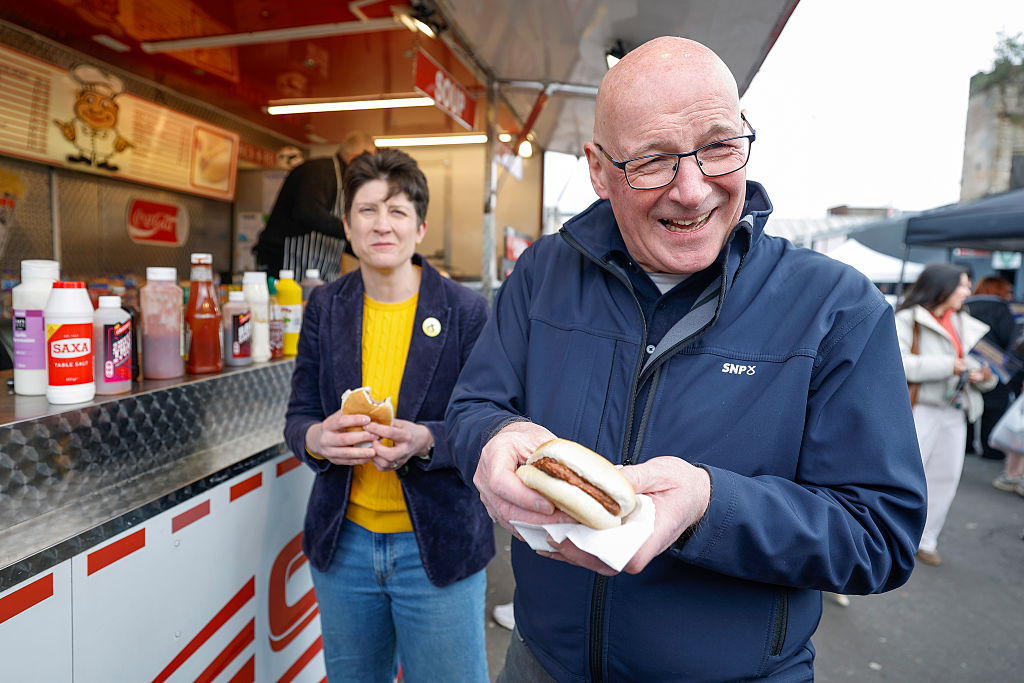
One thing that was clear from the SNP’s manifesto launch yesterday (16 April) was how comfortable John Swinney now is as party leader and First Minister. He has authority and his own particular form of quiet charisma. He is not showy or flamboyant, but there is an impressive calmness to the man that wasn’t always present during his earliest months in the job. He described his leadership as “experienced, steady, practical, hopeful”, and there is something in all of that. As the storms – global, national and local – rage around us, steadiness and practicality can be their own virtues.
This is the week in which the detail of what the parties are promising the electorate was filled in. By the weekend we will have had manifestos from all of them (the Lib Dems go today), and a clearer idea of the differences, and indeed the similarities, between them.
Labour’s offering is relatively subdued, intentionally so due to their belief that voters no longer trust politicians who make extravagant promises about transformational policies. There is lots on the NHS and plenty on the cost of living. It is a busy, detailed, sometimes finnicky document, intent on showing the party has done its preparation and is ready for the hard work of government. Whether it does enough to differentiate the party from the SNP, which also operates on social democratic territory, is a live question.
The Greens came next, with a manifesto that is the most radical of the bunch, as you might expect. A four-day week, free bus travel for everyone, and end to exams in secondary school, the school starting age raised to seven: the party is proposing an almost wholesale recasting of society. It will appeal to the kind of people it will appeal to.

And then the SNP. Swinney promises the pursuit of economic growth will be at the heart of his next government. He outlined plans for a “major projects office”, which would cut through red tape to enable “nationally significant” initiatives to proceed faster. There would also be a “high-growth unit” that would aim to help companies with scale-up potential do just that.
There was plenty on the cost of living too, which along with the NHS has been identified as voters’ main priority in this election. Tax rates and bands would not increase during the next parliament. There would be a £10,000 grant to help first-time house buyers secure a mortgage. An expansion of childcare. Bus fares for journeys within regional boundaries would be capped at £2. Slightly more eccentric: a free schoolbag for every child when they start school, which is of a piece with the SNP’s determination to make Scotland the home of “free stuff” – the bag joins tuition fees, the baby box, eye tests, prescriptions and more as a universal giveaway.
Even more eccentric: a basic income for artists of as much as £15,000. This is based on the Irish model, but leaves me slightly alarmed – artists should be independent and free to think and challenge the state, not a client of it. One needs only look back at the National Collective, the group of artists who campaigned for independence in 2014, to see how compromised these people can become. This is a bad (and expensive) idea.
But there was an additional marmalade-dropper. Swinney announced that he intends to use his powers over public health, which is a devolved matter, to set a maximum price for essential food items in supermarkets. Essentially, those shops would be told to provide a cut-price option on somewhere between 20 and 50 essentials judged to form a nutritious diet – bread, milk, cheese and the like. Is this a mad policy? It certainly feels that way, and the questions are as immediate as they are obvious.
What will be the impact on smaller community shops, which will be excluded from the scheme? What about farmers, whose margins are already squeezed by supermarkets? What will the UK government have to say about this, given it may fall foul of the Internal Market Act? There are certain policies that fail the sniff test, that sound fun while being knocked around by spads in the backroom but crumble on exposure to the real world. The SNP is no stranger to these, and this feels like another one. Steady Swinney was noticeably unsteady when journalists challenged him on the details. The words “back of a fag packet” came to mind.
And, finally, the thorny issue of independence. This was supposed to be the first election for two decades in which independence was not a key topic of debate. It is low down the list of areas voters say they are most interested in, but this being the SNP they will not – they cannot – let it lie. They have been helped in this by two recent MRP polls which predicted the Nats are in line to win an overall majority, which Swinney has said is his benchmark for demanding a second referendum.
It seems vanishingly unlikely that Keir Starmer or any of his potential successors is likely to grant another plebiscite. It would be hugely divisive and disruptive at a time of major global and national instability. Even if the SNP secure an overall majority, they will do so on a much reduced share of the vote compared to Alex Salmond’s victory in 2011, which persuaded David Cameron to agree to the 2014 referendum. Will that count as a convincing national mandate? Is there broad national desire for a rerun? If the SNP won a majority again in 2031 would they be entitled to a third referendum?
Nevertheless, Swinney insists a vote on breaking up the UK is an “entirely realistic” option for 2028. While this is clearly an attempt to rally the troops and the pro-independence half of the electorate ahead of May 7, it is also wishful thinking. But nonetheless there may be a major row ahead between the SNP and the British government. “I keep my promises. I am only just getting started,” Swinney said at his manifesto launch. On some of his pledges, it’s hard to see where the money is coming from. It’s difficult to see the political path to that fabled second referendum. Not all promises can be kept.
[Further reading: Scottish Labour’s campaign is already starting to fall apart]
Content from our partners
Related
Join the debate
Subscribe here to comment