
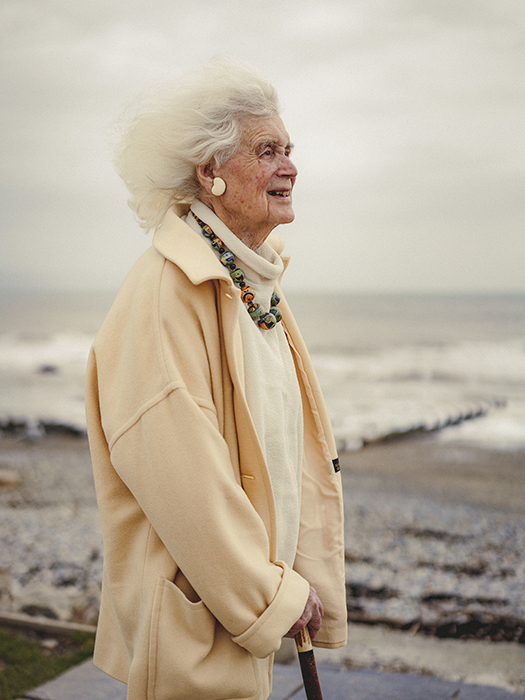
He was a man: then she was a woman. He, and then she, wrote some of the most mellifluous and evocative prose composed in English in the past 100 years: he and then she was a hack who recycled past writings shamelessly. He and then she was a prompt and punctilious journalist, who always met a word-count exactly: he and then she rewarded a generous and patient publisher by throwing tantrums over jacket design and sales figures. He and then she was a surface-dweller seduced by the “aesthetic” of British imperialism, the patrician insouciance of a khaki uniform topped with a rakishly tilted trilby hat: he and then she wrote profoundly thoughtful accounts of the empire – its cruelty, its magnificence, its idiocies. He and then she was loved by a loyal group of distinguished friends. He and then she was an aloof and unhelpful parent whose children look back on their upbringing with anger. The travel writer and historian James and then Jan Morris was an elusive, self-contradictory person who makes a terrific subject for a biography.
Sara Wheeler, herself a notable travel writer and biographer of travellers, brings to the task gifts nicely complementary to those of her subject. Where Morris was grandiose, Wheeler is brisk and sardonic. Where Morris span out reams of luminous prose from the slightest material, Wheeler is sharply concise. Where Morris preferred misty nuance to outspokenness, Wheeler turns up the light and lays out the facts as she finds them.
Here are some of those facts. (Following Wheeler’s practice, I’m using the name and pronouns Morris was using at the times concerned.) Morris was the child of socially mismatched parents. His mother, Enid, came from a family of educated professionals. Enid was musical and bookish. Wheeler writes that “half-open volumes lay around” her kitchen “like partially eaten sandwiches”. Walter Morris, whom she married in 1919, worked as a house painter and a taxi driver. Such a father didn’t suit Morris’s self-image – he was to write that Walter was “an engineer”.
At ten years old, James was sent away to Christ Church Cathedral Choir School in Oxford. He was thrilled by the rituals of the venerable institution. “How tall the candles were! How rich the cakes! How twinkling the regius professors!” The boys were required to stay there over Christmas, “hard at in the choir stalls”, but Morris didn’t mind. Home was happy enough, but for the future traveller, away was more exciting.

He went on to Lancing College. On leaving, in 1943, he volunteered for the Home Guard, though, at 16, he was underage, and was called up a year later. By the time he went overseas the war was over, but he loved the paradoxical freedom that he discovered within the army’s strict discipline. He was posted to Venice and wrote: “I found the wistfulness of the place almost orgasmic.” He had happened upon a subject that perfectly suited his temperament – romantic, decadent, grand.
Next posting, Palestine. Wheeler writes that Morris “was the 20th century”, and certainly he had a knack for being where history was made. Palestine in 1947, between the King David Hotel bombing and the Nakba, was just such place. There, wrote Morris, Britain “first admitted impotence”.
Morris was reading voraciously. He revelled in Charles Montagu Doughty’s Travels in Arabia Deserta, and Edward Gibbon’s Decline and Fall. He was learning to be an attentive observer. He was preparing himself for his next career. At 21, he left the army, enrolled on an Arabic course in London, and looked around for a reporting job. He found one in Cairo. While there he sent a telegram to Elizabeth Tuckniss, whom he had met in his London boarding house. “PLEASE MARRY ME STOP WRITING LOVE JAMES MORRIS.” It may have been the wisest thing he ever did.
Elizabeth accepted his proposal and continued, for the rest of their long and complicated marriage, to accept everything. They set up home in a rented houseboat on the Nile, moved to Oxford when Morris won a place there, and to London when he landed a reporting job at the Times (“He is quite out of the run of normal candidates,” wrote the editor who hired him), and then back to Cairo when he became the paper’s correspondent.
Everything was falling into place. A loved and loving wife, children, a promising career. But something was not right, something to do with sex. As an adolescent, Morris, as he later recalled, found it “natural to play the girl’s role in generally light-hearted romances” with other schoolboys, but he didn’t relish “the mechanical business”. As a soldier he struck his fellow officers as “rather better looking than any young man is entitled to be” and felt himself to be “like one of those unconvincing heroines of fiction” who don britches to go to war. When he joined the Times he became friends with fellow journalist Peregrine Worsthorne, who wrote that “at no point was James ever one of the boys”. But when people tried to help by introducing him to homosexual friends, he “baulked”. That wasn’t what he was after. But what that was, he wasn’t yet ready to say.
In 1953, a British team were to make an attempt on Mount Everest. The Times had syndication rights, and permission to send along a reporter. Morris, aged 26, was dispatched to have lunch with John Hunt in the Garrick Club. Over brown Windsor soup, Hunt judged him (correctly) “utterly inexperienced and physically substandard”, but he got the job anyway.
When the news of the expedition’s success was broadcast on Elizabeth II’s coronation day, Morris received almost as much adulation as the climbers. Wheeler gives a sparkling account of the adventure – the arduous marches, the jackal pack of rival journalists, the makeshift radio transmitter powered by a bicycle, the codenames, Morris gallantly climbing a difficult icefall, the tears and jubilation when those watching from camp saw mountaineers Tenzing Norgay and Edmund Hillary returning triumphant from the peak. It’s a great story, and it was James Morris who first told it.
It made him a celebrity. Publishers begged him to write books for them. The Times repeatedly refused to grant him leave to do so, and so eventually he left the paper. Wheeler’s narrative sags a little around its mid-point, as Morris takes on more and more commissions, struggling to meet his rapidly escalating expenses. He always lived beyond his means. “I like a touch of swank,” he wrote. He wanted to be a squire – one home was actually called The Big House. School fees – one son went to Eton, though his daughter bitterly notes that her education was nothing like as grand. Vintage cars. Good suits, including a bright turquoise one from Jaeger. To pay for it all he wrote at hectic speed. Each expenses-paid feature-writing trip provided the material for a book as well, many of them written in just a few weeks. And yet, for all the overproduction, some of the books are wonderful. Venice is justly acknowledged to be a classic, and so are the three volumes of Pax Britannica, Morris’s “huge antique mosaic of imperialism”.
The first volume of that trilogy is by James; the second and third volumes are by Jan. One starlit wintry night, during his army days, when Morris was crossing the desert around the Suez Canal in an open Jeep, a fellow officer with a bad stammer and grand cosmopolitan connections (his aunts were Hapsburgs) threw his greatcoat across both their shoulders and said “G-G-God… I w-w-wish you were a woman.” It gradually became clear to Morris that that was what he wanted, too. He wanted it so urgently that if it could not be done, he would kill himself. Wheeler takes this seriously, but doesn’t pretend to explain it. Using the language of the late 1960s and 1970s, she chronicles Morris’s “sex change” with a judicious degree of detachment. For years Morris took pills that made him ill. Finally, he found a surgeon who could help him. After a year of living as a woman in a rented house in Oxford (while Elizabeth held the family together in Wales) he went to Casablanca. There, James underwent surgery, and came home as Jan.
The most interesting and surprising thing about this development, as Wheeler persuasively tells it, is that, once it was done, it was no big deal. Temperamentally conservative, Morris had done a courageously unconventional thing, and, often quick to exploit a marketable topic, wrote from the clinic “it will make a not unentertaining piece of memoir”. But her sexual politics were far from progressive. She wrote that her newly feminine body was formed to “yield and accept”. Feminists were dismayed by Conundrum, her transition memoir. So were her publishers. Morris declared that though “the urge to change sex has been the most compelling instinct of my life” it was not “important”. The book eschews specifics. “I shall not pander to prurient curiosities,” she wrote. She had always felt she was female, she said, and now some redundant body parts had been removed – c’est tout.
Sara Wheeler writes extremely well about writing, and wittily about social history. Her narrative is full of crisply detailed anecdotes, and astute reflections on the many paradoxes of her subject. She says of Morris, “her work is superficial; but through it she guides the reader to gaze deep”. One could say the same of this book, in which elegant lightness is combined with perceptive thinking about a hugely talented, often maddening, peculiarly interesting person.
Jan Morris: A Life
Sara Wheeler
Faber & Faber, 432pp, £25
[Further reading: Artemis, the Moon and the case for utopia]
Content from our partners



Related


This article appears in the 08 Apr 2026 issue of the New Statesman, The Fall
Join the debate
Subscribe here to comment