More Americans are pro-life and more believe abortion should be legal. (Not a typo)
A strange finding by pollsters Gallup.
By Alex Hern Published 24 May 2012 15:39
A rather odd trio of findings by the American pollsters Gallup. The proportion of Americans describing themselves as "pro-choice" has fallen to a record low of 41 per cent:
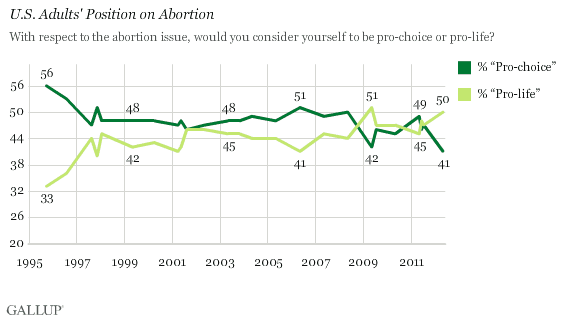
Yet the proportion who think abortion should be illegal under all circumstances has fallen, while the proportion who think it should be legal under some or all circumstances has stayed flat (though it should be pointed out that the opposite framing is also true; "legal under certain circumstances" is obviously synonymous with "illegal under certain circumstances"):
And the proportion who think abortion is morally wrong hasn't changed:
It's hard to know what to make of the findings. It seems like the most likely reading is that there is a growing proportion of Americans who describe themselves as "pro-life", but are ambivalent about the morality of abortion and think that it should be legal in some circumstances. More conflicting views have been held in the past...
Latest tweets
More from New Statesman
- Online writers:
- Steven Baxter
- Rowenna Davis
- David Allen Green
- Mehdi Hasan
- Nelson Jones
- Gavin Kelly
- Helen Lewis
- Laurie Penny
- The V Spot
- Alex Hern
- Martha Gill
- Alan White
- Samira Shackle
- Alex Andreou
- Nicky Woolf in America
- Bim Adewunmi
- Glosswitch
- Kate Mossman on pop
- Ryan Gilbey on Film
- Martin Robbins
- Rafael Behr
- Eleanor Margolis
- Tools and services:
- Polls
- Predictions
- Archive
- Magazine
- PDF edition
- RSS feeds
- Advertising
- Subscribe
- Special supplements
- Stockists


6 comments
Uh-oh...hidden camera tapes in the US now showing Planned Parenthood counseling on Gender-selective abortions. Chew on that one heathens...
"legal under certain circumstances" is obviously synonymous with "illegal under certain circumstances"
Uh, excuse me? No, if 51% think it should be legal u.c.c., then 49% think it EITHER should be illegal u.c.c., or perhaps they don't have an opinion... there might even be other categories. They are definitely NOT synonymous.
I think you've misunderstood. If you think it should be legal under certain, but not all, circumstances, then there must be some circumstances under which you think it should not be legal - or, to put it another way, you think it should be illegal under certain circumstances.
A false dichotomy is created when the anti-abortion stance is labelled as 'pro-life' since it creates the unavailable converse, anti-life, which is then labelled 'pro-choice'. To take the obvious example, preventing the abortion of an anencephalic foetus is not a pro-life choice because there is no viable life to be preserved. To then ask the questions differently by referring directly to abortion and compare the answers with the previous formulations is not meaningful. One should not, therefore, be surprised if the results appear paradoxical when like is not compared with like.
Just to be clear, in the case of the anencephalic foetus, abortion would be the pro-life choice since a first trimester abortion is always safer for the mother than carrying a pregnancy to term.
It's not necessarily evidence of conflicting views. Personally, I disagree with abortion, but I think it is a woman's right to choose and it should be available. I'm not a woman, so I'm never going to be put in the position of having to decide to terminate a pregnancy for whatever reason. Therefore I am allowed to disagree with abortion at the same time as recognising that it is something which, for many reasons, has to be available. Rather than a conflicting approach, it is a pragmatic view.
Friends of mine have had abortions and I have happily talked it over with them when they were having to make the decision. At no point did I try to influence their thinking or try to get them to change their mind - what was right for them as a woman in their individual situation was what was important. Perhaps the poll is evidence that people, while objecting in principle, take a more nuanced view than they are being given credit for.