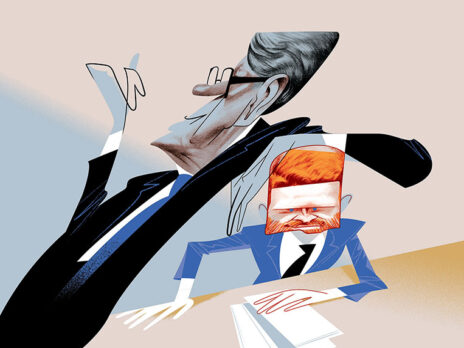
Romanticising the late Ted Kennedy
A great man, with a dark past
By Mehdi Hasan Published 26 August 2009 12:50Here in the New Statesman offices, we are in the midst of drafting a leader that pays tribute to the "Lion of the Senate", Senator Ted Kennedy, who has died following a battle with a brain tumour at the age of 77.
Kennedy was undoubtedly a great man who, in the word of the BBC online obituary, "possessed the full mixture of the virtues, and the vices, that defined America's most famous political dynasty".
It is the "vices" that are often underplayed or even conveniently ignored when a great man or great politician (especially a Kennedy) passes away. But, to be fair, the BBC obit does refer to the infamous "Chappaquiddick incident" in some detail:
On 18 July 1969, he was at a party on the small Massachusetts island of Chappaquiddick with a group, including six women known as the boiler room girls, who had worked on his brother Robert's presidential campaign.
Kennedy left the party, supposedly to drive his brother's former secretary, Mary Jo Kopechne, to catch the last ferry back to the mainland but, instead, the car turned on to a side road and crashed off a bridge into a tidal creek.
Kennedy pulled himself from the upturned car and, swimming across a narrow creek, returned to his hotel without reporting the accident.
It was the following morning before local fishermen found the sunken car and discovered the body of Mary Jo Kopechne still inside.
Evidence given at the subsequent inquest suggested that she had probably remained alive in an air pocket for several hours and might well have been saved had the alarm been raised at the time.
Think about that for a moment. This great man, who was one of only 23 senators to oppose the Iraq war, so bravely and presciently, a key figure in helping Barack Obama win the 2008 Democratic nomination for the presidency and at the forefront of the ongoing progressive campaign for health-care reform in the United States, nonetheless was responsible for the wholly avoidable death of a 28-year-old woman. He served no jailtime, continued to be re-elected to his Senate seat until his death, and will now be lionised as a political saint across the liberal commentariat.
Would we be so forgiving, I wonder, were he not a Kennedy?
Latest tweets
More from New Statesman
- Online writers:
- Steven Baxter
- Rowenna Davis
- David Allen Green
- Mehdi Hasan
- Nelson Jones
- Gavin Kelly
- Helen Lewis
- Laurie Penny
- The V Spot
- Alex Hern
- Martha Gill
- Alan White
- Samira Shackle
- Alex Andreou
- Nicky Woolf in America
- Bim Adewunmi
- Glosswitch
- Kate Mossman on pop
- Ryan Gilbey on Film
- Martin Robbins
- Rafael Behr
- Eleanor Margolis
- Tools and services:
- Polls
- Predictions
- Archive
- Magazine
- PDF edition
- RSS feeds
- Advertising
- Subscribe
- Special supplements
- Stockists


7 comments
magician3all
arabonly
anime3as
animok3a
delegnt3a
mexaty3a
animeta7a
mexaty3a
animes3t
mexa2at
3arb-anime
anim5k
albrqn3t
mexat3an
top3film
z7may
z7mhat
ta7ata
animeyate
mnhosat
mokmsyat
animeca3fe
mazaryte
animeyzo
animesnipat
anime-bnatc
banatm5dern
star5at
monaystat
mal7zat
zol7at
kol7at
animoyat
foxyat
maz7kat
3solaty
kool7at
ta7oy
mal7oy
zalyta
ma7aryat
sokolat
barn7ty
tey5at
d5olat
caloyat
anim3snipe
sadt3ars
animeonlye
nsf7
3solat
mnoms
magicians4all
animexyt
mexyt
delegnet
I can't imagine that we would be. He acted to try and save his career, not the life of another human being. In the absence of any meaningful judicial censor, he ought to have forefeited that position in public life.
It's amazing the see the hipocracy the Democrat Party has with this kind of stuff, including the media. If Ted were a Republican would he have been held responsible by the government, media and the people? Sure he would have been. We are all sad for those who loved him in his family. But quite frankly, Mary Jo knows what kind of man he is and his name only is the reason he never went to jail.
Come to America, I dare you. You'll be tarred and feathered with great haste.
Harrison Ford, at the end of the romantic comedy (movie) "Six Days Seven Nights", asks Anne Hech, who is known for her offscreen life as for her onscreen performances, "Should one be fussy about everything?" The entire episode can be made applicable to the comments being raised after Fox News, anchor Mr. Gretchen Carlson called Sen. Ted Kennedy (D-MA) a “hostile enemy” of the United States because he has demanded that Congress vote on whether to approve funding for escalation in Iraq. TOM feels that "Kennedy was lying murdering left wing looney who should have spent the last 30 years in prison.
Now, perhaps Mary Jo Kopechne can finally rest in peace." Is it not necessary to feel us to weigh as why was the health-care plan Ted Kennedy proposed, faced heavy criticism and an uncertain fate. We should acknowledge that some critics see ideology behind any of the opinions expressed. "Sen. Kennedy lived a long public life so, of course, it had some wrinkles" said Clemente. We should be objective while deliberating on this count. A question remains, when are we going to be liberal and allow others to speak, which they feel is truth and nothing but truth? When some opinions go against our 'faith' and 'brainwash' we exihibit our anguish and go on harping the untruth until it becomes Goebel's truth! Why?
If Ted Kenedy had some weaknesses and some discredit, then why should we say that they are not acceptable?Why should we not ready to accept the embarrasment, which the late ted had bestowed on us? If John F. Kennedy had some human attributs (including vices), then why should we deny them? Are we rigid in accepting democratic values in their genuine sense or we are bent on considering that democratic values are those, which are acceptable who believe in hegemony? Or are we scared of defying a dominating bible-toting preacher, who says hail Mary full of grace...?
NOW says that She/he was raised in an Irish Catholic houshold and she/he still didn't buy into the Kennedy BS. She/he appears to be indifferent (a bit!).
Is it necessary to say that had Ted not been a Catholic, then he would nt have been rated as'good' but only 'bad' and 'ugly'?
Senator Edward 'Ted' Kennedy stood for sleaze. Bloated and drunken, he used his standing in the Kennedy clan to chase vulnerable women - which brought his dream of reaching the White House to a shameful end.
He was the youngest of the four Kennedy brothers, and by far the longest lived.
Incredibly, he was in line to inherit his brother John F. Kennedy's legendary presidency, but his chances were dashed following the drowning of the pretty, young campaign assistant Mary Jo Kopechne.
Forever known as the Chappaquiddick Incident after the Massachusetts island where it took place, the scandal in 1969 broke the Kennedy grip on the White House.
A drunk Ted had been driving back from a party to the family 'compound' on Martha's Vineyard when he veered off a bridge and into a deep tidal dyke.
Mary Jo was in the back seat and, while he claimed he was just giving her a lift back to her hotel, it was widely thought that he had picked her up for sex. Kennedy swam ashore to save himself, but left Mary Jo to drown - in fact, it was even worse than that.
It was nine hours before he reported the accident. In the meantime, he walked back to his motel, complained to the manager about a noisy party, took a shower, went to sleep, ordered newspapers when he woke up and spoke to a friend and two lawyers before finally calling the police.
Divers later estimated that if he had called them immediately, they would have had time to pull out Mary Jo. She had not drowned, but had survived in an air pocket inside the car - she was asphyxiated only when the oxygen ran out several hours later.
As always, Ted used the family name to save his neck. In any other state but Massachusetts, the Kennedys' home turf, and with any other name, he would have been charged with homicide.
Instead, he escaped with a slap on the wrist: a two-year suspended sentence and the loss of his driving licence for a year. He had been allowed to plead guilty to no more than the charge of leaving the scene of an accident.
Kennedy lawyers arranged for him to pay £55,000 to the Kopechne family from his own pocket with a further £30,000 from his insurance. Mary Jo's mother later said: 'I don't think he ever said he was sorry.'
As he entered the Senate, Kennedy was admired for his commanding 6ft 2in stature and the good looks that seemed a family blessing. But he was already drinking and womanising with the greed that has become known as a vice of Kennedy men.
Keeping such a vice under wraps seemed to run in the blood (as did charisma). His father, Joe, the patriarch who had got away with bootlegging in the Prohibition years to establish the family fortune, had also behaved that way.
While Ted drank and took advantage of compliant women in Washington, his wife Joan stayed at home in Boston to look after his three children. Like her sister-in-law Jacqui, she seemed to have learned that Kennedy women had to put up with humiliation.
The effort ruined her health, however. Kennedy's unending philandering turned her into an alcoholic and, in 1983, she could take no more.
She could no longer stand the hypocrisy of her husband posing for the public as if he lived for family values. She divorced, publicly confessed to her alcoholism and helped shatter what was left of the Kennedy aura.
Charisma, political skill, good timing and ruthlessness had enabled the family to dominate U.S. public life, despite foibles from links with Chicago gangsters to the sexual arrogance that had, according to legend, seen both JFK and RFK seduce Marilyn Monroe.
A writer once noted: 'Ted Kennedy born and bred to act like the last of the Regency rakes: to be a boor when it pleases him, to take what he wants, to treat women as score markers in the game of sexual sport and to revel in high stakes risks.'
His brothers got away with it, but Ted Kennedy's divorce removed the last bounds of shame and he plunged into a life that left him looking like a Saturday night drunk, waving a bottle and calling for any woman who could tolerate him. He staggered from scandal to scandal, reduced to fodder for lurid ' supermarket' tabloid newspapers.
One congressional aide, just 16, told of being propositioned by Kennedy from the back seat of his limousine in Capitol Hill. She testified that he leaned from the window, waved a wine bottle and asked whether she or a friend she was with wanted to join him.
He reeked of drink by nine in the morning and could be relied on to be bawling drunk at four in the afternoon. In Washington's top La Brasserie restaurant, he once threw a waitress over a table in a private room and tried to have sex with her.
His face, once handsome, became as round as a football, bloated and criss-crossed with the broken veins of an out-of-control drinker.
Remarkably, he held on to his political clout and his legislative skills. He won re-election after reelection, dying in office as America's second-longest serving senator.
He was also responsible - or credited by the Left - for an unrivalled body of 'liberal' legislation. He reformed immigration and labour laws, supported 'pro-choice' abortion rights, voted for tougher gun laws and against the Iraq war, and supported gay marriage.
It wasn't long before he became embroiled in another Kennedy family scandal. In 1991, the U.S. was outraged when clan-member William Kennedy Smith was accused of a date rape.
The Kennedy men had gathered at the family's winter beach house in Florida. Smith (Ted's nephew) was accused of taking a young woman, Patricia Bowman, on to the beach late at night and forcing her to have sex against her will. Smith was found not guilty after building a defence of 'rough', but consensual, sex.
But at the young man's trial, Kennedy was left, once again, with his trousers down. Witnesses testified that he had been lounging in his boxer shorts as Smith coaxed Bowman on to the beach, and did nothing to intervene.
It had been Kennedy who had earlier woken the younger men in his party and insisted that they go out to a nightclub to hunt for women.
After that, Kennedy seemed to seize a final chance to gain a measure of personal control. He offered a mea culpa in which he said he recognised his 'shortcomings, the faults in the conduct of my private life'.
He married a second time, to Washington lawyer Victoria Reggie, who survives him, and said of her: 'She has enriched my life beyond measure.'
At 60, his Kennedy mane still thick but snow white, it finally seemed as if the youngest brother had learned his lesson. Indeed, it was another tragedy that devastated the family and the nation that partly rehabilitated Kennedy in the public mind: the death in the light aircraft of John Kennedy Jr, the son of JFK and the heir presumptive to his Camelot. He was the little boy photographed saluting his father's coffin, and who had become a handsome young man with true potential. America was heartbroken.
At the height of the scandal, Kennedy went on TV to explain himself in an extraordinary 13-minute address in which he denied driving drunk and rejected rumours of
'immoral conduct' with Kopechne.
He said he was haunted by 'irrational' thoughts immediately after the accident, and wondered 'whether some awful curse did actually hang over all the Kennedys'.
He said his failure to report the accident right away was 'indefensible'.
Yet the tragedy and his actions appalled millions of Americans.
Edward Kennedy, for once, rose above his own character defects to preside over the mourning at the funeral.
In his eulogy for John, he said: 'We dared to think, in that other Irish phrase, that this John Kennedy would live to comb grey hair. But like his father, he had every gift but length of years. He had a legacy and he learned to treasure it. He was part of a legend and he learned to live with it.'
In his own right, Ted Kennedy was a legend, too - but for all the wrong reasons.
Read more: http://www.dailymail.co.uk/debate/article-1209313/Ted-Kennedy-The-Senato...
More...
• RUTH DUDLEY EDWARDS: Ted Kennedy loathed Britain - so why did Gordon Brown knight him?
End of a dynasty: As Ted Kennedy dies a 'heartbroken' Obama leads tributes to 'the greatest U.S senator of our time'
When some say(1) "It's amazing the see the hipocracy the Democrat Party has with this kind of stuff, including the media. If Ted were a Republican would he have been held responsible by the government, media and the people? Sure he would have been. We are all sad for those who loved him in his family. But quite frankly, Mary Jo knows what kind of man he is and his name only is the reason he never went to jail", and (2) "I can't imagine that we would be. He acted to try and save his career, not the life of another human being. In the absence of any meaningful judicial censor, he ought to have forefeited that position in public life." it means something.
Romanticising the late Ted Kennedy
Posted by Mehdi Hasan 26 August 2009 11:50 3 comments Print version Listen RSS
A great man, with a dark past
Here in the New Statesman offices, we are in the midst of drafting a leader that pays tribute to the "Lion of the Senate", Senator Ted Kennedy, who has died following a battle with a brain tumour at the age of 77.
Kennedy was undoubtedly a great man who, in the word of the BBC online obituary, "possessed the full mixture of the virtues, and the vices, that defined America's most famous political dynasty".
It is the "vices" that are often underplayed or even conveniently ignored when a great man or a great politician (especially a Kennedy) passes away. But, to be fair, the BBC obit does refer to the infamous "Chappaquiddick incident" in some detail:
On July 18 1969, he was at a party on the small Massachusetts island of Chappaquiddick with a group, including six women known as the boiler room girls, who had worked in his brother Robert's presidential campaign.
Kennedy left the party, supposedly to drive his brother's former secretary, Mary Jo Kopechene, to catch the last ferry back to the mainland but, instead, the car turned onto a side road and crashed off a bridge into a tidal creek.
Kennedy pulled himself from the upturned car and swimming across a narrow creek, returned to his hotel without reporting the accident.
It was the following morning before local fishermen found the sunken car and discovered the body of Mary Jo Kopechne still inside.
Evidence given at the subsequent inquest suggested that she had probably remained alive in an air pocket for several hours and might well have been saved had the alarm been raised at the time.
Think about that for a moment. This great man, who was one of only 23 senators to bravely and presciently oppose the Iraq war, a key figure in helping Barack Obama win the Democratic nomination for the presidency, and at the forefront of the ongoing progressive campaign for healthcare reform in the United States, nonetheless was responsible for the tragic and avoidable death of a 28-year-old woman. He served no jail time, continued to be re-elected to his Senate seat until his death and will now be lionised and eulogised as a political saint across the liberal commentariat.
Would we be so forgiving, I wonder, were he not a Kennedy?
A question arises after reading the all above, who will write history on the late Ted Kennedy? A Catholic or a non-Catholic? History on Princess Diana's life and death have been interpreted as per the angle of viewing her. So, the nature of History will shape, the coming generations will be conditioned!!
I thik it is obviously that he went on to fight for the "people" -- especially the rights of women -- because he had a guilty conscience. I was ten when Chappaquidick happened and I remember that my mother was spitting mad. These are the acts that rich powerful men have always gotten away with -- even relatively recently.
The members of my family were al lifelong democrats. I agree with his politics but he was a murderer and should have been punished.
I thik it is obviously that he went on to fight for the "people" -- especially the rights of women -- because he had a guilty conscience. I was ten when Chappaquidick happened and I remember that my mother was spitting mad. These are the acts that rich powerful men have always gotten away with -- even relatively recently.
The members of my family were al lifelong democrats. I agree with his politics but he was a murderer and should have been punished.