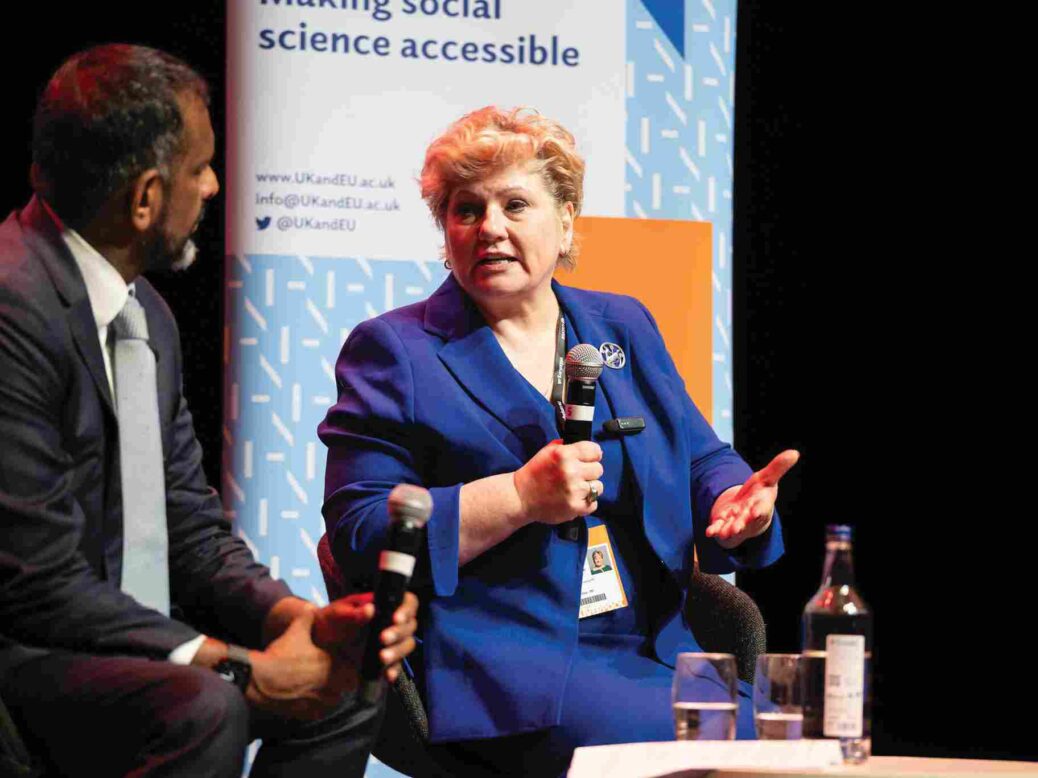
Asked what first drew her to politics, Emily Thornberry doesn’t reach for abstractions. She goes straight to the point: eviction notices, bailiffs at the door, a Labour councillor who found her family a home, and a mother who was told to “pay back” by standing for the council herself.
That is why she is “Labour through and through”. Speaking with Anand Menon, director of the UK in a Changing Europe initiative, at a New Statesman fringe event at Labour conference, the chair of the Foreign Affairs Select Committee reflected on both her political roots and her party’s first year and change in power. Having served in multiple shadow cabinet roles in opposition, Thornberry now sits on the back benches. It may not be where she had envisaged herself in the wake of Labour’s landslide victory, but it’s a position she readily admitted gives her space to speak more freely.
“I think we’ve done some great things,” she said, reeling off housebuilding, workers’ rights, and restoring a degree of seriousness to Britain’s place in the world. “But we need to be a calling, a movement. What’s our guiding light? The Labour Party is about emotion as much as anything else – it has to grab you by the heart.”
The critique sounded less like disloyalty than impatience: a veteran loyalist urging her party to recover its sense of purpose. “It isn’t enough to be better managers than the other lot, which obviously we are. Why are we in politics? What do we want to achieve?”

On Europe, her view was similarly direct. The political class “headed for the hills” after the 2019 “get Brexit done” election and stopped engaging with the damage it wrought. She hasn’t changed her mind: “I’ve always been in favour of us being in the European Union. I think we should be there. It’s tragic we’re not.”
The sensible path now, she insisted, is to rebuild ties as far as the public will allow – and she believes voters have given permission for more ambition. The government, she said, started small, met the usual accusations of betrayal “from the right and the left”, then discovered “people just want a better relationship with the EU”. Nor, she added, is the choice binary. We need not pick forever between piecemeal fixes and a wholesale leap back into the single market.
Compromise, she argued, “cuts both ways”. “The European Union needs to be pragmatic and so do we… Let’s work together and have a deal that’s going to work for you and for us.” Britain’s traditional role – the bridge between Washington and Europe – remains useful. “It’s not an easy place to be,” she conceded, “but it’s quite a valuable one.”
Her comments on Ukraine also carried a mix of conviction and realism: “We’ve played a blinder and the Ukrainians know it.” The warmth she said she has encountered in Kyiv is real, and must be matched by sustained support. With ongoing talk of a possible ceasefire, Thornberry cautioned against mistaking talks for resolution. The “coalition of the willing”, she said, will still need an American backstop if negotiations stall or Russian aggression resumes – and the challenge remains to keep President Trump committed to Nato and to Ukraine’s defence. That requires constant engagement – and, she suggested, careful use of the political capital the government has built up in Washington.
“We get the right sort of response and [Trump] seems to be in the right place and then he seems to sway back again – that’s the difficulty. But there is a good relationship between our Prime Minister and the president.”
The domestic is even more of a challenge. The government, she noted, inherited “the highest tax burden we’ve ever had, the highest debt, public services on their knees”, and a public that expects Labour to fix the lot in 12 months. Politics must, she argued, be honest about constraints – “less announcing things and then not delivering” – but also bolder about how to make progress.
Thornberry gave the example of the criminal courts backlog, where victims wait four or five years to give evidence. She did not endorse any specific reform, but sketched out the kind of candour she thinks is required: if ministers believe temporary measures – for instance, jury trial restrictions in certain cases – would help clear the backlog, then say so openly, legislate with a firm time limit, and commit to restoring normal process once the crisis has passed. “You need to be honest that it is going to be difficult. But we do have a plan,” she said.
That same plea for plain-speaking ran through her reflections on Labour’s internal politics. Thornberry put herself forward for deputy leader because the role is elected, unsackable – and therefore capable of “telling truth to power”. She said she wasn’t after “the greater glory of Thornberry”, but a platform to ensure “the boys in the blue suits” hear what they need to hear. The party opted for a different profile; so be it. The task for the winner, she said, is to use the platform well – and for the leadership to recognise criticism offered in good faith.
Strategically, she warned against chasing Reform UK around the ring. Labour is a broad coalition; trying to “out-Reform Reform” ignores almost all of those constituent parts. Better, she argued, to be confident in what the party is and build a response from there. “I love my country, so does everybody else here. It’s not a competition.” Thornberry’s tone throughout was less that of a rebel than of a party veteran impatient for renewal.
After two decades in parliament, her faith in Labour’s ideals remains, but so does her insistence that competence alone will not carry the argument. “Say what you mean and mean what you say,” was a repeated mantra. For a government that frames itself as having restored calm after chaos, her message was clear: the next test will be to turn steadiness into conviction – to remind the country, and itself, what it came into power to do.
Content from our partners


Related