Travelling abroad for medical procedures was once seen as a recourse for either the incredibly privileged or the unimaginably ill. But in recent years, flying overseas for treatment has become far less of an outlier, to the extent that, for cosmetic and elective procedures at least, it is fast entering the mainstream.
In 2024, an estimated 523,000 UK residents left the country for medical treatment, according to Office for National Statistics data, a significant uptick on previous years. For that number, Turkey was by far and away the most popular destination, accounting for nearly 200,000 visits.
It speaks to the country’s burgeoning reputation as Europe’s foremost elective-surgery port of call. Patients travel to Turkey for a wide range of treatments, from cosmetic surgery and dental work to ophthalmology, weight-loss procedures and orthopaedics. But one field has come to dominate the country’s international reputation. Even among the hirsute classes, Istanbul is now widely known as the hair transplant capital of the world.
A concentration of specialist clinics, international transport links and established medical infrastructure has helped to normalise short-term travel to the banks of the Bosphorus for this ever more popular elective procedure.

The reasons so many of these people choose Turkey are largely practical. Hair transplantation is a high-volume procedure, and Turkish clinics have invested heavily in the techniques, infrastructure and staffing required to deliver it at scale. Follicular unit extraction (FUE) – transplanting individual hair follicles from donor areas of the scalp to thinning or receding regions – is now a routine procedure in many Turkish clinics, refined through years of repetition and technological development. High patient volumes empower providers to standardise processes and build specialist teams focused exclusively on hair restoration.
Appeal also lies in the clarity of the treatment journey itself. Remote consultations, fixed pricing and defined treatment schedules can help reduce uncertainty, particularly for those balancing procedures with work and family commitments. Clinics operating in the international market increasingly view this logistical reassurance as central to patient confidence.
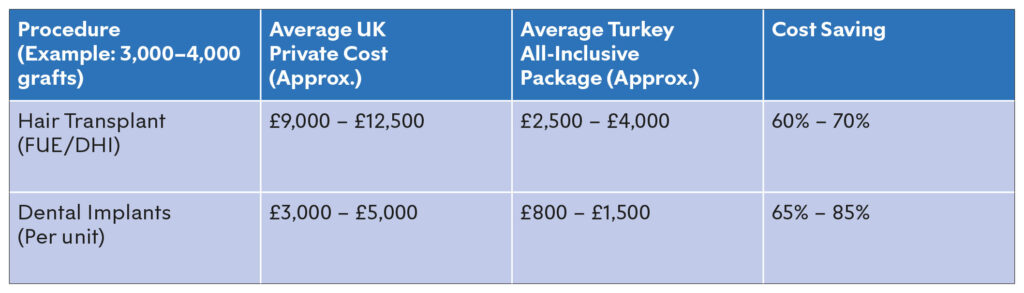
Cost is another decisive factor. Hair transplant procedures in the UK not only often involve long waiting lists, but can also run into many thousands of pounds, placing them beyond the financial means of many. Turkish clinics are typically able to offer the same procedures at significantly lower prices, frequently through all-inclusive packages that cover consultation, surgery, accommodation and transfers. The difference can be substantial.
The rise of social media has also played a role in increasing visibility around hair restoration abroad, driving demand, and removing previous taboos. Hair loss affects a significant proportion of men, often at a relatively young age, and the availability of effective, accessible treatments has shifted expectations about what is possible, as well as growing the number of forums in which these issues can be discussed.
As with any medical procedure, those considering hair loss treatment are advised to research clinics carefully, understand what is included in available packages, and ensure that procedures are carried out by qualified professionals in regulated facilities. The most reputable providers are clear about candidacy, outcomes and limitations, rather than promising instant or universal results.
Within this landscape, clinics such as Doku Clinic have positioned themselves to serve an international patient base across a range of elective and specialist treatments. Based in central Istanbul, this multidisciplinary 5000m2 medical centre employs more than 400 healthcare professionals, providing an array of services that include hair restoration, cosmetic surgery, dental treatments and ophthalmology, alongside associated diagnostic and aftercare support.
Hair transplantation is a core area of expertise, with particular focus on FUE techniques delivered in a hospital-grade environment. As with its wider clinical offer, the emphasis is on structured pre-treatment assessment, procedures carried out by experienced medical professionals, and clearly defined aftercare steps designed for patients returning to the UK and elsewhere.
For those weighing up their options, Turkey’s emergence as a destination for hair restoration reflects a broader change in how healthcare services are accessed internationally. Doku Clinic typifies this shift, operating in a competitive, globalised market where reputation, outcomes and patient experience matter as much as price.
As demand continues to grow, Turkey’s position is unlikely to diminish soon. For many British patients, it has become not a last resort, but a considered and deliberate choice driven by Turkish clinicians’ long and growing track-record of success.
Related