
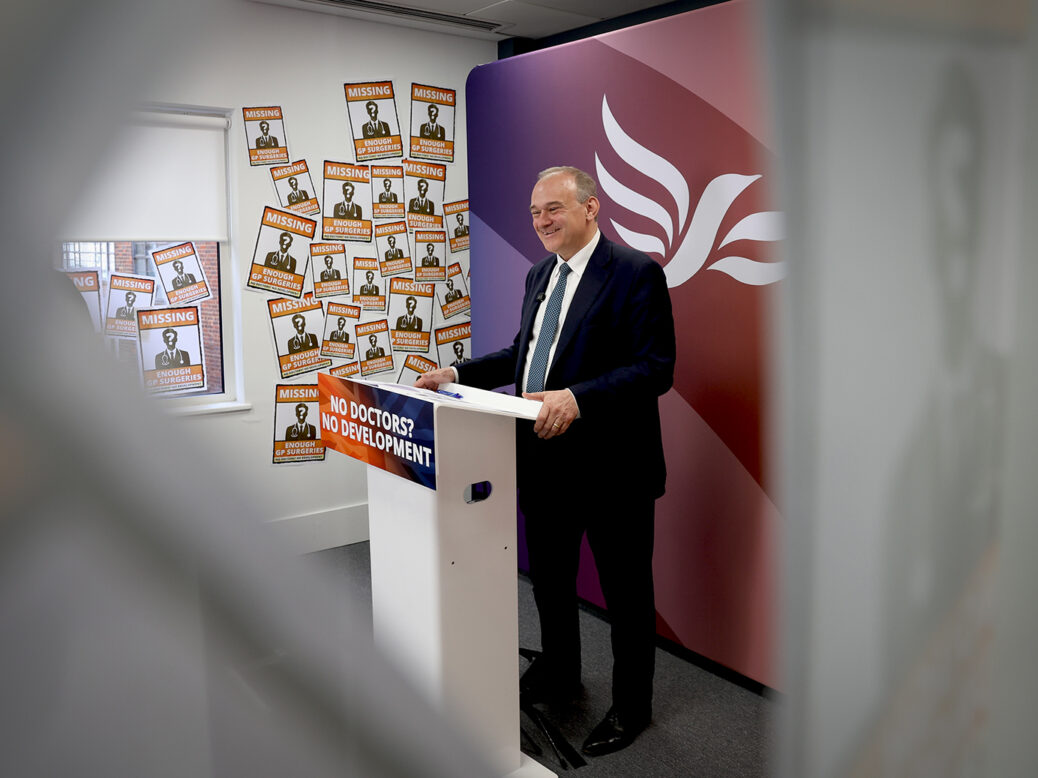
The Labour Party has run Haringey council in north London for more than half a century. While geographically it’s technically one borough over, spiritually we are in Islington, the deep red home of the Corbynistas. Indeed, Momentum seized control of the council in 2018. Reform and the Tories are nowhere to be seen in this lefty urban jungle of tower blocks, corner shops and cycle lanes.
This is prime territory for one of the key battles shaping up for this set of local elections: a tired and unpopular governing Labour Party up against the insurgent Greens. A recent poll put eco-populist leader Zack Polanski on track to wrench this corner of Labour’s London heartlands, while YouGov’s latest MRP of the capital shows a nail-bitingly close race.
Yet in the midst of this red-green war, tendrils of yellow (or orange – the exact colour is hotly debated) are attempting to creep through. Out and about around my local corner of north London, I find a textbook Liberal Democrat campaign.
It begins in a community owned pub in Bowes Park, a neighbourhood of family homes and Cypriot cafes on the outskirts of Haringey, where inner city high-rises start to blur into terraced suburbia. The Lib Dem candidate here, Dan Jones, is the mastermind behind the pub. It is owned by local residents after Jones launched a successful fundraising campaign to buy the building, nestled on a street of independent shops and restaurants, back from a developer insistent on turning it into flats.

He also voted Labour in the general election two years ago. This recent change of allegiance does not seem to bother him. In fact, it chimes perfectly with the party’s message here: Feel let down by Labour? Give the Lib Dems a try instead.
As I traipse around the surrounding streets on an unseasonably hot April afternoon, Lib Dem posters in the windows far outnumber any other party. On the doorstep, voters get a pitch about local policing and more money for upgrading playground facilities. There are accusations that the council is diverting money to other areas like Tottenham, ignoring the somewhat more middle-class residents here. Complaints about the peculiarities of the low-traffic neighbourhood (LTN) dominate.
No one mentions Ed Davey, Keir Starmer, Donald Trump, the Iran war, or even Brexit. Campaigners and voters alike seem happy with this arrangement. The one exception is a middle-aged man eager to list his grievances with Nick Clegg. He is reassured that the former deputy prime minister abandoned frontline politics long ago for Silicon Valley. There is no question: voting for change here means voting against Labour. And the Lib Dems are on-hand with a ready-made alternative.
The day after I shadow Lib Dem pavement pounders across this patch of north London, the party launches “Operation Dodo”. The less-than-subtle title refers to the Conservatives, who the memo claims are facing “an extinction-level event in their former heartlands”. Those heartlands include Hampshire, East Surrey, West Surrey, East Sussex and Huntingdon (once home to John Major), and are about as different from Haringey as one can get.
But the messaging is remarkably similar: if you’re fed up with the Tories, try the Lib Dems – with an added flavour of “stop Reform here”.
The story in the run-up to these local elections has been one of insurgents: Reform on the right and the Greens on the left, cannibalising support from the two mainstream parties. The Lib Dems, traditionally the default “other” option, have been left behind in both narrative and polling terms. As the Greens have risen in national polls to vie with Labour and the Conservatives below top-placed Reform, Ed Davey’s party of 72 MPs has remained stubbornly stable, on around 12 per cent of the vote. Voters are not abandoning the Lib Dems, but neither are they flocking to them in droves.
One might imagine the Lib Dems are a tad annoyed about this. And among the party’s new cohort of MPs, frustration is growing that they seem to have been overtaken by glitzier options, with complaints about Davey’s lack of direction. “He’s just too beige,” one MP laments. They are not alone in their sentiment.
But in terms of the local elections, party strategists genuinely believe this lack of definition plays to their strengths.
“We’re everyone’s second choice,” a senior Lib Dem source tells me. “Which might not sound very glamorous, but under first past the post (FPTP), that matters.”
The Liberal Democrat Party has spent its entire existence lobbying for electoral reform, railing against the injustice of the FPTP system that – until now – has shoved smaller parties to the fringes. But it has recently figured out how to make the current voting model work in its own interests. After the disappointment of 2019 (a humiliating attempt at a national campaign which resulted in a leader who had claimed she could potentially be prime minister losing her own seat), the party changed its strategy. Resources would be ruthlessly targeted at areas where the party had a strong local presence in the form of councillors rather than spread nationally. The result was seismic: between 2019 and 2024, the Lib Dems increased their vote share by just 0.7 percentage points and actually lost votes, but won six times as many MPs.
Almost all of these gains were from the Conservatives, hence the Lib Dem rallying call to “finish the job” of demolishing the Blue Wall, which has now morphed into “Operation Dodo”. It has been nearly two years since the Tories suffered such catastrophic losses, and Lib Dem strategists still see a “massive opportunity” to go even further. The Tories are even lower in the polls today than they were in the run-up to 2024 (talk about a Kemi Badenoch revival forgets the fact that she took over a party polling at 25 per cent), and are so focused on seeing off the threat of Reform that they are alienating many of their core centrist voters.
Enter the Lib Dem alternative. A strong showing specifically in formerly Tory local councils this May will lay the groundwork for the party’s attack come the next general election. There are 25 Conservative MPs in the councils highlighted under Operation Dodo, I am told. Parliamentary maths is such that, were the Lib Dems to hold all their current seats and take two dozen or so from the Tories, they could be virtually tied for the second largest party in parliament.
Such optimism is not exactly reflected in the polls. “Liberal Democrats remain stable” is the lukewarm assessment of the More in Common MRP, which sees the party mostly defending its 2024 gains but making little progress.
But when I put this to a Lib Dem strategist, they remind me that the same poll has the Greens on virtually the same share of the vote (12 versus 13 per cent) yet winning just 22 seats compared to the Lib Dems’ 62. In a fragmented electoral system, things can get unpredictable. And being tactical can matter just as much as being popular. “The bar for winning is getting lower,” they note, pointing out that in last year’s local elections, a Lib Dem won Truro Moresk & Trehaverne in Cornwall on 19 per cent of the vote – with the Tories and Reform virtually tied on 17 per cent.
The Greens under Polanski are certainly happier to take bold stances, and this strategy has helped boost their visibility. But it can also be polarising. (I have heard from both Reform and Tory strategists who believe Polanski’s approach benefits them, by making the right look less radical and “scary” than the left.) More in Common offers a fascinating alternative perspective on the political landscape by asking voters who they would most like to vote against if they could. In its March data, the answer was unequivocal: 38 per cent of Brits would vote against Reform, 34 per cent against Labour, 7 per cent against both the Conservatives and the Greens, and just 3 per cent against the Liberal Democrats. They might not be the top choice for most voters, but they are the least disliked.
This matters when voters are tasked with thinking tactically about how to avoid the outcome they want least rather than voting for what they want most. It also explains why so many Lib Dem digital ads focus on how they’re the party to beat whichever party voters in that particular area most fear or dislike.
“The polling shows there is a big group of people who are willing to vote for any option that is not Labour and not Reform,” a Lib Dem source told me. “That can cover a lot of places.” Places like Hampshire and Haringey, perhaps?
The day after my Bowes Park walkabout, just as Operation Dodo is launching, the Lib Dems release a campaign video of Davey. He is standing on a church roof. Would voters perhaps like him to fix it? This is, of course, a jibe at Kemi Badenoch, whose dismissive line that “a typical Liberal Democrat will be somebody who is good at fixing the church roof” has become a Lib Dem campaign staple, a point of pride for a party that considers hyper-localism a feature, not a bug.
This little corner of Haringey doesn’t have a church roof that needs fixing right now. But it does have a particularly dangerous junction just outside the tube station, a shortage of local police officers and an issue with HMOs. That’s what the Lib Dem canvassers are focusing on. And in a way, it doesn’t matter whether their main opponents are Labour, the Conservatives, the Greens or Reform. When you’re aiming to be everyone’s second choice, the message is the same.
[Further reading: Zack Polanski is still learning]
Content from our partners


Related



Join the debate
Subscribe here to comment