
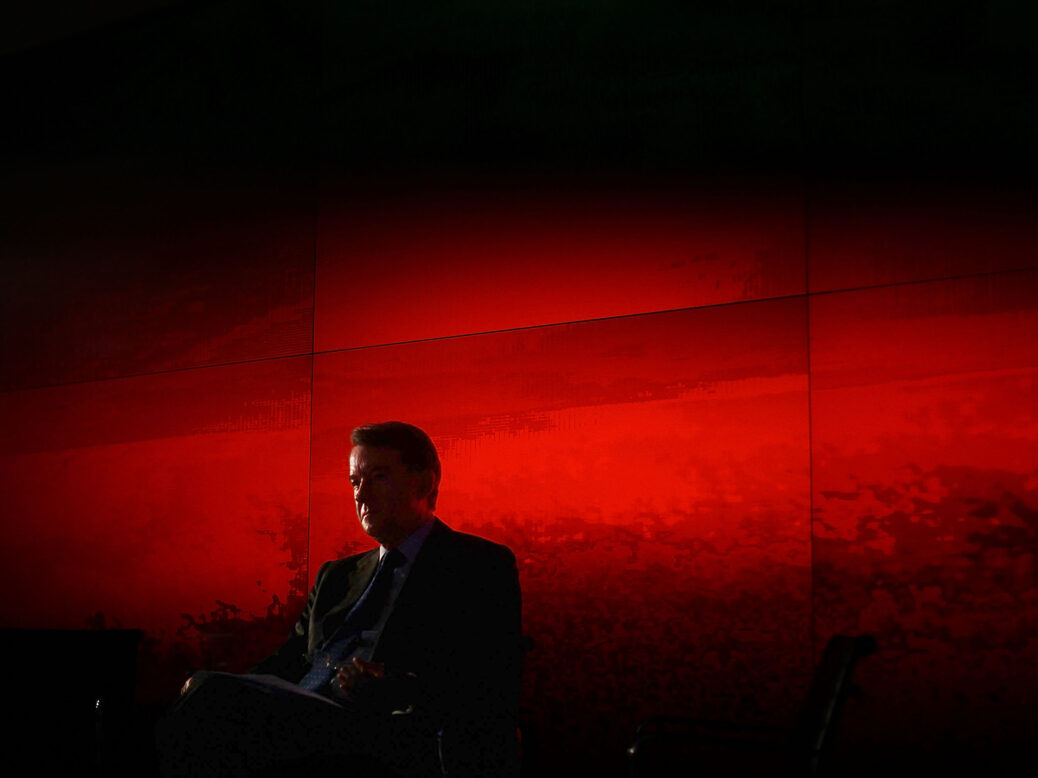
I first came across Peter Mandelson when he was still young and moustachioed. I was doing a diary column for the Independent and at a party conference, wrote an item about how he was ordering shadow ministers to clear anything they said with him – which, in those innocent, far-off days, seemed a bit much. Anyway, he didn’t like what I wrote. In the middle of the night I was woken by the scratching of an envelope being pushed under my hotel room door. In it there was a missive, handwritten, telling me never to communicate with him in any way, ever again. It was signed, in a delightful flourish, “Labour Party director of communications”.
Later, when I was BBC political editor, if I said something he thought disobliging on the ten o’clock news, he’d call me to warn me that my job was on the line: he was about to have a drink with the director general and would be obliged to tell him that Tony was very, very upset. These were unpleasant to receive, although nothing ever came of them. You can’t understand Mandelson without appreciating his hypnotic presence in the flesh. He was a man who could, literally, raise or lower your blood temperature with a single look. Now he has finally gone (oh yes he has) there’s nobody remotely like him left in British politics.
Dangerous moves
Stan Greenberg, the US pollster who did so much work with Tony Blair and Bill Clinton, gets in touch to share his latest polling. Its summary begins: “Labour is crashing. It alone is continuing to lose major support and reputation. The Budget not only failed to stabilise Labour’s position, it intensified the opposition…” I won’t go through the numbers because I don’t want this column to be too bleak. But this analysis puts further pressure on the Chancellor. There is already gossip about whether Keir Starmer would throw Rachel Reeves overboard, perhaps to offer his most obvious challenger, Wes Streeting, her job.
But there is an evident problem. Streeting is himself a close Reeves ally. If she was ousted and, outraged, said she was being blamed for decisions taken jointly with the Prime Minister, that’s the kind of thing that might provoke Streeting to move. I am indebted to the Blackley and Middleton South MP, Graham Stringer, for the following metaphor – he used it in connection with the Andy Burnham dilemma – but Starmer is now in the position known in chess as Zugzwang, when moving in any direction is bad, weakening his position further.

There is a shrewder defensive move being discussed in parliament: that Starmer intends to leave office after four years, leaving time for a successor to bed in, but not so much time that they become a national hate figure before the general election. True or not, it’s a useful story to be doing the rounds just now. Meanwhile, will the Denton and Gorton by-election bring forward the moment of crisis? If Labour comes third, behind Reform and the Greens, as I fear it will, then yes. “Zugzwang” may be a useful political term this spring.
Can the centre hold?
Reform’s biggest triumph may come not in Denton and Gorton, Wales or Scotland, but in the heart of England. The Manchester mayoralty is off the table, but trade union sources suggest that in May, Reform could take Birmingham, Europe’s largest local authority. Given Muslims form nearly 10 per cent of the population of the West Midlands (the total for England and Wales is 6.5 per cent), that would be quite a moment.
You are what you read
Articles abound on the end of the book and the remorseless advance of screen addiction. But wedged on to a busy Tube the other day, I saw about a dozen people, of all ages and backgrounds, glued to books. Most were reading fantasies and thrillers. But one man was reading Dickens’s Hard Times, and the woman opposite appeared to be gripped by Jane Eyre. Perhaps, already, the book is back.
Then there’s the question of whether the political culture affects what we read. At Heathrow recently, I considered the non-fiction bestsellers. Top of the list? Ichiro Kishimi and Fumitake Koga’s The Courage to Be Disliked. At number three, Mark Manson’s The Subtle Art of Not Giving a F*ck. And I wondered: some Trump effect? Ah, but what was number two? A Short History of the World in 50 Tyrants by Ben Gazur. Case closed.
Feel the crust
No sooner do I mention the London Library in this column then it hits the headlines in a row between the management, intent on adding catering facilities and a coffee bar, and the crustier traditionalists. I am firmly crusty. These days, we have too few well-paying jobs and eloquent politicians, but too many coffee shops. Sometimes it seems as if everywhere – every cinema, every bookshop, every station – is being café-fied. A library is a library. Enough, already.
[Further reading: The Epstein files expose the rot of Mandelson’s Britain]
Content from our partners



Related


This article appears in the 04 Feb 2026 issue of the New Statesman, The Mandelson affair
Join the debate
Subscribe here to commentCuriouser and Curiouser: The Selective Memory of the Press Gallery
Andrew, your latest autopsy of Peter Mandelson’s career is compelling, but it leaves me feeling a bit like Alice at the Tea Party—surrounded by riddles.
You write with such searing clarity about Mandelson’s “harsh treatment” of you and the “toxicity” that has finally ended his political life. And yet, it was only a few weeks ago that you were speaking of him with deep empathy (New Statesman in early February 2026) reminiscing about the pleasant evenings you spent together and describing him as a “good person.” You even stood as a literary champion for his work.
How is it that the “Prince of Darkness” can be a charming dinner companion and a “good man” one month, only to be cast as a political corpse whose time has rightfully passed the next?
It seems the world of UK politics is becoming curiouser and curiouser. When the scandals break, the very journalists who enjoyed the “hypnotic presence” of the man are the first to grab the shovel. To the outside observer, this looks less like objective analysis and more like being two-faced—praising the man when he is in the room (or the drawing-room) and dishing him the moment the wind changes.
If Mandelson is “dead” to politics, perhaps we should also ask if the consistency of political journalism died with him.