
For much of this week, whenever I have given in to the temptation of opening my phone and staring at the endless stream of content flashing before me, I have found myself watching a clip from the New Statesman’s new culture podcast, “The New Society” (available wherever you get your podcasts). The clip in question features our very own Tanjil Rashid discussing the decline of reading with podcasting superman Dominic Sandbrook. In the clip, Dominic mentions how before the recording he had popped in to see me in my office and spotted a biography of Harold Macmillan on my desk. Macmillan, Sandbrook notes, was so fond of reading he would often tell his cabinet colleagues to put events into perspective by going home to read a bit of Livy. Today, in contrast, most of the cabinet will return home and do exactly what I did: open their phones and scroll.
But does this really matter, Tanjil asks. In Dominic’s view, the answer is, yes, of course. “A world in which our politicians are basically spending their evenings on Twitter… in which the ecosystem does not give them time and space to reflect and think about things other than politics… I think we get worse politicians as a result.” This is because our leaders are denied the magic of fiction, says Dominic, to transport them into the minds of other people. Even if you put yourself in somebody else’s shoes only for a brief moment, this is “an act of empathy” that makes you understand and sympathise with those with whom you might otherwise have little in common.
I thought of this exchange as I sat down to write this week’s note. On my desk was no longer DR Thorpe’s magnificent Supermac: The Life of Harold Macmillan, which somewhat remarkably I had actually tidied away back on to my shelf, but two collections of essays by the late (and great?) Michael Foot. My favourite of these collections is Debts of Honour, published in 1980. What a man Foot was. Opening the book, the first page you come across is his bibliography, which starts 40 years earlier with Guilty Men, that blistering polemic against those who had led Britain to the point of catastrophe.
Of the essays in Debts of Honour, the best is his defence of Benjamin Disraeli, “The Good Tory”, as he calls him. In Foot’s estimation, the genius of Disraeli was to cloak his inherent radicalism and disdain for the Conservative Party in the comforting clothes of romantic old Toryism. He was, according to Foot, a visionary who had the novelist’s greatest trait: imagination. “In imagination, I shook thrones and founded empires,” Disraeli once wrote. “I felt myself a being born to breathe in an atmosphere of revolution.” In Foot’s account of Disraeli’s life, the author always makes himself the hero of his novels, “a hero whose whole instinct was to join, indeed to command, the revolt against the existing order”.

We live in an age of constant revolt against the existing order – often for good reason – but without any real imagination to mould or shape it into something better, “to impose order on the revolutionary passions”, as Foot put it. Perhaps this has something to do with the perceived decline of the novel as well. Not only do our politicians seem incapable of taking a break from politics by escaping into the novel, but in this failure they also seem unable to think beyond the realm of what already exists.
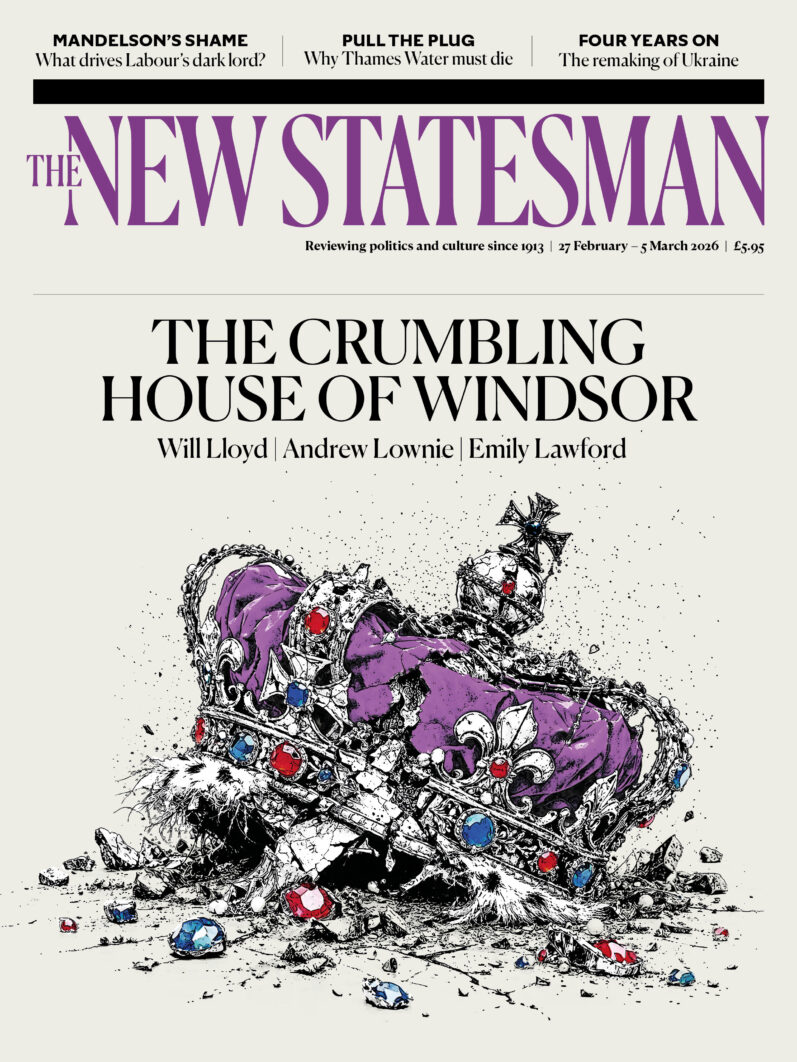
Something like this feels the case today as the nation’s institutions crumble before us. The most obvious case in point is, of course, the monarchy, as our deputy editor, Will Lloyd, writes in this week’s cover story on page 20. But it is not just the monarchy whose authority seems to be disintegrating. Get too close to any British institution today and you are liable to catch the stench of decay hanging over it, whether it is Thames Water (as Will Dunn writes on page 26), the party system (as we may see in this week’s by-election in Gorton and Denton), or even the Union itself, which will, once again, be on the ballot paper in the elections to Holyrood and the Senedd in May. There’s a radical spirit out there in the country, but no radical imagination.
Where are our modern Disraelis? In the summer of 1836, as Disraeli’s private life began to spiral out of control, he escaped into his imagination, writing Henrietta Temple. “When both his love life and his financial affairs were collapsing into fiasco,” Foot writes, “he somehow created for himself a world of hope and composure.” We could do with some of that now.
[Further reading: The crumbling Crown]
Content from our partners



Related


This article appears in the 25 Feb 2026 issue of the New Statesman, The Crumbling Crown
Join the debate
Subscribe here to comment