
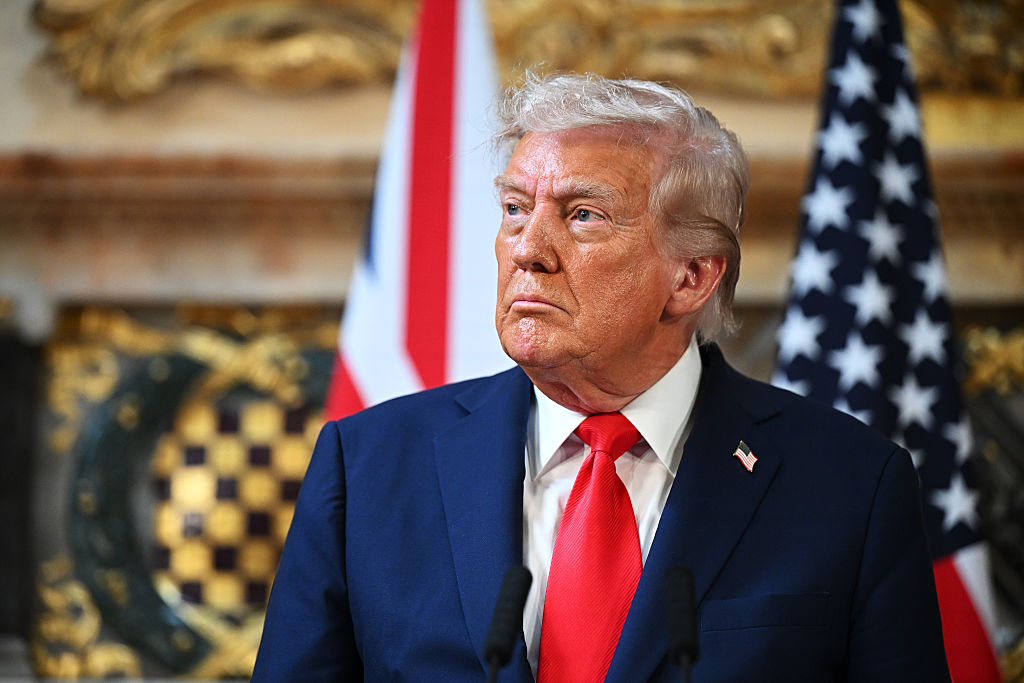
For President Donald Trump, legal threats to sue are about the art of leverage, if not (as the title of his book suggests) the art of the deal. He uses civil litigation, where one party takes another party to court, as a deft means of promoting his commercial and political interests. He is a master of this craft – or of craftiness.
Few of these cases ever get to full trial with a judgment and a final court order. And if they do reach that point and go against him, he will simply appeal and, if necessary, appeal again. The strict legal merits do not matter, for Trump has a shrewd understanding of the underlying power relationships and keenly spots institutional weaknesses.
Many of his threats will be withdrawn, once they have served their practical purpose, or the other side will settle the claim. These settlements will invariably involve money going to Trump and will be portrayed as (and may well be) capitulations. It does not matter if the other sides are worldly law firms or august universities: Trump will know how to play them.
Usually we in the United Kingdom get to watch this “lawfare” from afar and watch how those who often should know better often surrender and give Trump what he wants. From time to time there will be brave entities and individuals that will defy his demands backed by litigation menace, but usually we will see him chalk up another victory.

This week, however, this “lawfare” spilled over to the United Kingdom. Trump’s target was our public service broadcaster, the BBC, in respect of the broadcast of a Panorama programme just before his 2024 re-election.
On the face of it, his claim was weak. His Florida lawyers’ letter was little more than bluster. The programme had not even been broadcast in the United States and was not formally available on iPlayer. There was no evidence that anyone in the US watched the programme or was even aware of it.
The weakest part of the letter was its assertion that Trump had suffered “overwhelming financial and reputational harm”. This was asserted three times in the letter, presumably on the Beetlejuice principle that if you say something three times it somehow appears. But the letter provided no evidence of this whatsoever. Indeed, rather than suffering any obvious harm, Trump was re-elected as president days after the broadcast.
The letter then stated the damages claim would be for no more than $1bn, an eye-catching amount which then led the next day’s news headlines. But the figure was arbitrary, and there was no more basis for it than for a claim for $1tn or for a nickel. The lawyers’ letter was not a serious legal threat.
But it was a threat, and a real one. For it does not matter what were the legal and evidential merits of the claim. Trump and his lawyers had spotted a weakness, in the way that certain animals are said to smell blood. And the weakness here was that the BBC had made a non-trivial mistake in their broadcast.
There was an edit of the speech Trump gave as president on the fateful day of the attack on the Capitol, 6 January 2021. The edit spliced together two distinct moments to make it look that, in one utterance, Trump was calling on his followers to commit violence. In fact the start and the end of that utterance were nearly an hour apart in that long rambling speech.
This was a bad mistake by the BBC, as it gave a misleading impression of what was said by Trump. As the programme was made by a production company, it may be that the journalistic error was not directly that of the BBC, but the BBC approved what was broadcast and so it was legally as well as editorially responsible.
Whenever there is an aggressive legal letter in the news, some people online urge that the recipient respond with the famous reply given in Arkell v Pressdram. But here the BBC could not afford to be so playfully robust. In that hallowed incident, Private Eye knew they could stand by their journalism and so could be less worried about how any litigation would go. They could risk an elegant response ending with an expletive. In this situation, however, the central facts were not in the BBC’s favour. They had mucked up.
A different response was needed. One possible way the BBC could have reacted was to indeed offer Trump compensation, among other things. The broadcaster could pay him to go away. They could even seek to give him money in return for favourable treatments. After all, this is what broadcasters and other targets of Trump have done over there, in the United States.
But wonderfully the BBC has stood firm. Yesterday the BBC offered an apology and a retraction. This was right and proper, given the breach of broadcasting standards. The BBC should not defend the indefensible. When mistakes are made apologies and retractions should follow.
The BBC, however, has refused to pay any damages, either of one billion dollars or at all. This also is right and proper. There was no sound legal basis for a claim for money and so, in turn, there was no sound basis for a public service broadcaster to meet such a demand.
The BBC has expressly provided five reasons for non-payment of damages. These are that the programme was not broadcast in the US and nor was it there available on iPlayer, that the documentary did not cause Trump harm as he was re-elected shortly after, that the clip was not designed to mislead and not done with malice, that the clip needed to be seen in context of the programme as a whole, and that it was a matter of public concern protected by free speech rights.
These legal points would be obvious to any competent media lawyer, but when dealing with Trump and his lawyers’ demands, the legal merits often do not matter. When there is institutional weakness there will be senior demands for concessions and compromise, regardless of the correct advice of in-house and external lawyers. Directors and managers panic and want things to go away.
The BBC is therefore to be congratulated for dealing with this legal threat in the best way. The broadcaster has yielded where it needed to yield, but it is resolute where the claim has overreached itself. This is always the best way for dealing with such legal threats. It removes the leverage for any demands for more.
We do not yet know how Trump and lawyers will react to this sensible, measured response. He may well file suit, for the sake of demanding more. But even if he does, the BBC response so far places the broadcaster in the best position for dealing with any claim.
Or Trump may declare a victory on the basis of the apology and the retraction – things to which any person wronged by the BBC would be entitled, whether a president or pauper.
The BBC has done well with its response, even though there were failures in the original broadcast. This indicates the BBC – or at least its legal advisers – also understand the art of leverage. It is not a craft – or a craftiness – reserved to just one person, even if he is a president.
[Further reading: Trump’s attack can rescue the BBC]
Content from our partners


Related
Join the debate
Subscribe here to comment