
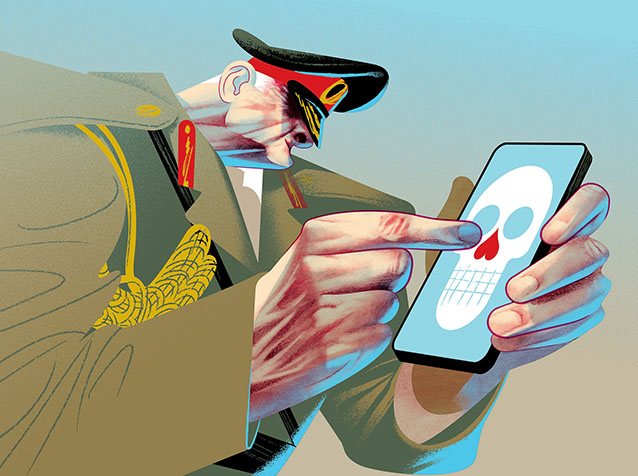
The corridors of the Old War Office are 9-feet wide and the air is thick with ghosts. Churchill and TE Lawrence worked here, as did Stafford Beer and Ian Fleming. Up the stairs is the room in which MI5 and MI6 were conceived; the intelligence men took their guests to the basement for interrogation. Every corner holds the shade of a person or decision of great consequence. This being 21st-century Britain, we have of course sold the building to overseas investors, and it has been repurposed as a hotel, Raffles at the Old War Office, but in its corridors the defence of the realm is still discussed. At the London Defence Conference, ministers, heads of state, soldiers and arms dealers have gathered to discuss a question: is the UK ready for war?
Are you prepared for war? Has your Uncle Terry dug a bomb shelter in his allotment? Has Mrs Bagworth from No 43 sharpened her bayonet? Such questions belong to another era: the late 1930s, perhaps. Back then, a Conservative government – goaded by the Daily Mail – had spent much of the previous decade imposing a programme of drastic cuts to public spending, while at the same time deluding itself that defence could also be slashed, because some bright spark (Winston Churchill) had made up a “ten-year rule” that posited war was a distant prospect. Back then, one of the world’s major powers was taken over by a racist megalomaniac who sought to make a deal with Russia, and Britain was forced to conduct humiliating diplomacy with this man – who was as risible as he was terrifying – while his far superior military invaded other countries and we scrambled to rebuild our defences. It’s a good thing that’s all safely in the past! Phew!
That’s the theme of this conference: readiness. The Defence Secretary, John Healey, arrives to announce that the UK will be ordering a load of new missiles called Skyhammers. Kemi Badenoch shows up the following day to complain that the economy her party destroyed isn’t doing the defence spending her party failed to do. By the tables where coffee and lunch are served, there are banners emblazoned with sponsors’ logos, companies named like angry gods (Chaos, Destinus, Nexus, Tiberius) or nouns from Lord of the Rings (Strider, Palantir). On stage, one panellist refers to “the business we’re in”, which it very much is. Defence spending is unique. In transport, health and everything else, the state commits to providing something and tries to do so as cheaply as possible; in defence, the state commits to spending an amount and finds things to spend it on.
The prime minister of Kosovo, Albin Kurti, tells the audience that Russia is engaged in “a preparatory phase for war”. A Dutch general tells the audience that the population of the Netherlands is being trained for resilience; people are being taught to go to the aid of their neighbours. He says the public has already begun to take an interest in national service. In defence circles this is known as a whole-of-society response. Will a country as unequal and fragmented as the UK be capable of that? Will the baristas leap to the defence of the management consultants? Will the HR directors take a bullet for the zero-hours cleaners?

And what are we supposed to be ready for, as a society? Warfare is more devious and complicated now than ever before. A British academic tells the crowd he has intelligence that Russian mini-submarines have placed remote controlled explosives near our undersea cables. An American congressman speaks admiringly of “the most recent display of American capabilities”, by which he means the disastrous war in Iran. He says the US’s glorious victory is what’s keeping China from invading Taiwan. “It’s incredibly instructive to our adversaries what the US is capable of,” he declares, and while I am no defence analyst, I do think this is true: America has shown China that for all its might, it can be embarrassed by a much smaller and less well-equipped force. The big danger to Xi Jinping at the moment is that he might laugh so hard he’ll give himself a hernia.
The Dutchman, General Hoojebombe, says there is no question that the US would come to Europe’s aid should the time come, and the congressman does a weird head-shifting motion, forward and back, a kind-of nod. No one mentions Greenland.
The crowd at a defence conference makes for interesting viewing. There are soldiers from various countries, generals garlanded with golden rope. There are ex-military types in suits (whose size and posture marks them out), lobbyists and arms dealers. In the auditorium, someone seated to my left is scrolling through videos of Lebanese villages being flattened by the IDF. As a panel session ends, two posh ladies in their sixties embrace, exclaiming with plummy delight, asking after husbands and families. Among the dainty white chairs, they could be at Henley Regatta. There is some corner of military culture that will forever be the preserve of the equestrian class, the families who have been ready since the emerging technologies were plate armour and halberds. You might find these same women at Glyndebourne, stepping from elderly Land Rovers, the same mwah-mwah-darling-how-ARE-you, the same loud, oblivious superiority. Such people are too well-bred to notice people below their station, let alone surrender to them.
An Israeli defence executive is wearing skin-coloured Louboutins and a trouser suit as blue as a serious computer malfunction. Her company makes something called a “battlefield operating system”, which links together different pieces of technology to make them more lethal. She talks about “open architecture” and start-up culture; she could be on stage at any tech conference, except occasionally she uses a phrase like “digitising the kill chain”. On stage with her is Louis Mosley, the UK head of Palantir, who uses Churchill’s phrase – the “wizard war” – to describe the new high-tech battlefield. They talk about “exquisite systems” (things like missiles, which destroy people at great expense) and “attributable mass” (things like drones, which destroy people for less money) and lowering the “cost to kill”. In this conversation, Israel and Ukraine are talked about as equivalent – two plucky countries changing themselves and the world in the face of an “existential threat”. The existential threat to the Palestinian people is never mentioned.
Mosley talks about how his company sold its technology to the Ukrainian military, overcoming reticence and suspicion battalion by battalion; a Ukrainian says how important it is that the “platform” has lots of “daily active users”, like it’s a social media app. The Israeli executive says her friends in the tech sector once used to take their innovations to San Francisco, but now they want to innovate for defence: “This is something the world should enjoy the fruit of.”
On a road about a mile away I pass a student protest against the conference; they seem to have been misdirected. Students and others chant their support for Palestine. A woman holding a flag raises her arms to hug a friend and for a moment they are both wrapped in it, clothed in the colours of the Islamic Republic of Iran, its central prayer repeated winding and fluttering across their shoulders. The most recent polling finds one in four people in the UK see the US as an ally that shares our interests. The question of Britain’s readiness for conflict is not just a question of spending priorities and industrial capability, as it was in the 1930s. It’s a political question: could we agree what side we’re on?
[Further reading: Donald Trump is WEAK on Catholicism]
Content from our partners



Related

This article appears in the 15 Apr 2026 issue of the New Statesman, Angry Young Women
Join the debate
Subscribe here to comment