
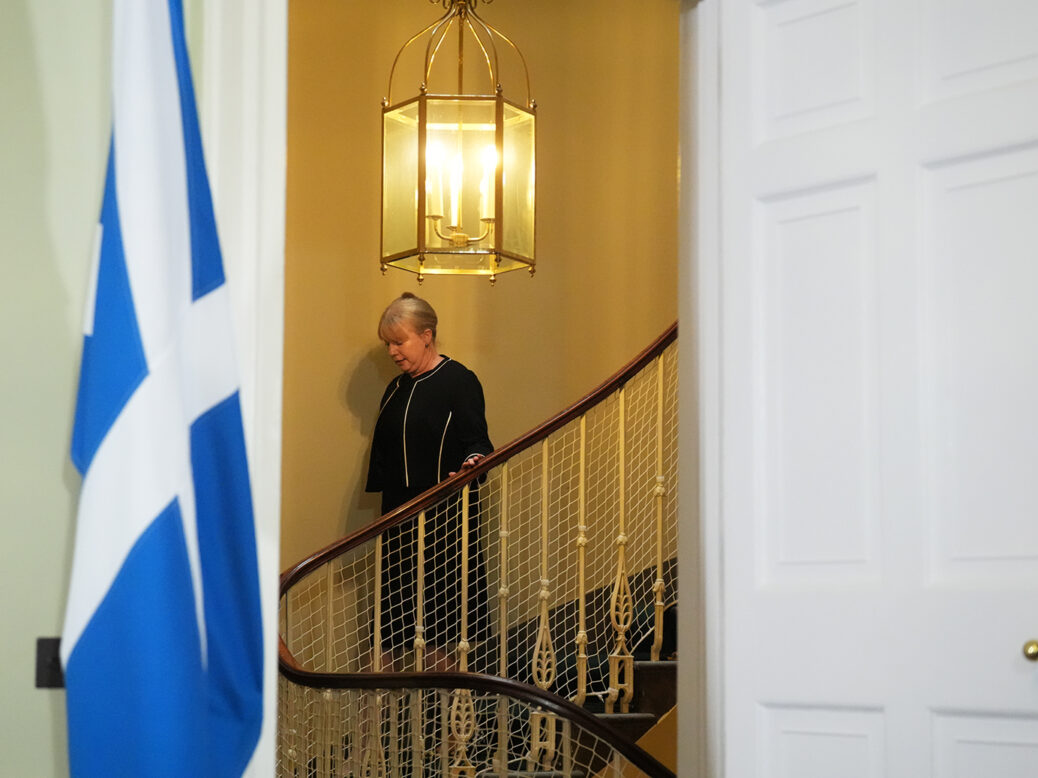
In her upcoming Budget, Rachel Reeves is rumoured to be planning a revision of council tax as part of a wide swathe of tax rises. Owners of expensive houses could be asked to pay thousands more, with the plan estimated to raise around £4bn a year. For decades, governments have shied away from reforming council tax, wary of a backlash from those affected. It has never seemed to be worth the political capital it would cost. Now, though, our desperate Chancellor seems likely to take the risk. It’s about time Scotland’s leaders did the same.
They are certainly talking the talk. Last month, finance secretary Shona Robison published a consultation on reforming council tax. On the back of a paper by the IFS, the Scottish government said it would work with Scotland’s councils to devise a new system. Properties are currently taxed on their 1991 value, which just shows how long it has been since this particular thistle has been grasped.
Robison says the government “is not advocating for a specific reform”. However, it seems likely that those in the priciest homes will pay significantly more. The new system won’t arrive any time soon, though, with Robison stating it “would require a long delivery period and would likely not be complete in this decade”. Doing something slowly is better than doing nothing, I suppose, and the time frame might allow the SNP to prepare voters and build some political consensus behind the plan.
But they should be doing more. Scotland – ironically, given its devolved status – is one of the most centralised nations in Europe. The Scottish parliament, especially under SNP rule, has consistently gathered power to itself, stripping councils of autonomy over policy, services and finances, and creating national agencies everywhere you look.

This goes against the healthy principle that decision-making is better exercised as close to communities as possible. The challenges facing the Borders are very different from those facing Glasgow, which are different from those faced in Aberdeen. Yet, too often, it has seemed like the man or woman in Bute House has felt that they know best. As a result, starved of resources and unable to do much about it, local democracy in Scotland has withered. Polls show public trust in councils has plummeted since the advent of Holyrood.
Contrast this with the vibrancy that has been unleashed in those English areas with directly elected mayors. When I attended Labour conference in Liverpool, the city seemed to be buzzing with renewed purpose. The same is true of Manchester under Andy Burnham, and Tees Valley and the West Midlands have found new life under their mayors.
Scottish Labour has made noises about introducing directly elected mayors, though we may not know the detail of its plans until the party produces its manifesto for May’s Holyrood election. But the polls consistently indicate that the SNP is likely to emerge as the largest party, and the national leadership has shown little interest in pursuing the innovation.
This would be a shame. It’s hard to avoid the suspicion that the SNP’s reluctance to go down the mayoral route – which is standard in many countries – is in part based on a desire to avoid creating peripheral power centres, which, as we’ve seen in England, can create problems for the centre. It is also a nationalist instinct to put a national identity above local ones – if you want Scots to vote for independence, they should feel Scottish first and foremost, rather than Glaswegian or Dundonian. Hence all those national agencies and powers dragged to the centre – these are the trappings of potential statehood.
If we want Scotland to flourish, then this is most likely to begin at a local rather than national level. Local businesses drive economic growth, so allow local politicians to devise and implement strategies that will help them. Local communities care most about their city and town centres, so give them the ability to revitalise these places. A directly elected mayor is a figurehead, but also an advocate, a scrapper for local priorities and a lightning rod for a community to think and talk about itself: what it is, what makes it distinctive, what it might yet be.
In a forthcoming paper on local government reform that will be published by Enlighten, my think tank, the Mercat Group of former council chief executives argues that “the aim should be for decision-making at the most local level, consistent with sound democratic and financial accountability. The devolution settlement always saw devolution extending to the most appropriate level. The Scottish Parliament has, so far, assumed a top-down approach, and local democracy has perished in its wake.
“The key objective should be to increase the participation of both people and businesses in the governance of Scotland. Both councils and communities have become less involved in shaping their futures as more decisions are taken centrally. The consequence has been the loss of trust in both councils and the Scottish government.”
This is clearly and demonstrably true. One solution to the rise of political extremes is to empower people to make decisions and take responsibility for the environments in which they live every day. A sense of ownership is a powerful and inspiring thing. That’s why change should be embraced by whoever wins in May.
[Further reading: Distrust between Scotland’s leaders is a barrier to reform]
Content from our partners


Related
Join the debate
Subscribe here to comment