
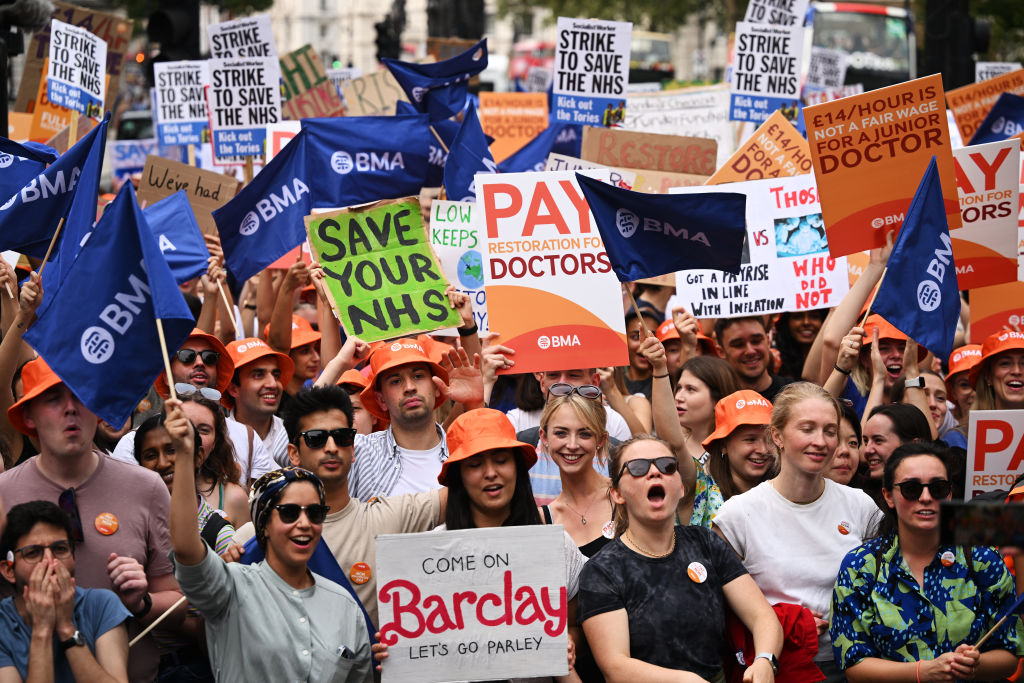
“The start of a new relationship between the government and NHS staff.” That was Rachel Reeves’s assessment of the decision to offer a 22 per cent pay rise to junior doctors weeks after Labour won power.
A year later, that relationship has soured. Resident doctors, as qualified medics below consultant level are now known (the term “junior” was thought derogatory for the work they do and experience they have acquired), voted this week for six months of industrial action – starting with a five-day strike at the end of this month. Or, at least, just under half of them did: turnout for the ballot was 55 per cent of BMA members, of which 90 per cent voted to walk out.
Their demand? Another pay rise of 29 per cent, to reverse a real-terms reduction in salary since 2008.
Health Secretary Wes Streeting was quick out of the blocks to condemn the move, calling it “completely unreasonable” and adding “The NHS recovery is hanging by a thread, and the BMA are threatening to pull it”. He pointed out that resident doctors have received a 5.4 per cent pay rise this year in addition to last year’s 22 per cent, and that the public “would not forgive them”.

This latter point is going to be key in determining how this fight plays out. Before the election in June 2024, over half (52 per cent) of people supported junior doctors going on strike. By May, that had fallen to 39 per cent (with 48 per cent against), and a new survey from the Good Growth Foundation has put it at just one in five. (Interestingly, the numbers are about the same for people who voted Labour in 2024. This is not an issue that splits down party lines.) If they walk out on 25 July, doctors will be going against the wishes of their patients.
No doubt this collapse in public support for the young medics who staff our hospitals is in part due to the huge pay settlement they got last year (most British workers will not have seen their salaries rise by 29 per cent in a two-year period). Covid fatigue and the public’s reluctance to rehash yet again how challenging things were during the pandemic years probably also comes into it. In the same way that the Labour government quickly exhausted the excuse that the Tories broke everything, NHS workers are facing similar hostility to their case that they deserve redress for decisions taken under Cameron and Osborne. The argument that they lost out may be true, but – looking at falling living standards, broken public services, pay loss in other public sector areas and higher costs all round – so did everyone else.
But public frustration at the strikes doesn’t necessarily help the government. For one thing, critics are arguing that the BMA only feels so emboldened because Labour caved so quickly last year: “the unions are coming back for more”, as one right-wing commentator put it. And the government has somewhat hamstrung itself with its arguments, both before the election and after, that resolving pay disputes is less expensive than the cost of strikes themselves. While technically accurate, this simply invites unions to threaten more walk-outs for more pay rises. Which, indeed, they have done.
The other challenge for the government is that, regardless of what voters make of the demands, you can’t actually force people to work in the NHS if they don’t want to. The BMA notes that “between September 2022 and September 2023, 15,000-23,000 doctors left the NHS prematurely in England”. Qualified doctors can choose to work elsewhere – in the private sector, in more attractive places like Australia and Dubai, or in other sectors entirely where the work is less stressful and they are, for example, allowed to book off annual leave for their own weddings.
It is this area, the working conditions, where the government thinks there is room for negotiation: rotations forcing young medics to move across the country, doctors not finding out which hospital or even city their placements will be in until weeks beforehand, bottlenecks in career progression that leave people stuck in jobs they are over-qualified for, plus more notice for shifts and the ability to book time off in advance. Streeting has acknowledged there are ways in which the NHS can do better as an employer as well as a provider, treating people who trained for nearly a decade to work in it with more respect and consideration. His aim to use discussions with the BMA was, he said, to “improve the working lives of resident doctors”.
BMA representatives feel that such offers are little substitute for a deal on pay. But given the fact that a majority of its members did not vote for strike action, it’s possible most resident doctors themselves feel differently, and would be more inclined to accept the pay deal they’ve received (the highest in the public sector) if it came with improvements on working culture. There is also the prospect – reported in December to be under consideration – of allowing public sector workers to trade some of their generous pension entitlements in exchange for higher salaries now, which former cabinet secretary Gus O’Donnell described as a “win-win” as it would save taxpayers money in the long term.
Elsewhere in the world of healthcare, there is good news for Wes Streeting to trumpet this morning: new data shows overall waiting list numbers fell in May (for the first time in 17 years) to their lowest level in two years, and the GP patient satisfaction survey shows improvements (though modest ones) on a range of patient experience metrics since last year. Labour can make the case that NHS provision is finally heading in the right direction. It can also remind the public of the millions of appointments cancelled and billions of pounds lost during NHS worker strikes under the Conservatives, and raise once more the spectre of a Reform party that wants to “scrap the NHS”, given what Nigel Farage has said in the past about funding healthcare.
Nonetheless, a five-day walk-out in British hospitals is deeply unhelpful for a government that promised to fix the NHS – a pledge which, along with raising living standards, will likely define the next election. The stakes for this particular show-down could not be higher. No pressure, Wes.
This piece first appeared in the Morning Call newsletter; receive it every morning by subscribing on Substack here
[See also: The left’s losing streak]
Content from our partners



Related



Join the debate
Subscribe here to comment