

It’s the emptiness that hits you first. In Conservative Party conferences of recent past, the vast, cathedral-like cavern that is the Manchester Central Convention Complex (MCCC) has been packed to the rafters, becoming (in keeping with the city’s emblem) a frenzied humming beehive of activity for three days. But now there is space to breathe, to sit, to charge a laptop or take a phone call. The exhibition hall, usually crammed with corporate and charity stalls jostling cheek-by-jowl, is an eerie wasteland, the few stands that have made it this year lone rocks looming out of the barren landscape.
I am told by one party faithful that the deserted vibe is down to unlucky logistics. The MCCC is such a huge venue, even a small drop in attendance is noticeable. Had the Tories not been tied to an existing contract they could have booked a more modest conference centre, and it would not be so obvious just how much smaller this gathering is. Yet the contrast to previous years – even 2024, the party’s first conference in opposition in a decade and a half – is so dramatic attendees are suffering a kind of culture shock.
Emerging through security and finding no crush to fight through, no snaking queues, they are pausing, open-mouthed. Is this it? The polls – which have seen the party plummet from almost 30 per cent when they last gathered to 16 per cent now – have told a depressingly consistent story over the past year. It should not be news that the Conservative Party is suffering an existential crisis. Yet there is a difference between reading dry numbers on a page and seeing that reality played out in the flesh, in rows of available seats at events which should be invite-only. The promise from Tory officials that the speeches on the main stage will include a raft of new policy announcements is not enough to prevent shadow frontbenchers from addressing half-empty halls.
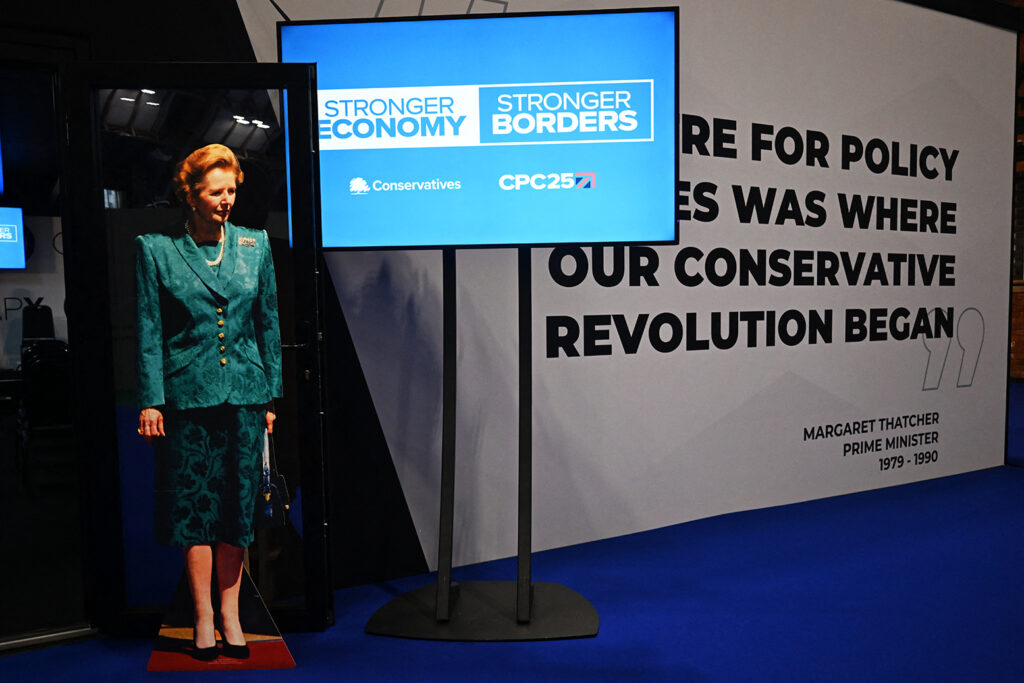
The atmosphere in the exhibition hall has an edge of magical realism. The ghost of Margaret Thatcher haunts proceedings. As well as the Thatcher Theatre, an exhibition commemorating 100 years since the Iron Lady’s birth displays mannequins of her most famous outfits. One almost expects them to come to life, Doctor Who-style, and rampage through the installation opposite – branded “Labour’s circus of despair” where participants can “roll up” to “whack a taxpayer” or spin “Rachel Reeves’ wheel of tax”. No one is. Attendees can also worship at the altar of giant JCB tractor – a company whose owner, the erstwhile Tory mega-donor Anthony Bamford, is openly flirting with Reform. Sunday night sees a rather manic Victoria Atkins, shadow environment secretary, reciting a speech (or possibly filming a video – there doesn’t seem to be a camera so it’s hard to tell) in front of an imaginary audience right beside it. She turns and beams: “Hello, tractor!” She seems delighted to have made a new friend.

Further down, another prime ministerial spectre has been brought back to life: a CGI Winston Churchill, spotted bow-tie at the ready, stands in wait to converse with anyone who will listen about the risks and opportunities of artificial intelligence. Of the five prime ministers the Conservatives have had in this century, there is no trace.
This is a party that still has no idea how to escape from the curse of recent history. For half an hour on Monday morning the main stage is devoted to a debate entitled “Big Tech on trial”. It’s about the Online Safety Act – a flagship Conservative policy developed under multiple Conservative prime ministers, implemented by Labour earlier this year. The shadow science and technology secretary Julia Lopez hosts: is the act protecting children or policing speech? The audience are unequivocal. They do not like the Online Safety Act their party thought up, designed and push through parliament. What is a party whose members – including MPs – despise what it did during 14 years of government meant to do?
One answer is to back into more comforting times. At a reception on the Sunday night (fuller than most, but at which it is still surprisingly quick to get a drink) one Tory MP tries to rally guests’ enthusiasm for Kemi Badenoch by reminding them that 50 years ago the party was also led by a difficult woman who was widely underestimated – and look where that led. “Cargo-cult mentality,” says an exasperated party insider later on. During the Second World War, religious movements arose among indigenous communities in the Pacific that received food and supplies from technologically advanced nations via airdrops. When the war ended, the people created military-inspired rituals and built models of aeroplanes to try to magic the airdrops into resuming. The Tory party is embroiled in its own version, repeating the motifs of the 1970s in the hope of conjuring a Thatcher-like victory out of thin air. Kemi Badenoch is a model plane.
Other paths forward are available, personified by Robert Jenrick’s “Duracell bunny” tour of the conference. “We need him in charge to stem the bleeding,” one member says at a TaxPayers’ Alliance (TPA) event Jenrick is due to speak at. “It’s not about winning – it’s about cauterising the wound.” Jenrick’s speech is upbeat and succinct. He is unstintingly gracious about Badenoch (no Andy Burnham antics here) and respectfully sceptical of Nigel Farage, saving his ire for the Labour government. He delivers witty asides about Ozempic that morph into an erection joke about Keir Starmer’s cabinet and their difficulties when it comes to growth. It doesn’t make a lot of sense, but the crowd adore it. At least someone seems to be having fun.
The TPA tent is decorated with a giant TV screen showing the national debt ticking up, second by second. This is the other Conservative strategy: economy, economy, economy. “Stronger Economy, Stronger Borders” screams the slogan emblazoned on everything. The big announcement from shadow chancellor Mel Stride, reimagining himself as a British, wild-swimming version of chainsaw-wielding Javier Milei, is £47bn worth of public spending cuts – about the size of the black hole Liz Truss found herself with after the tax-cutting mini-Budget. The money would come from stripping back welfare from non-UK citizens and slashing the civil servant headcount. It’s not clear that the numbers add up, but apparently this isn’t the point. “We’re the only party talking about fiscal responsibility,” a slightly giddy Tory policy wonk tells me on Sunday night when the press release gets sent round. “Labour are spend, spend, spend, Reform are just as bad. We’re the only centre-right party left. Voters want a party that will be honest about public finances.” I point out that in the Exhibition Hall, just opposite the life-sized Margaret Thatcher cardboard cut-out welcoming guests to the Centre for Policy Studies lounge, stands a wall-sized sign demanding “Keep winter fuel”. It has been placed there by CCHQ, to fill the space in the absence of a corporate stall to take the slot. I ask if fiscal responsibility also applies to the over-65s. He goes to get another drink.
[Further reading: The danger for the Tories is simple irrelevance]
Content from our partners

Related
Join the debate
Subscribe here to comment