
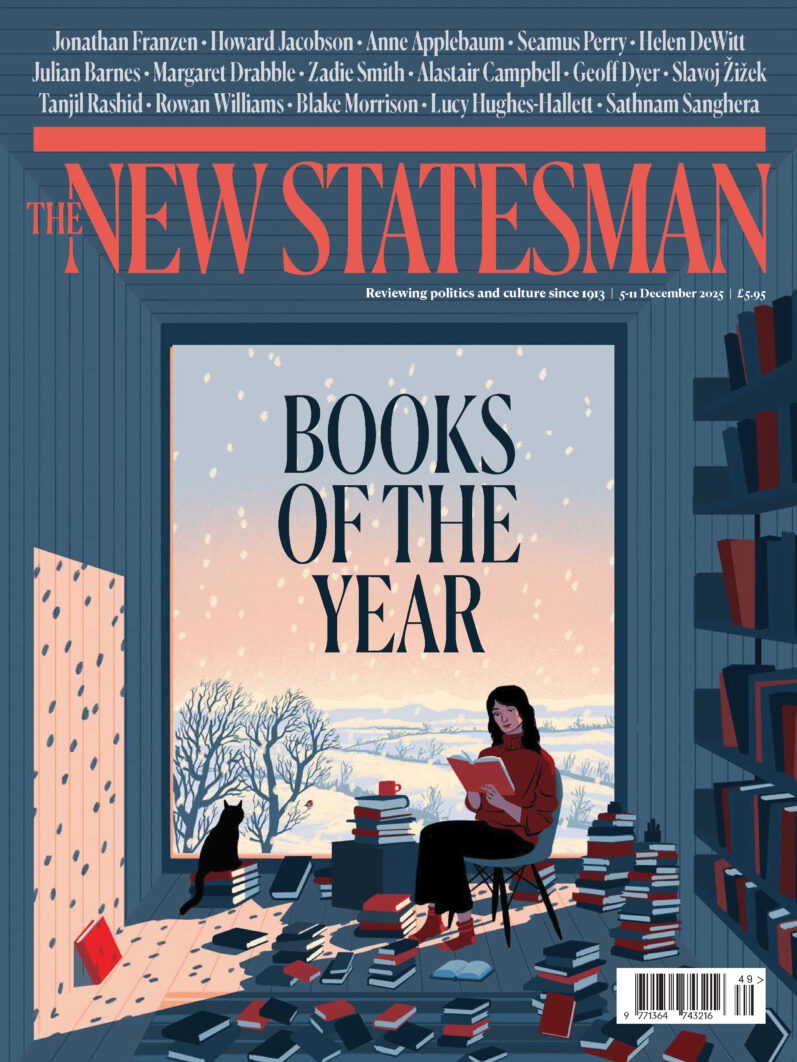
When Tanjil Rashid approached me to ask whether I would nominate a book of the year for this week’s special edition of the New Statesman, I had a pang of anxiety. Had I read anything suitable? For much of the first half of this year, I spent almost every waking hour working on my own book rather than enjoying other people’s. What reading I had done was largely focused on Britain’s long, difficult relationship with Europe since the Second World War, the subject of what became Between the Waves.
Of the books I had managed to read for pleasure, almost none seemed to fit the bill, either because they were too obscure, too old or simply not good enough. Towards the end of last year, I thoroughly enjoyed George Saunders’ Lincoln in the Bardo, one of the strangest and most beautiful books I have ever read. In the book club of south-east London dads to which I belong, I gave it eight out of ten. I scored the next even more highly: Cormac McCarthy’s All the Pretty Horses, which I found completely mesmerising.
At one point early in the novel, McCarthy writes about a young boy who goes to watch a play starring his runaway mother. “He’d the notion that there would be something in the story itself to tell him about the way the world was or was becoming but there was not,” McCarthy writes. “There was nothing in it at all.” Oof. What a thought. I find myself coming back to these lines all too often when looking despairingly at our political leaders today, none of whom seem able to give an illuminating account either of the way the world was or what it is becoming.
The book club’s latest novel was Penelope Fitzgerald’s Offshore, but this was published in 1979 so could hardly count as a book of 2025. I was less enamoured with this book anyway, though its setting – the riverboats of Battersea Reach in Chelsea – has stayed with me: a bobbing, indeterminate place to live. The book lies in front of me now, a page folded down to mark another sentence lodged in my mind, about a little girl who “cared nothing for the future and had, as a result, a great capacity for happiness”. Is this the answer? Instead of demanding that our leaders tell us a story about the world, we simply need to stop worrying? However cynical I might have become lately, I cannot bring myself to accept this. Yes, contentment is important, but we can also – reasonably – demand more.

In the end, there were only two books published this year that I can plausibly claim to have read. The first is Charles Moore’s single-volume biography of Margaret Thatcher – though, in fact, I have only skimmed this volume, because I am one of those political obsessives who has read all three of his original volumes, published in tranches over a decade from 2013. The combined work is a remarkable achievement, the closest anyone in Britain has come to Robert Caro’s The Years of Lyndon Johnson.
The other book I considered nominating is the latest Cormoran Strike novel by Robert Galbraith (JK Rowling), The Hallmarked Man. Here, though, I must first confess I did not actually read this one: I listened to it. My wife and I have made a habit of doing this in the evening whenever the latest Galbraith novel drops. I thoroughly enjoy it – if I can stay awake long enough to become hooked.
Though I do not think the latest in the series is the strongest, what fascinates me about these novels is the Britain – or, rather, the London – that Rowling portrays. If Conan Doyle and Joseph Conrad captured the dark underbelly of imperial London, and Hanif Kureishi the banality of Thatcherite suburbia, then Rowling seems to present a dark, paranoid place of violence and manipulation, conspiracy and superficiality, in which the heroes of our time are those brave enough to separate themselves from the mess around them to pursue the truth. One of the reasons I think the detective series has become so popular – beyond the romantic intrigue woven throughout – is that this picture of modern Britain feels so alive and real. It is a grimmer version of reality, of course, but it is recognisable, even if only in the gloomier corners of our fearful imaginations.
Unlike McCarthy’s disappointed theatregoer, we at the New Statesman remain convinced that there is still much to discover from the great show of life. We have been reviewing politics and culture since 1913. Politics will no doubt continue to churn, ever more darkly. For this week, though, it is time to give culture the space to shine its light on what it is all for. We hope you enjoy reading our books of the year as much as we did collating them.
[Further reading: Books of the year 2025]
Content from our partners


Related

This article appears in the 04 Dec 2025 issue of the New Statesman, Books of the Year
Join the debate
Subscribe here to comment