
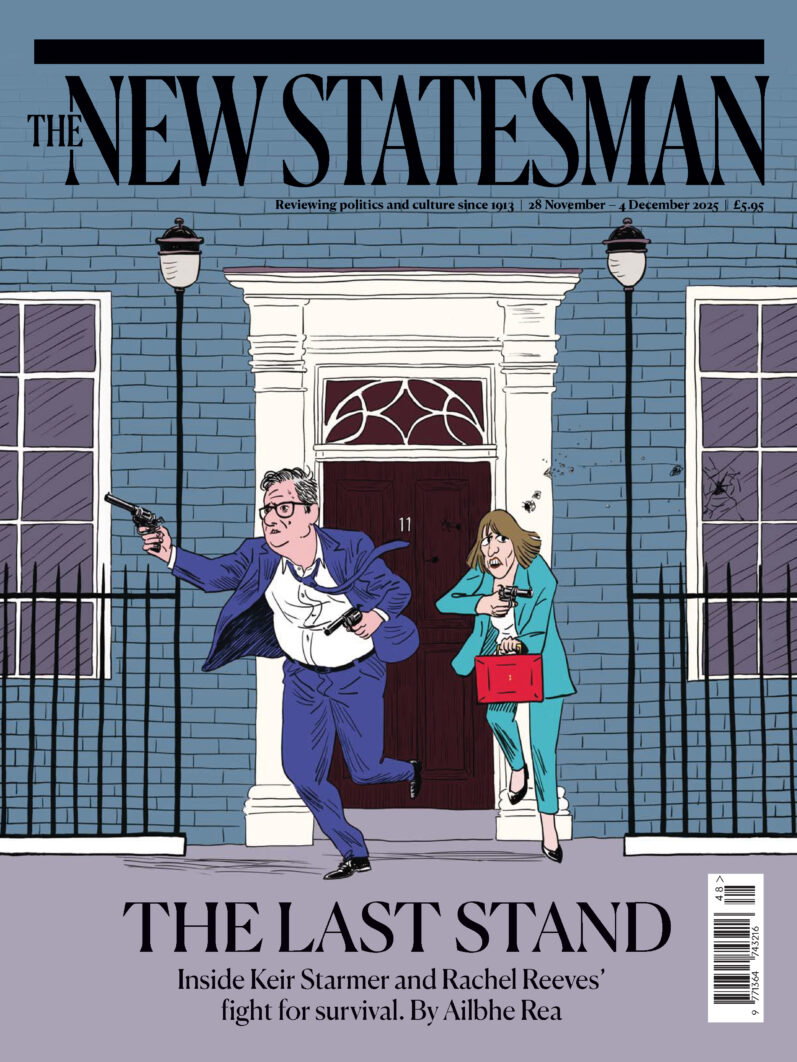
It has become a common refrain – almost a cliché – that we are living through a repeat of the 1970s, that decade of apparent decline and disorder when the old Labour Party lost its way. This, after all, was the Britain captured so painfully by John le Carré: that “poor island with scarcely a voice”, which still seems to speak to us today.
As David Edgerton and others have shown, much of this narrative is either unfair or bogus. Oh, what we would give for the rising living standards of the 1970s today! The prospect that history will repeat itself hangs over this government. Put simply, there are many in the Labour Party who are petrified that history will come to see them not as the hard-working “grown-ups” who ended 14 years of Tory rule, but as the unsuspecting midwives of a Reform revolution, much as the governments of Harold Wilson and James Callaghan are remembered for ushering in Margaret Thatcher’s decade of upheaval.
Thinking about Labour’s predicament this Budget week has, however, pulled my gaze further back, beyond the 1970s to the decade which came before; not to the second Wilson premiership of 1974-76, but to his first, of 1964-70. In his masterful biography of the former Labour leader, Ben Pimlott captures the intellectual energy and ambition that made Wilson such a formidable politician, bestriding British politics for the best part of two decades.
In his early years, Wilson had much of what Keir Starmer lacks today: a clear, radical purpose; a brilliant way with words; a wily ability to adapt to the situation in front of him. In 1963, as he prepared for the general election the following year, he lifted the national mood with an electrifying speech condemning the failures of Tory rule and promising an economic revolution based on scientific, modern national planning. A new Britain would be forged in the “white heat of this revolution” Wilson promised.

When Wilson was elected the following year, he then had both a purpose and a mandate. And yet, within two years his national plan was dead, driven on to the rocks by his determination to maintain the value of the pound. As Pimlott writes, Wilson’s failure not only destroyed his government’s purpose but also “the very idea of planning for growth”. Without this, however, what was it that Labour was actually for? “A hole was created in Labour’s raison d’être which, arguably, has never been filled.”
Pimlott wrote these lines in 1992, but it is a question more relevant today than ever before. What is it that this government is for? When Wilson lost his purpose, his slide into unpopularity was swift, raising questions over his leadership that destroyed his chances of re-election. Starmer’s descent has happened even more quickly, in large part because of his failure to define the central purpose of his premiership. If he is to survive, 26 November’s Budget must be the beginning of a concerted effort to set this out.
There will be some – perhaps Starmer himself – who will shudder at such advice. Was Wilson’s fault not actually in coming up with the wrong plan to begin with? Shouldn’t the wise leader avoid tying themselves to plans or visions that can quickly come undone? “In political activity… men sail a boundless and bottomless sea,” wrote the conservative philosopher Michael Oakeshott. “[There is] neither starting place nor appointed destination. The enterprise is to keep afloat on an even keel.”
This, of course, is the ultimate conservative position: ideas are for fools, progress does not exist, visions are for those who hallucinate. Whether Oakeshott’s pessimism is right, it is easier to keep afloat when looking at the horizon, convinced the destination is just ahead. Besides, if we are drifting hopelessly at sea, it will not be long until a mutiny is led by the crew. What is so startling when speaking with Labour MPs, advisers and even cabinet ministers is how mutinous the mood in the parliamentary party has become. The threats to Keir Starmer and Rachel Reeves are serious. The plots are real.
I am sure Starmer would agree with Pimlott that “opinion polls have a lot to answer for” in this regard. But no matter how often politicians deny their influence, there is an iron law in British politics, as Pimlott also identified: “A prime minister whose poll ratings show him (or her) to be failing as a populist leader, automatically comes under pressure. Conversely, a premier who succeeds in opinion poll terms is almost impossible to challenge.” Starmer needs the polls to change – and quickly. And for that to happen, he needs to lead.
[Further reading: Rachel Reeves’ risky sequel]
Content from our partners



Related

This article appears in the 26 Nov 2025 issue of the New Statesman, The Last Stand
Join the debate
Subscribe here to comment