
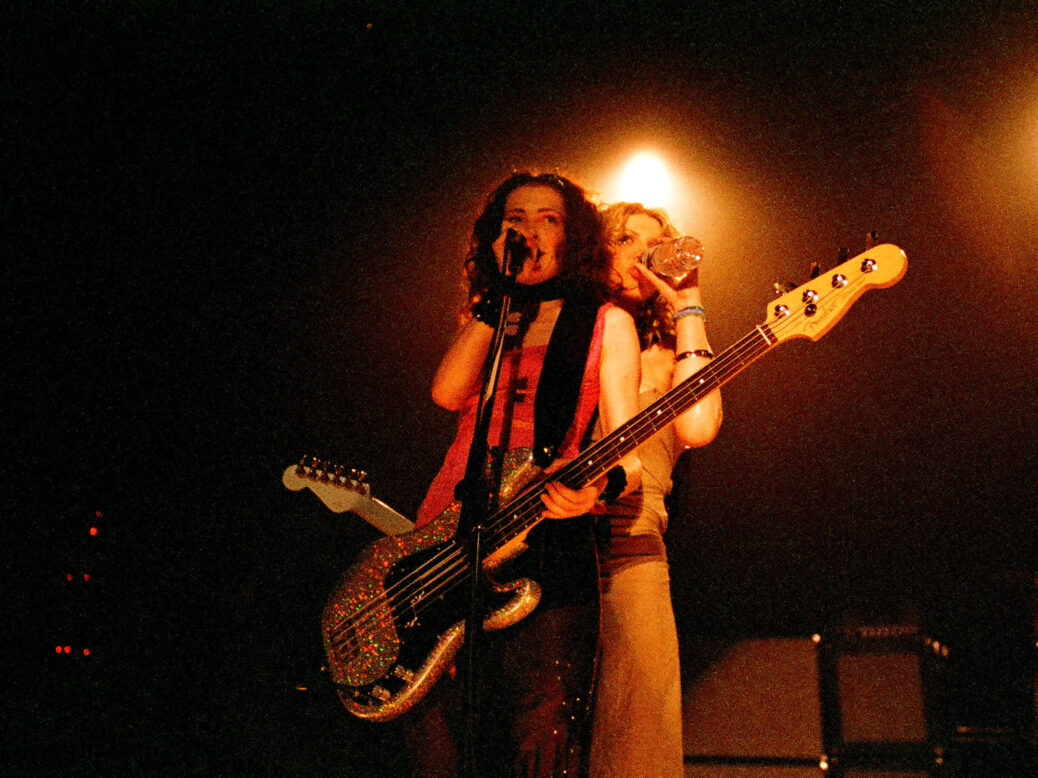
This week I’m interviewing Melissa Auf der Maur, the former bassist for Hole and the Smashing Pumpkins, during the UK leg of her book tour, which has meant tumbling down a rabbit hole of Nineties nostalgia. Melissa’s memoir Even the Good Girls Will Cry is a thrilling counter-narrative to the canon of rock memoirs. It begins with her joining Hole at 22 for a baptism by fire in front of 65,000 people at Reading Festival, supporting a frontwoman, Courtney Love, who was mired in grief after the death of her husband, Kurt Cobain, and had her own fierce drug addiction. Love, Melissa writes, “was a raging, rolling tornado”, but she was also the only woman in rock performing like men did, confronting the crowd head on, charging at her detractors, stoking the chaos. The beginning of my book, Girl on Girl, is about the shift during the Nineties from riot grrrl and musical rebellion to girl pop and teen icons, a cultural swing that stopped third-wave feminism in its tracks. I was too young for Hole and in thrall to the Spice Girls by 13, so it’s riveting to read an account of culture’s last gasp from someone on the front lines.
Objectionable times
Because of the historical era my book analyses, I’ve been tagged in a number of videos lately, as millennial women cross-reference the culture of their childhoods with the revelations from the Epstein files, deducing that 2000s fashion and media was intentionally grooming girls en masse via Victoria’s Secret, Christina Aguilera songs and MTV’s Spring Break. I can’t quibble with any of them, because to revisit the 1990s and 2000s with even offhand commitment is to be astonished by how rabidly women and girls were being objectified. (The “joke” of Gail Porter’s bottom being projected on to the Houses of Parliament by FHM in 1999 almost feels too awful to be true, as does Chris Evans weighing Victoria Beckham live on air shortly after the birth of her first child.) Yes, women and girls were being coerced by all forms of media into self-objectification. But we were also being bullied into full-throated consumerism, with the idea that if we bought enough products, we could turn ourselves into the ultimate commodity. We’ve evolved past the first part, but are still compelled by beauty culture and the promise of the second.
Repeat prescription
At 42, I’m young enough to remember being mortified by the way my mother would romanticise the 1960s, and old enough to realise I’m guilty of my own nostalgic yearning for the last truly offline decade. At night, I binge-watch ER on Netflix, a show so propulsive and groundbreaking that its producers recreated it wholesale with HBO’s The Pitt. The most fascinating thing to me about watching ER now is how much its storylines are dominated by the Aids crisis – which is logical for a series about emergency medicine during an era when an HIV diagnosis was often a death sentence and front-line workers suffered the full scale of something the rest of us only glimpsed. The Pitt, set in current-day Pittsburgh, flashes back to the early months of Covid-19 for similar emphasis, but it also earnestly tackles almost too many modern American epidemics to count: gun violence, fentanyl addiction, vaccine hesitancy, medical bankruptcy and, most recently, the cruelty of Ice. The Pitt’s popularity, and ER’s resurgence, makes me wonder whether what we’re really nostalgic for with regard to the Nineties is moral optimism – a moment when it really did seem like things could only get better.
Crashing the internet
The past year or so of book promotion has required a brain-rotting amount of Instagram, and the demeaning realisation that my algorithmic diagnosis is: pictures of status bookshelves (true), curiosity-gap reels offering parenting advice (meh), and videos of plastic surgeons dissecting – metaphorically at least – Emma Stone’s face (never, not even once). So it was a relief in March when all three were edged out by a new category: archival photos of Carolyn Bessette Kennedy, whose 1999 death in a plane crash alongside her husband, John F Kennedy Jnr, cemented her status as a tragic Nineties icon.

Ryan Murphy’s recent miniseries about CBK and JFK, Love Story, is now Disney+’s most-streamed drama of all time, less for its portrayal of epic romance than for the show’s aesthetic and sensory appeal – think Calvin Klein minimalism, butter-blonde highlights, Kangol caps and indoor smoking. Carolyn, like her British avatar Princess Diana, was relentlessly stalked by the paparazzi during her life and death, so there’s something grimly fascinating now about seeing her exposed to the internet’s surveillant gaze, ageless and forever inaccessible. Apparently, even a quarter-century after your death, you can always be turned into content.
[Further reading: Ken Burns’ visions of America]
Content from our partners



Related



This article appears in the 08 Apr 2026 issue of the New Statesman, The Fall
Join the debate
Subscribe here to comment