
By this point, Harlan Coben and Netflix are synonymous, symbiotic, two heads of the same beast. In 2018, the prolific American thriller writer, who has churned out 39 mystery novels since 1990, signed a multimillion-dollar, five-year deal with the streaming giant to adapt 14 of his novels. Last year, Fool Me Once was one of the platform’s most watched shows, drawing 108 million views in its first six months.
So it is something of a departure that Harlan Coben’s Lazarus (it’s a mark of just how much of a Big Name Coben is that all his shows are billed this way) was made by Amazon. Lazarus is also unusual for being an original screenplay, created by Coben and his frequent collaborator Daniel Brocklehurst, rather than a book adaptation. But in every other way, this is business as usual. Which is to say: utterly implausible, absurdly pacy, with more twists and turns than Thorpe Park, and just as likely to make you feel a bit queasy.
Lazarus’s eponymous Lazarus (Lazari?) is actually a father-son duo: the younger, Dr Joel “Laz” Lazarus (Sam Claflin), and the elder, Dr Jonathan Lazarus (Bill Nighy), are both psychiatrists. We meet Laz at the impossibly beige secure psychiatric hospital where he works. There, he sits down with a new patient, who says he’s just been speaking with God: “I asked him to punish you,” he says, ominously. And what did God reply? “He would do that, just for me.” As soon as their session is over, Laz receives a call from another of the Lazari, his slightly woo-woo, tarot-reading sister Jenna (Alexandra Roach), to tell him their father has died by suicide. He left behind a cryptic note – “It’s not over” – above a drawing of what appears to be a three-legged table.
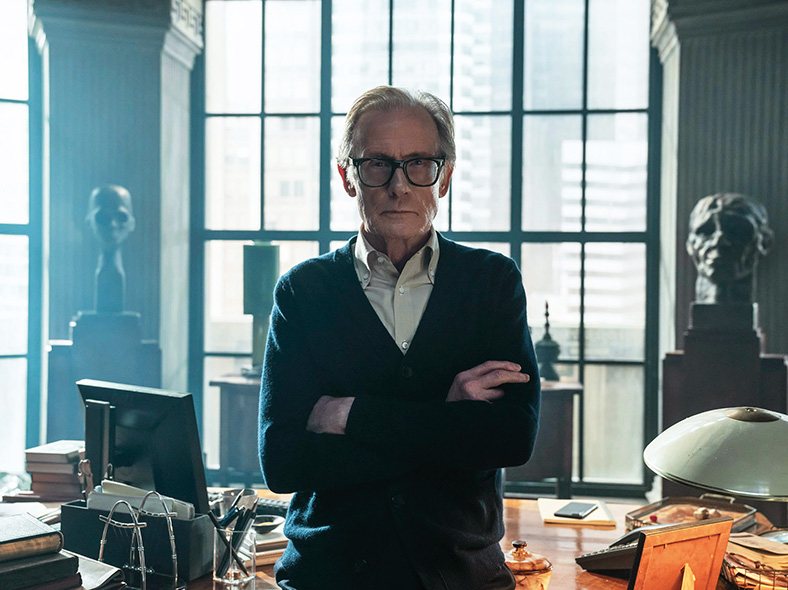
Laz pays repeated visits to the towering gothic building where his father had his private practice, a capacious, double-height office featuring a Freudian daybed and a drinks trolley in the shape of a globe. The whole thing could be straight out of a Christopher Nolan Batman movie. Whenever he sips from a tumbler of whisky and begins to zone out, his father’s former clients appear before him, ready for their therapy session. They seem to believe Laz is his father. They are also – it turns out, when he consults the office filing system – long dead. Perhaps they are not hallucinations at all but ghosts, raised from the grave, like the biblical Lazarus. Soon, Laz’s father appears, too, to tell him: “There will be others, son. They will come to you too.” Laz is also bedevilled by flashbacks to the day, in 1998, he found his then teenage twin sister, Sutton, murdered; her killer, we learn, remains unidentified. The corporeal and incorporeal blur, and Laz’s life – and mind – begins to collapse in on itself.

As if this wasn’t enough to be getting on with, there’s also Aidan, Laz’s ex-wife’s teenage son, who seems preternaturally connected to Laz; his police officer mate Seth, who – handily, for plot-developing reasons – has a rather lax approach to professional confidentiality; Billy, a comic-book mogul who was once Sutton’s boyfriend; and a creepy guy called Olsen, one-time suspect for her murder, who spends a lot of time watching Laz from across the street. Three episodes in and we’ve already had several big reveals and jump scares, and, knowing Coben, it’s only going to get sillier from here.
Claflin is about as convincing as it’s possible to be amid such a plot: he spends at least half the time rubbing his eyes, holding his head in his hands and/or screaming into the abyss. Nighy, meanwhile, plays the dead dad with a kind of camp panache, eyebrows twitching behind heavy glasses as he delivers lines like: “You can’t tell people you’re seeing ghosts, son – they’ll put you in the loony bin!” Sadly, being dead, he has so far had disappointingly little screen time.
In 2023, Netflix’s then global head of television, Bela Bajaria, told the New Yorker that the streamer’s ideal show is a “gourmet cheeseburger” – commercially appealing, addictive and perhaps not all that good for you. Lazarus is straight off the same menu. Let your mind wander for a few minutes and you’ve missed a reality-altering switchback, but it doesn’t really matter because it will all change again before the end of the episode, and anyway, you’ll have forgotten all about it ten minutes after the credits roll.
Harlan Coben’s Lazarus
Prime Video
[Further reading: Yrsa Daley-Ward: “How could anyone keep themselves all the way out of a novel?”]
Content from our partners



Related

This article appears in the 23 Oct 2025 issue of the New Statesman, Doom Loop
Join the debate
Subscribe here to comment