
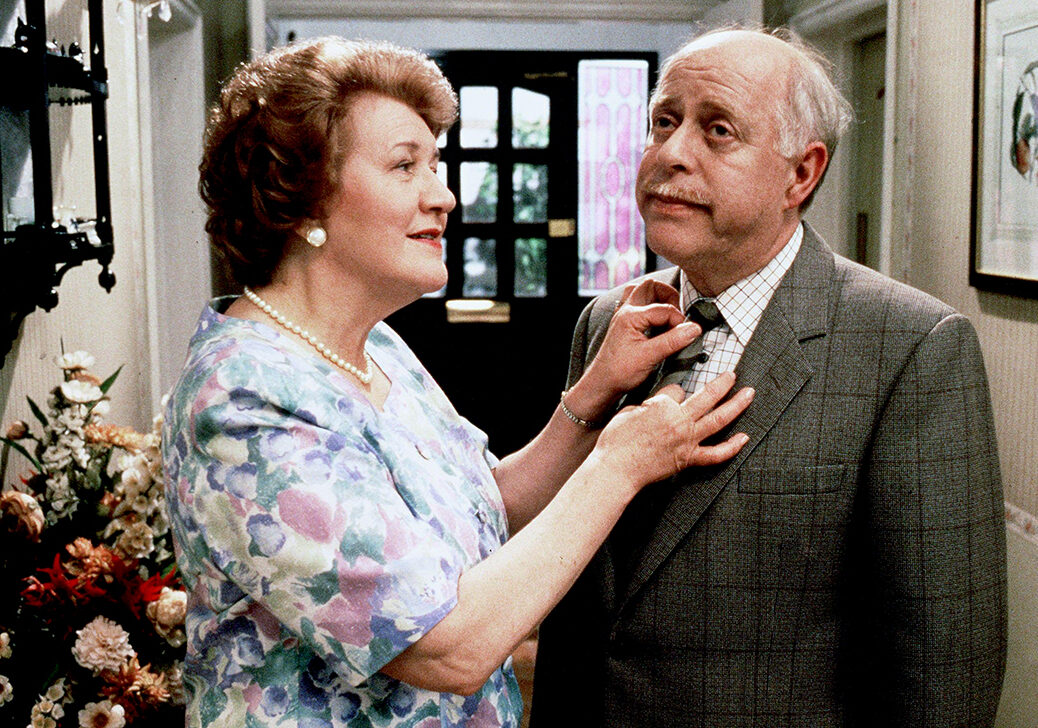
When I was at primary school I wrote a short play and forced my closest classmates to help put it on in the school hall in front of other, baffled, children who’d had the good sense to say no. Luckily they were all too young, or too embarrassed on my behalf, to point out that what I’d created was a truly amateur, if affectionate, recreation of an episode of Keeping Up Appearances, with barely disguised versions of Hyacinth, Richard, Onslow and Rose.
Even at the age of ten I knew that Patricia Routledge was one of the funniest people on television. On the planet, even. Nothing that has happened in the three decades since has dissuaded me of this view. And now she’s gone, and that makes me very sad.
At secondary school in the late 1990s I won a book token at the end of year prize-giving, and bought a compilation of Alan Bennett’s Talking Heads, because I’d somehow seen Routledge performing A Woman Of No Importance and wanted to own the words that she’d delivered so magnificently and heartbreakingly; the timeless tale of a trumped-up office worker who thinks the place would fall apart without her, only to discover it doesn’t. It was the perfect part for Routledge because she was capable of playing two personalities at once: the outward disciplinarian barely disguising the brittle insecurity beneath.
Similarly, there was Kitty from Cheadle, the suburban chatterbox written by Victoria Wood but brought to monstrous life by Routledge. I’ll never forget her confrontation with a communist: “‘Are you familiar with Marks?’ she said. I said, ‘Well, I think their pants have dropped off.’”

And of course, Hyacinth Bucket (“the Boucquet residence, the lady of the house speaking”). The desperate social climber, with her Royal Doulton with the hand-painted periwinkles, the white, slimline telephone and a sister with the Mercedes, swimming pool, and room for a pony. And her long-suffering husband. Even today when seeking to prevent an imminent accident, or just annoy the driver on a practically empty stretch of road, my wife or I will shout at the other: “Mind the pedestrian RICH-ARD!”
Behind all of Routledge’s women seemed to be a sadness, an instability, the unshakeable sense of desperation, where the need to be liked risked making them unlikeable. Yet Routledge knew these women, and played them for both laughs and, if not quite love, then a degree of affection that the viewer felt too.
The thing about Routledge is that she could do everything. Huge, big, pratfalls to get the biggest laughs, and the tiniest twitching eyelid to convey the deepest anxieties. She could emphasise a consonant like Rowan Atkinson’s Blackadder, convey a dented ego through an askew hat like Arthur Lowe’s Mainwairing, exploit social awkwardness like Ricky Gervais’s David Brent.
Not that she is gone we recognise that the world that she inhabited has gone too: the nautical cruising outfits, the chiffon nightgowns, the concern about what the vicar thinks. Showing you’ve climbed the social ladder these days is about the size of your podcast audience or the colour of the sea on your instagrammed holiday photos, not cut-glass condiment sets and worrying about whether the woman at number 23 had chance to see your hat.
But we were so, so lucky that we got to see Routledge in hat, pearls and handbag for all those years. Her final line, as she was lifted into an ambulance in the final episode of Keeping Up Appearances: “Tell God it’s Boucquet.” How could we, or He, ever forget?
[Further reading: Can this curry make Britain less depressed?]
Content from our partners



Related

Join the debate
Subscribe here to comment