
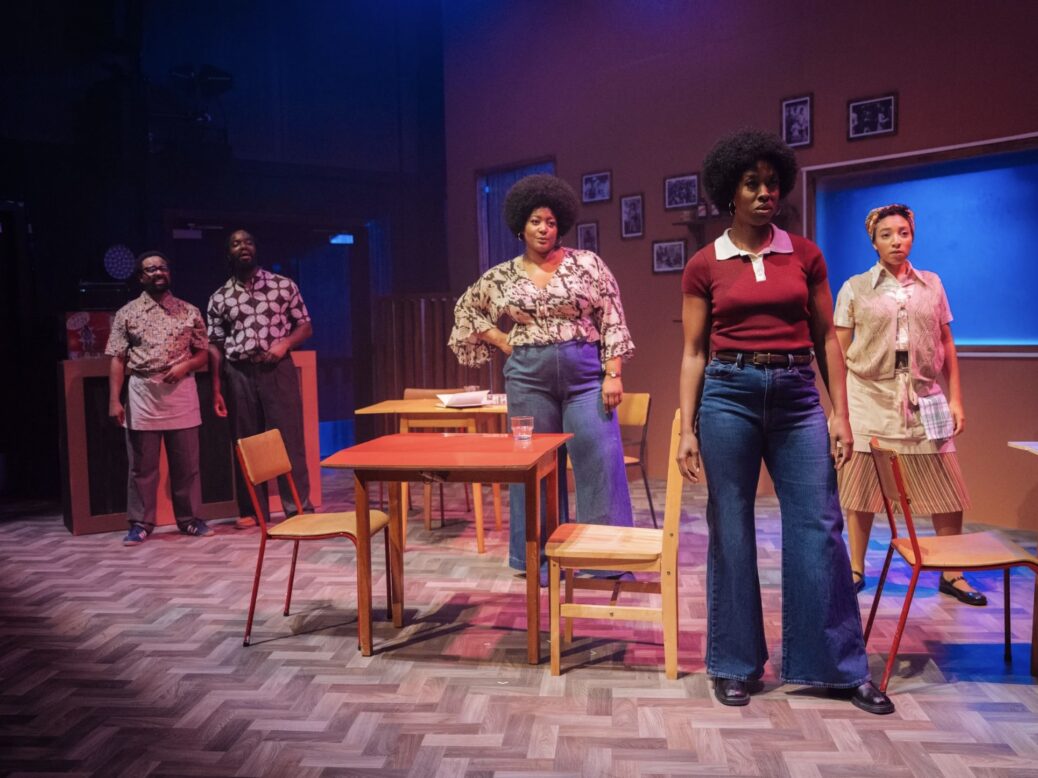
With the government increasingly suppressing the right to protest, there is no better time for Urielle Klein-Mekongo’s musical to remind us that such assertions of state overreach are nothing new. The Black Power Desk audience is transported to the 1970s, framed by Jessica Cabassa’s period costumes and Natalie Pryce’s retro, geometric wallpaper. At the play’s centre are two sisters, Dina (Veronica Carabai) and Celia (Rochelle Rose), who feel the crushing weight of the British state as the Labour government establishes the Black Power Desk, a sinister policing unit created to monitor and dismantle black political activism.
Inspired by the Mangrove Nine case, Klein-Mekongo hones in on the experience of women in the black activist movement of the 1970s and the misogyny they experience from without and within. The sisters’ lives revolve around the Drum, a west London Caribbean restaurant and meeting place for black activists. Through their experiences, Klein-Mekongo explores the suppression carried out by the Black Power Desk, showing how it intruded into and reshaped the personal lives of those it targeted. Dina is undermined and put at risk by the saviour complex of her partner, Jarvis (Alexander Bellinfantie). Colin (Fahad Shaft), a regular at the Drum, insists on a toxic model of male leadership, one that favours violent confrontation with police and racists. Maya (Chanté Faucher), the restaurant’s owner, tries to hold her family together while her husband, Carlton (Gerel Falconer), struggles with addiction.
A blend of soul and reggae is interwoven with archive clips of Enoch Powell and news coverage of the Oval Four and the 1981 New Cross fire to create a historical context. Scenes of police violence are supported by the presence of informants and undercover police seeking vulnerabilities to exploit. Protesters are denied freedom of expression. Confrontations with police are intensifying, as is the threat of the far right. The suggestion is clear: we would do well to take this cue and learn from the past.
Black Power Desk
Brixton House, London SW9

[See also: Jung Chang’s critical distance]
Content from our partners



Related


This article appears in the 17 Sep 2025 issue of the New Statesman, Can Zohran Mamdani save the left?
Join the debate
Subscribe here to comment