
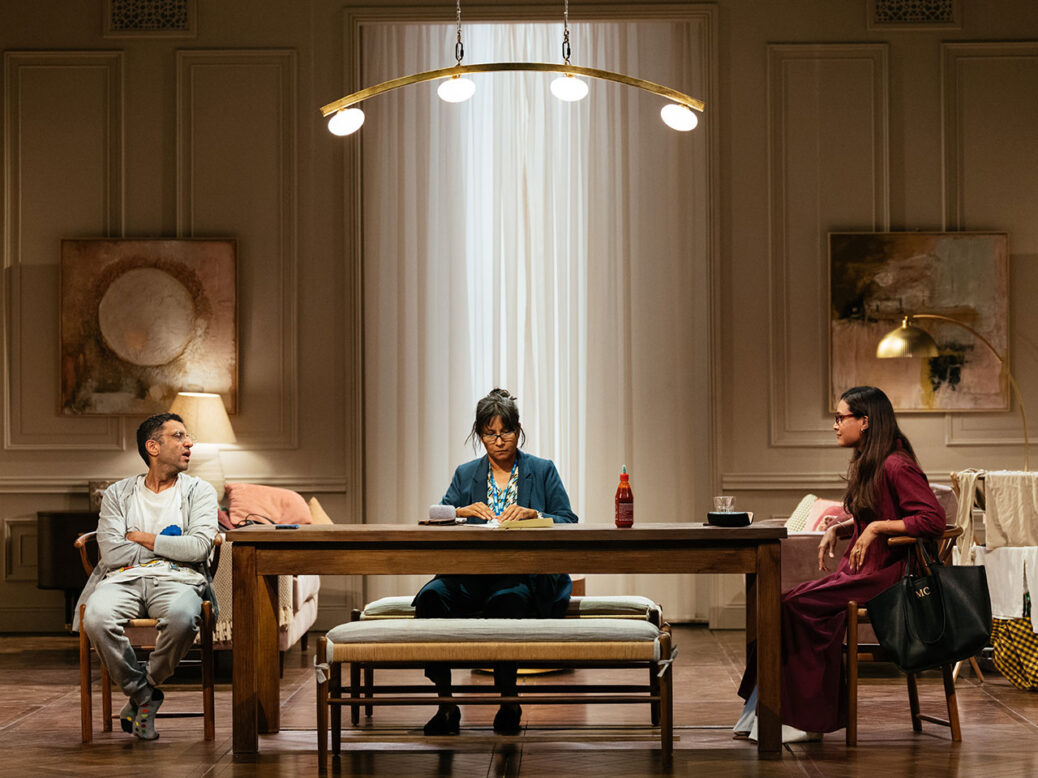
Fashioning art from the contemporary political scene is no mean feat. Politicians are up, then down, then up again, and ideas and policies are dreamed up as quicky as they are thrown out. The playwright Shaan Sahota’s debut play, The Estate, makes a valiant attempt to turn politics into drama: there are moments that echo the frenzied chaos of July 2022, when the prospect of Boris Johnson’s resignation seemed more like a Westminster fever-dream than a political reality.
Sahota’s protagonist, Angad Singh, is the MP for Reading Central and shadow environment secretary (his party isn’t identified). Angad, dexterously played by the Bafta-winning actor Adeel Akhtar, is a slight, asthmatic man, whose motivation for entering politics is unclear. The play opens in his office in Westminster, decked out with all the parliamentary trimmings (including green chairs, lanyards and visitor passes) in a set designed by Chloe Lamford. The leader of the opposition has just resigned over a sex scandal, throwing his party into a frenzy. Angad is immediately pressed to run for the leadership by his excessively keen staffers, who are more like caricatures from The Thick of It than developed, three-dimensional characters.
But this is not the only drama consuming Angad. Early in the play, his father dies, and his spectre hangs over Angad throughout the show’s two and a half hours. A Punjabi Sikh with a large property portfolio, Singh senior had high hopes for his only son: he sent him to Harrow and later supported him through Oxford. When Angad’s two elder sisters, Malicka (Shelley Conn) and Gyan (Thusitha Jayasundera), discover they have been written out of their father’s will, they spend the rest of the play locked in a war of attrition with their brother.
The Estate is captivating and deeply unsettling. It dances confusingly between critiques of the roles played by race, class and gender in the British political system. Even so, it is a bracing exploration of the corrupting power of politics and a reminder that underneath it all, MPs are still human.
The Estate
National Theatre, London SE1
[See also: Miyako Yoshida’s Giselle is a transfixing triumph]
Content from our partners




Related


This article appears in the 07 Aug 2025 issue of the New Statesman, Summer Special 2025
Join the debate
Subscribe here to comment