
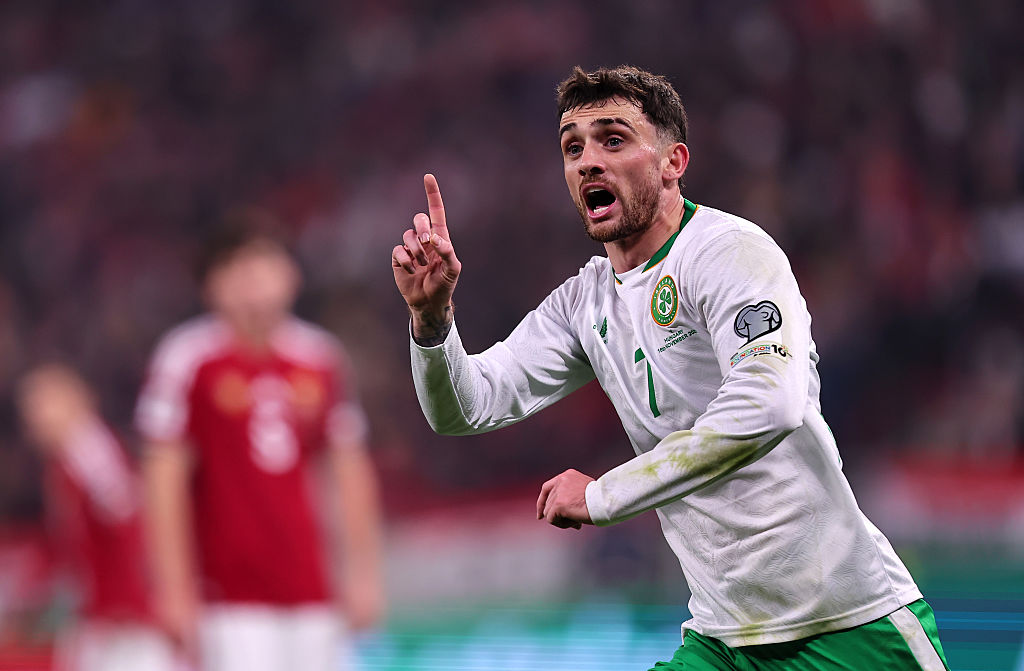
Troy Parrott’s goal at the death of the World Cup Qualifier against Hungary was enough on its own. Back from London for the weekend by sheer coincidence, the Dublin pub I was in convulsed as Parrott poked it home. Stools flying, glasses smashed, tops off. The usual.
Once the ecstasy had subsided, even the briefest look online showed the distances the goal had travelled, and the sheer amount of Meaning it seemed to have. Canada. Indonesia. The bar at Dublin Airport.
My personal favourite is from Sixmilebridge in the west of Ireland. Irish-language coverage of the Munster Club Hurling final takes a momentary detour to show the assembled spectators being notified of, reacting to, and hooting with abandon at, the news of Parrott’s winner. Beyond the goal, however, it was a moment that allowed Irish football fans to dream again.
In terms of active players and regular spectators, both Gaelic football and hurling put Irish football (“soccer”) in the shade. They may have won the same number of Six Nations titles as England over the past decade, but none of the all-island, two-anthem rugby team’s triumphs have generated general, untrammelled joy on the scale of Sunday’s win. Nothing on earth brings Irish people together like a Big Moment in international football.

The Republic has fewer residents than Yorkshire at the latest count, and as a result, the nation can converse with itself much more easily than in a country the size of England. After the Hungary match, RTÉ’s flagship news programme featured five separate segments on the win. Parrott’s grandmother, neighbours and former coaches all got a word in before the half-hour was through.
Having slowly extricated ourselves from the monoculture of the 20th century (one church, one national broadcaster, one successful political party), in some ways Ireland is still learning what it means to live in a world of pluralistic confusion, and occasionally the old ways sneak through.
Politicians speak as if addressing a class of schoolchildren rather than adult citizens of a modern state. The plot of most adverts implies that all viewers are two degrees of separation apart at most. Being Irish is ‘about’ particular things, and the boundaries are policed.
Nevertheless, the team itself proves how much the country has changed. Ireland has at last begun to resemble other European states in having more immigrants than emigrants feature in the squad. Chiedozie Ogbene, Adam Idah, and Festy Ebosele all featured on Sunday, starting or off the bench.
More broadly, it is worth taking a look over the nation of which Parrott is now a favourite son. Propped up by gargantuan corporate tax receipts and the beneficence of the US multinational sector, Ireland would seem to be a case study in ‘government on easy mode’ – were it not for the state’s housing crisis without end, its inability to build crucial infrastructure (3% of Ireland’s trains are electrified, the lowest figure in Europe), its outlandish cost of living, and its profound exposure to the whims of the American president.
Ireland’s basic strategy of attracting foreign direct investment and EU structural funding, becoming both a tax haven and an export powerhouse in the process, has a distinctly mercantilist vibe. “Pulling on the green jersey”, whether or not spoken in jest, sums up the approach. If no work of Irish literature can escape being “about” Irishness, then not a single euro can enter the country without being deemed proof of the model’s success.
The latter-day mercantilism infects how we talk about sport. Rare is the Irish person never to have drank nine pints and outlined a ten-part strategy for the football team to qualify for major tournaments again or for the country to win an eighth Eurovision. Cultural success is seen as directly downstream from public policy choices to an extent unfathomable in England. We’ve invested in film and music a bit; now our actors are winning Oscars, and our musicians are being Fontaines DC. A bit of judicious sport spending later, and we’re simultaneous Olympic champions in pommel horse and the 800m freestyle. It can happen.
The people running rugby have gone full Medici – rather than sign for individual clubs, players sign central contracts with the IRFU, and all activity is geared towards the men’s national team building on its considerable success.
Why Ireland can’t extend this logic to the world’s most popular sport, and hire some people capable of translating resources into outcomes, is a source of consistent bafflement. Smaller countries with competent FAs should be able to qualify for tournaments without straining every sinew to breaking-point. Have I told you about Cape Verde?
Prosaic reasons for our decades of underperformance would include a legacy of corruption, endemic financial mismanagement, the commercial weakness of the domestic league and the political power of the GAA, state within a state that it is – but who’s keeping tabs? When a goal like Parrott’s goes in, the rational world of actions and consequences feels a very long way away.
[Further reading: Around the world in 50 Irish pubs]
Content from our partners

Related
Join the debate
Subscribe here to comment