
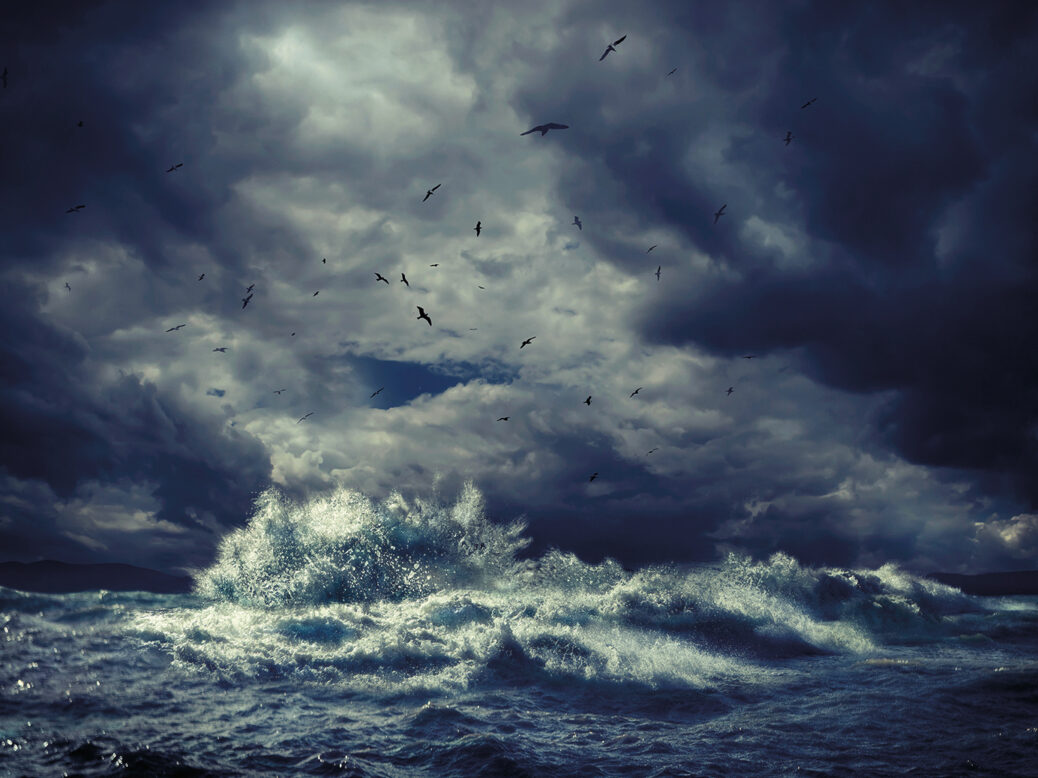
In 2025, the Shipping Forecast (Dogger, Fisher, German Bight…) celebrated its centenary. Since its first broadcast on BBC Radio 4 in July 1925 as a service to all mariners in UK waters, it has assumed national treasure status. Its aim is to provide a guide to what the weather is most likely to do for the next six hours in each of the 31 specified sea areas surrounding the British Isles, from south-east Iceland, just below the Arctic Circle, to Trafalgar, just above Africa. The forecast follows a strictly formatted sequence of measurements. First, the warnings of gales scaled from one to 12, then a “general synopsis” or overview for all UK waters, then an area-by-area forecast of wind strength and direction (“northwesterly four to six, increasing six to gale eight”), sea state (“moderate or rough, becoming mainly very rough”), the weather (“showers, becoming wintry”) and finally visibility (“good, occasionally poor later”). Each forecast takes precisely nine minutes to read.
Produced by the Met Office on behalf of the Maritime and Coastguard Agency, the Shipping Forecast is now one of the longest-running radio programmes in the world. Its beauty lies partly in its division of oceanic chaos into reasonable scales and partly in the comfort of knowing that however unpleasant your job or your journey to work may be, it’s as nothing to a storm force ten to the north of Rockall. Perhaps only the weather-obsessed British could have turned a weather forecast into a national totem, but even in its recently reduced form on FM radio (two out of four daily broadcasts are now long wave only) it still provides a service to lyricists, armchair sailors, and insomniacs everywhere.
Daily records of weather, barometric pressure and sea state had always been kept by those on watch around the coast, but it took the efforts of Vice-Admiral Robert Fitzroy before they were codified and broadcast. Fitzroy realised the power of sea-state forecasting after the Royal Charter, an emigrant ship returning from Australia, was wrecked in a gale off Anglesey in 1859, killing more than 450 people. Despite opposition from both the civil service and ship owners, he set up a system of telegraphed weather warnings which over time moved to radio format. But does the Forecast still serve any useful purpose? Or has it become just another antique ornament, preserved out of nostalgia? Does anyone out there in Lundy, Fastnet or the Irish Sea still benefit?
The answer is both yes and no. Up until the mid-1990s, the Shipping Forecast – compiled by the Met Office and broadcast on BBC Long Wave, FM, and on VHF radio – was the single nationally available source of predictive information for all seafarers. It didn’t matter if you were toddling off in your one-man sailboat for a spot of watery caravanning or captaining a 300-metre bulk tanker through the English Channel – everybody needed it and everyone listened in. Professional mariners who trained in the 1980s or 1990s all talk of observing the six-hourly bulletins religiously, scribbling down the details for their surrounding area. Which accounts for the obsession with clarity, pace and diction. If you were stuck off, say, the top of the Isle of Lewis listening to a crackly radio over the whine of the wind and the announcer rushed a few sentences, it really mattered.

But by the mid-1990s, the forecasting options had begun to expand. First came satellite TV, which initially gave coverage inshore (the waters immediately around the UK coastline) and then offshore. “That was the first nail in the coffin for the Shipping Forecast,” says Andrew Innes, who fished the sea areas Fair Isle, Forties, Cromarty, and Forth for 30 years, and who now acts as an industry adviser for the Scottish Fishermen’s Federation. “It was still observed, you would still have listened, but you would have followed it with the TV forecast more and more,” he says.
By the early 2000s, weather apps started to appear. Some, like the Met Office, gave detailed weather forecasts, and some, like Magic Seaweed (now Surfline) were concentrating on the kind of information – such as wave height – which might be useful to particular groups of users. They were joined by all the other electronic aids, from digital chart plotters to AIS (Automatic Identification System, a digital number plate which gives the individual identity, location, speed and direction of travel for all commercial and most recreational vessels). The Met Office is currently exploring the possibility of using fishing vessels as mobile weather stations, live feeding data straight to users’ mobile phones, and some ports also produce their own apps. The issue now is not silence, but overwhelm.
Step on to the bridge of a modern commercial vessel – whether it’s a pelagic trawler, a car ferry or a service ship for the oil and gas industry – and what you see is a bank of screens above and below, bracketing the sea outside. All those screens offer views impossible to the naked eye: shoals of digital fish, streams of arrowed cargo vessels, radiant topographies of the sea bed; a 360-degree global view of all above, below, approaching or unseen. “My great-grandfather and grandfather were fishermen,” says Innes. “If I was to show them what kind of tools we have now, I don’t think they’d believe me.”
Ramsey Faragher is the director and chief executive of the Royal Institute of Navigation. He points out that today’s shipping is no longer just dealing with true physical weather but with the creep of electronic fog. Anything that uses the global positioning and navigation systems (GPS and GNSS) can find its receivers jammed by a smirr of radio static. Worse still is spoofing, in which the true signal is swapped for a false one.
“Imagine you’re the captain of a commercial vessel,” says Faragher. “You’re on the bridge of your ship with all the lovely electronics spread out in front of you like the starship Enterprise, everything working perfectly, updating constantly. Now imagine you move into an area of electronic interference. First of all, an alarm will sound saying your GPS is off. That’s a problem because you don’t just need GPS to give your position, but to give time. Loss of position is a navigation problem, but loss of time is a cybersecurity problem. You can correct the course you’re taking, but you can’t mend a broken satellite signal.
“Then a bunch of other alarms go off and the screens go dark and suddenly you have to revert to the old methods: paper charts, compasses, sextants, dead reckoning. That’s not the end of the world because all professional mariners would be trained in traditional navigation and can revert in an emergency. The problem is when there’s a bad actor somewhere nearby who is broadcasting a false signal. Then what happens is all the alarms stop sounding, the electronics wake up, everything looks normal – but suddenly all your data is telling you you’re at the top of a mountain travelling at 100 miles an hour and it’s the middle of June 2044. The systems are lying.”
For commercial shipping, digital disruption is becoming an increasing problem. “Onshore,” says Faragher, “there are hundreds of jammers driving around all day – car thieves or gangs or people who are using company cars when they shouldn’t be. Offshore around the UK, the main issue [is] smugglers or fishing vessels who are working illegally and who are therefore trying to disguise their true position. But the bigger problem is ships coming in from, say, the Strait of Hormuz who may be dealing with interference all day, every day.” The institute is currently undertaking a survey among its members to find out just how many mariners – both professional and amateur – have been affected.
Ivana Carrioni-Burnett was once a navigation officer for the Royal Navy and is now a sea pilot for the Port of London Authority. A sea or river pilot’s job is to go out to a commercial vessel waiting offshore and guide it safely into port, whatever the weather or the sea conditions. In practice, that means a small vessel coming alongside an enormous one and a pilot making the long journey up a rope ladder to the deck before temporarily taking over the ship’s controls to guide it in. Carrioni-Burnett is used to working with all the available digital technologies and with the older ways, too. She still pays close attention to the Shipping Forecast’s offspring, the forecast for inshore waters, and works with traditional navigation aids: beacons, buoys, seamarks, the green and red of starboard and port. “You can’t beat looking out of the window,” she points out.
Some challenges she faces – fog, east winds, the slow rolling fetch of the North Sea – have been around a long time. Others are more recent. After the invasion of Ukraine, when sanctions were imposed against Russia, part of Moscow’s response was to send to sea a “shadow fleet”: often old and broken tankers or cargo vessels operating with false identities in the half-life of digital darkness. They can’t totally avoid detection – a ship is still a very large, very visible object – but they can mislead.
So far, the commercial shipping industry has responded to all this digital bluffing in two ways. Either it commits to an electronic arms race, investing in counter-measures which may develop their own vulnerabilities, or it reverts. “Loran” (long-range navigation) was initially developed during the Second World War and relies on radio signals in the same way as radar and sonar do. It was in general international use from the 1950s to the 1980s, but in the 1990s it was mothballed with the widespread uptake of GPS. Now, several countries are experimenting with enhanced Loran. “We’ve gone through the era of switching off the old instruments,” says Faragher, “and now we’re bringing them back.”
But as Captain Des Donworth, director of navigation at the English lighthouse authority, Trinity House, points out, not everyone at sea is in an aircraft carrier. “For a lot of the recreational users and smaller vessels, the world hasn’t moved on hugely.” The majority of the 20,000-odd yachties who sail mainly around Britain’s inshore waters most likely use a combination of apps, VHF, electronic depth finders and AIS, along with paper charts and, yes, the Radio 4 Shipping Forecast.
Attempts to game the maritime gods are nothing new. Some time in August 1814, the author Walter Scott set off up the backstreets of Stromness on the Orkney mainland to buy a wind. Scott, then at the zenith of his literary power, had been invited by the Northern Lighthouse Board’s commissioners to join them on their annual trip around the Scottish lights. Even now, Stromness is a town of sailors, but back then it was a major port, used by whalers and crews for the Hudson Bay Company waiting for the ideal weather.
Demand, supply. At the top of the town, a woman named Bessy Millie had set herself up as a purveyor of quality breezes to the maritime trade. “An old hag lives in a wretched cabin on this height and subsists by selling winds,” Scott wrote in his diary. “Each captain of a merchantman, between jest and earnest, gives the old woman sixpence and she boils her kettle to procure a favourable gale.” Millie’s pitch was a compelling one: high-quality winds delivered entirely through prayer, no funny business with the forces of darkness.
Like Millie’s other visitors, Scott was torn between ridicule and fear, noting that Millie’s terms and conditions factored in contingencies: a gale would undoubtedly arrive, she told her customers, she just couldn’t guarantee when. All of Scott’s group gave her a donation, including the captain who “made the regular offering on behalf of the ship”. Later that day, they set off, “and find Bessy Millie a woman of her word, for the expected breeze has sprung up, if it but last us till we double Cape Wrath”. When Bessy Millie died she was succeeded by a specialist in fogs, and then by Mammy Scott, who sold straws in the wind. Thrown in the correct order, they guaranteed the right conditions, but thrown wrongly and they’d blow a ship straight back to Stromness.
If attempts to change the weather have, so far, been unsuccessful, methods for predicting it are improving all the time. In the event of electronic blackouts, there also has to be a Plan B. The good news, as Faragher points out, is “the maritime attitude is that the old ways still work”. The word “sextant” has cropped up several times in the institute’s survey, he notes. In practice, the analogue navigational aids that once steered us – the stars and buoys, the paper charts or pilot guides – may only exist as back-up, but they have a part to play. You can’t switch off a piece of paper, or jam the Fastnet lighthouse. As the rhythm of the Shipping Forecast reminds us, the medium doesn’t matter, but the message really does.
Bella Bathurst is the author of “The Lighthouse Stevensons” (HarperCollins)
[Further reading: Books of the year 2025]
Content from our partners



Related



This article appears in the 12 Dec 2025 issue of the New Statesman, All Alone: Christmas Special 2025
Join the debate
Subscribe here to comment