
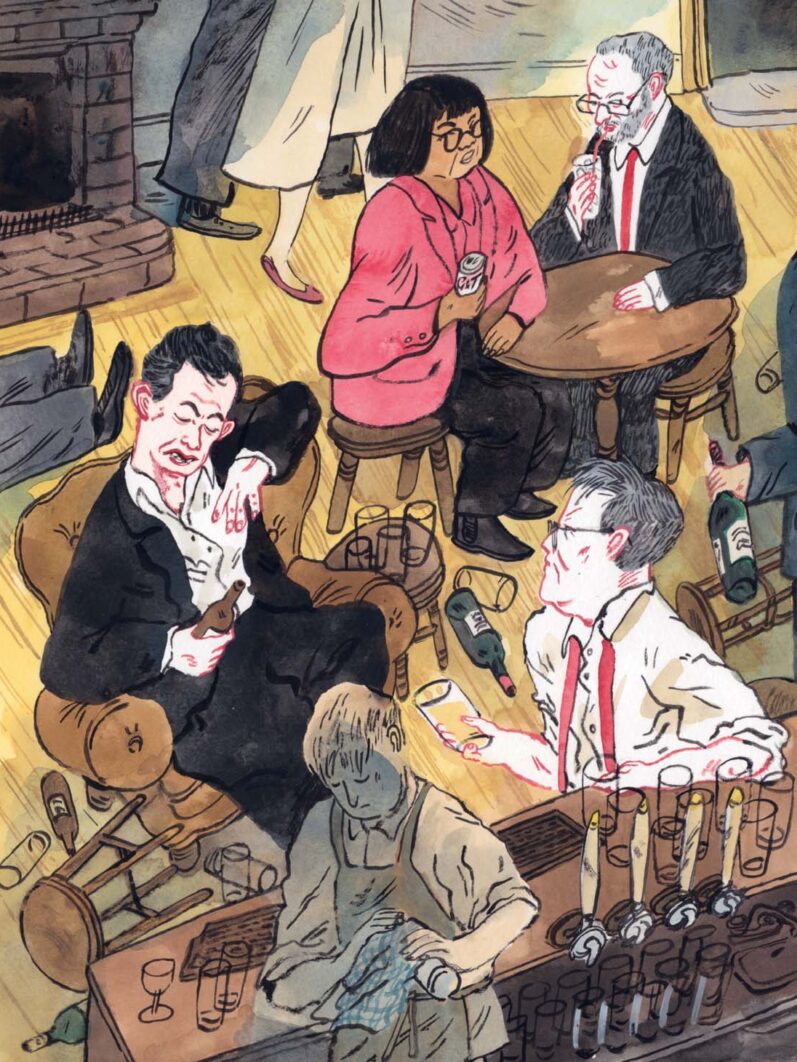
A question that a great many people across the country ask is: is it not somewhat remarkable – or at least weird – that four out the past five leaders of the Labour Party live or have lived in the same square mile-and-a-half of the capital? This is north London, a much-misunderstood part of the metropolis. Its neighbourhoods trip off the tongue: Kentish Town, Archway, Barnsbury… The home of barristers, council workers and luvvies has swung in some parts to the right but remains the factory floor for progressive policy, where its leaders live, roam and drink. For almost a century, it has been an incubator of Labour ideology – Jeremy Corbyn and Tony Blair, of course, but also Michael Foot stalking South End Green. Even Tredegar’s own Neil Kinnock can’t resist the pull of Tufnell Park in his dotage.
As passionate pintmen and blow-in residents of the N postcodes, we’ve conjured a little pub crawl, through which you can ponder the past and present of left-wing politics in this country, and also, we hope, have a stuttering blast with your friends. If you’re coming from further afield, you might like to congregate at Gospel Oak Station, which abuts the great green acreage of Hampstead Heath.
Despite the mewlings of the broadsheet press, there are barely any “Hampstead intellectuals” left. They’ve been priced out – apart from David Hare and Melvyn Bragg. There’s only one Labour “big beast” in the NW3 jungle now: Alastair Campbell, who, despite never having led the party, has provided much of Labour’s intellectual force in the past 30 years.
The podcaster and mental-health campaigner lives close to the Southampton Arms, regarded by some as the best pub in London – which is, in our view, not an altogether fair judgement. Campbell, who is famously sober, doesn’t go to the pub (instead, he can be spotted most mornings at Parliament Hill Lido around the corner). Regardless, “the South” is a beacon for real-ale enthusiasts and earnest young men and women enjoying discussion of the finer points of Zack Polanski’s social media presence over a pint of something from a rural microbrewery. If this sounds like a good time to you, stay for more than one – you’ll enjoy the live jazz, too.

A brief charge down Chetwynd Road and a hook left on to York Rise and you’ll find the Dartmouth Arms, a reliable choice for the boujie residents in the surrounding area who, come the summer, spill out onto the cobbles outside. It’s also Ed Miliband’s local. The Environment Minister lives close by in a residence quite considerably above the lower band of value in the new “mansion tax” that will come into effect in 2028. You might recall that, more than a decade ago, the tabloid newspapers took great delight in photographing the house’s two kitchens. And Ed, who has positioned himself quite snugly as the Mayor of Dartmouth Park, is there quite often. We saw him, suited and booted, enjoying a quick pint with a Spad last August, on the very evening the Labour Party floated the idea of banning smoking in pub gardens (by the time you venture upon this crawl, this particular pleasure might, alas, finally be verboten).
Next it’s time to head south down to Kentish Town. It’s not far, about an eight-minute walk down Fortess Road, to the Pineapple, one of the many boozeboxes in the capital where you can wash down a Thai red curry with some fizzy continental lagers. This was once the doorstep boozer of Keir Starmer himself, who, prior to the removal vans’ chuntering outside Downing Street, lived around the corner and did, quite genuinely, treat the place as his local. Starmer is the only prime minister in British history with an unspun love of the pub. The nation’s great politico boozehounds have, over the centuries past, opted to take their refreshments by the warmth of their own hearth, or, failing that, away from the masses, in the comfort of a club in SW1 – think of Roy Jenkins guzzling Claret and sharpening his patrician vowels from the armchaired luxe of Brooks’s Club off Pall Mall. Did Harold Wilson really like the pub? Who knows? But if you’re stuck for conversation, it might make for a briefly diverting topic.
Now three or four drinks deep, it’s time to visit one of London’s greatest pubs, the Prince Edward on Parkhurst Road, a Victorian pub with a perfectly preserved interior. There are lush burgundy banquettes, a Lincrusta ceiling and, at the back, two copper reliefs depicting the Black Prince himself. Opposite the remains of HMP Holloway, it serves the local community pints of Guinness at £4.80. It’s one of north London’s few remaining wet-led boozers, and for now remains resolutely ungentrified, despite the best efforts of some earnest American podcasters with a passion for Mikel Arteta and his band of merry men in red.
The same can’t be said for the Landseer Arms, which is just over the road: come Arsenal matchdays, you’ll find Starmer and his Gooner cronies enjoying some post-game lagers accompanied by plates of boquerones and padron peppers. If you’re a completist, you might head over to the Tollington Arms, which is close to the Emirates, and very close to the home of Jeremy Corbyn, the constituency MP (Islington North, since 1983). Corbyn, like Campbell, is a sober man – this is probably where the similarities stop – but he did join the successful campaign to keep the Tolly open after energy debts imperilled its fortunes post-pandemic. So you can thank him personally for your £7 Amstel.
Now it’s time for the long stretch down the Holloway Road, a street of wonderful possibilities, and some even more wonderful pubs and restaurants. There are few better feelings to be had than walking down its two-mile stretch three sheets to the wind. For at this stage in the crawl you might be a bit peckish, so how about some lashings of Sichuan from Shu La-La, a dash of South American fusion at El Rincon – or perhaps a steaming bowl of pasta from Trevi Ristorante, the long-running mid-tier Italian restaurant located by Highbury & Islington Station. It – or rather, a fictionalised version of it – featured heavily in Tony Parsons’ 1999 novel Man and Boy. While never a New Labourite himself – far from it – he is indelibly linked to that era, in much the same way as Nigella or TFI Friday or Sarah Alexander: a pre-9/11 period of promise, possibility and, in the case of Parsons and his fellow Gooner Nick Hornby, some very blokey prose.
It would be remiss at this stage not to make a pilgrimage to New Labour’s fountainhead: Granita on Upper Street, site of the infamous 1994 pact between Blair and Brown, where the future of the country was divvied up between tiramisu and cappuccinos. The restaurant itself is long gone (it’s currently a branch of Anthropologie), but a few doors down you’ll find Slim Jim’s Liquor Store, a slice of divey Americana plonked incongruously in the middle of Islington. Presumably not named after James Callaghan, it is nevertheless an excellent place to get a drink after hours – it’s open until 3am on weekends. But for now, finish up your pint of snakebite. We’ve got a couple more stops to make, and we imagine you are getting rather unsteady on your feet.
We must divert deeper into Barnsbury, New Labour’s true terra firma, to the Albion, a particularly chichi boozer featured on middle-of-the-road “best of” lists. It has a beautiful expanse of a back garden but a largely irritating clientele comprising of Hinge dates and post-Hinge relationships guzzling back measures of Merlot and jugs of Aperol. It was also the boozer of one Anthony Charles Lynton Blair, when he lived round the corner on Richmond Crescent. (Blair may have left the street in 1997, but Emily Thornberry and Margaret Hodge remain.)
Of course, it was under Blair that the great wave of London pub closures began, with the introduction of the smoking ban in 2007 (a policy that came into effect after Blair had resigned, but which was set in motion a year earlier). The wave reached its peak around the 2012 London Olympics, but under New Labour nine pubs in Barnsbury alone closed for good.
Still, he did introduce 24-hour drinking, even if very few pubs actually stay open later than 11pm. One place that certainly feels as though you’ve been boozing all day is the Tarmon, at the opposite end of Richmond Avenue, on the corner of Caledonian Road. It’s one of London’s truly bacchanalian boozers: spartan, convivial and with most pints of grog clocking in at around the £4 mark – we really can’t get into why here for legal reasons. As such it’s the perfect pitstop before the last pub, even if there is no real Labour connection to it.
And so to our final stop. The Cock Tavern in Somers Town is a working-class Irish pub that’s the home of the RMT trade union. First opened in the early 19th century and rebuilt in the 1930s, the pub today is a proper community hub for the residents of Somers Town, a wedge of London between St Pancras and Euston stations – itself an area with a radical leftist history. The Cock has more recently become big with a new generation of pint-guzzlers enchanted by its buzzy atmosphere, live sport and regular trad music sessions.
There are photographs of deceased regulars, decades-old Sligo Rovers merchandise and Celtic FC regalia. It also boasts a particularly unhinged cat who, of an evening, is prone to attack the curtains but is quite friendly when drowsy. It is likely the most left-wing pub in the capital, and without a doubt one of the best. You might encounter the RMT general secretary, Eddie Dempsey, and his officers taking their glasses upstairs for a confab – but at this stage of proceedings, we really wouldn’t advise you to ask them to stand their round.
Drinking done, Euston and King’s Cross are an equidistant three minutes’ stumble from the Cock’s door. Which is handy for those of you who live elsewhere in London. But for those of you resident outside the capital, there will be a few hours’ lonely wait until the first morning train home.
“The Pub” by Charlie Baker and Jimmy McIntosh is published by Ebury
[Further reading: The story of John Lennon’s bloodied glasses]
Content from our partners


Related
This article appears in the 12 Dec 2025 issue of the New Statesman, All Alone: Christmas Special 2025
Join the debate
Subscribe here to comment